🧵 Rag Quilt Size Calculator
Calculate fabric yards, block count, batting, and flannel needed for your rag quilt project
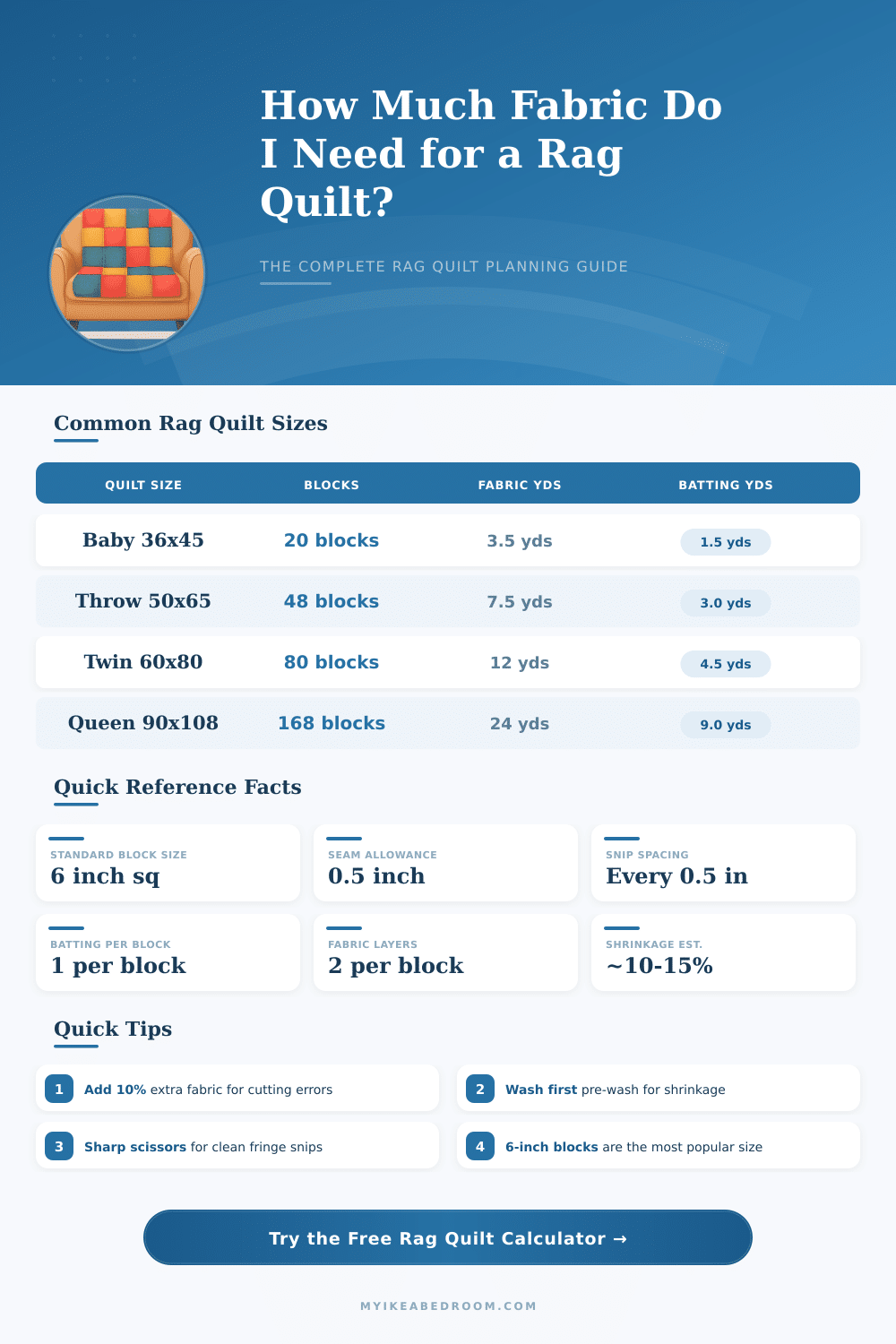
| Quilt Size | 6-in Block Count | 8-in Block Count | 10-in Block Count | Finished Dimensions |
|---|---|---|---|---|
| Baby | 30 blocks (5x6) | 20 blocks (4x5) | 12 blocks (3x4) | ~36 x 45 in |
| Lap | 56 blocks (7x8) | 30 blocks (5x6) | 20 blocks (4x5) | ~45 x 60 in |
| Throw | 80 blocks (8x10) | 48 blocks (6x8) | 30 blocks (5x6) | ~50 x 65 in |
| Twin | 120 blocks (10x12) | 80 blocks (8x10) | 48 blocks (6x8) | ~60 x 80 in |
| Full | 180 blocks (12x15) | 120 blocks (10x12) | 72 blocks (8x9) | ~80 x 90 in |
| Queen | 252 blocks (14x18) | 168 blocks (12x14) | 108 blocks (9x12) | ~90 x 108 in |
| King | 324 blocks (18x18) | 196 blocks (14x14) | 130 blocks (11x12) | ~108 x 108 in |
| Quilt Name | Total Blocks | Fabric Yds (no buffer) | Fabric Yds (+10%) | Batting Yds |
|---|---|---|---|---|
| Mini 24x30 | 20 | 2.5 yds | 2.75 yds | 0.75 yds |
| Baby 36x45 | 30 | 3.5 yds | 3.9 yds | 1.5 yds |
| Lap 45x60 | 56 | 6.2 yds | 6.8 yds | 2.5 yds |
| Throw 50x65 | 80 | 8.8 yds | 9.7 yds | 3.25 yds |
| Twin 60x80 | 120 | 13.2 yds | 14.5 yds | 4.75 yds |
| Full 80x90 | 180 | 19.8 yds | 21.8 yds | 6.75 yds |
| Queen 90x108 | 252 | 27.7 yds | 30.5 yds | 9.5 yds |
| King 108x108 | 324 | 35.6 yds | 39.2 yds | 12.0 yds |
| Block Size | Blocks per Row | Rows per Yard | Blocks per Yard | Cut Size (w/ seam) |
|---|---|---|---|---|
| 4 in block | 11 | 9 | 99 blocks | 5 in sq |
| 5 in block | 8 | 7 | 56 blocks | 6 in sq |
| 6 in block | 7 | 6 | 42 blocks | 7 in sq |
| 7 in block | 6 | 5 | 30 blocks | 8 in sq |
| 8 in block | 5 | 4 | 20 blocks | 9 in sq |
| 9 in block | 4 | 4 | 16 blocks | 10 in sq |
| 10 in block | 4 | 3 | 12 blocks | 11 in sq |
Do Rag Quilt are funny, simple and quite a lot cheap. The results look genuinely nice. Between the most pleasant parts of Rag Quilt are the little need of planning.
It likes more to create good taste than obey strict recipe. Even so reach the right size require attention, especially if you prepare it for a certain bed or folk.
How to Measure and Cut a Rag Quilt
Before starting, you must measure the bed and expected overhang. For single beds, the usual cover size is 55 x 47 inches, what matches around 140 x 120 cm. Cover for queen size usually measures 90 x 108 inches.
For royal bed, many favour that the cover cover everything entirely, what requires even more squares.
The most common squares for Rag Quilt are cut between 5 and 10 inches. The ended size of all squares end in 1 to 1.5 inches more small than the original slice, because of the sewing allowance. For instance, square cut in 8 inches end in 7 inches after sewing with half-inch allowance.
Cover with 8 rows across and 9 rows down, using such sqaures, result around 56 x 63 inches, what answers for gift or round table.
Throw-size Rag Quilt commonly measures around 46 x 60 inches. You can alter the number and size of squares to adapt the cover to bigger or more small. There are charts for Rag Quilt sizes and square slices, that simplify this calculation.
Simply point the wanted cover size, choose the block size, and the chart points how many squares to cut.
The lining should be cut around 2 inches more small than the fabric squares. So, if the fabric squares are 10 inches, the lining will be about 8 inches. Cut the lining too near the fabric size can create troubles, because it risks pulling from the sewing allowance.
Use bigger sewing allowance delivers more fabric for the fray, what gives fluffy ragged look. Three-quarter inch or one-inch allowance works well for much fraying. Even so, recall that bigger allowance shrinks the final size of the cover.
After sewing, the edges trim all half inches, in half inch depth.
Flannel answer well for Rag Quilt and 9-inch flannel squares give three rows from won yard of fabric. Some cover uses denim and cotton up and below, with flannel in the centre. Picking fabric that frays well are important, because the frayed seams create the unique Rag Quilt look.
Sew big X through the centre of every block is common method for setting the layers together. The walking foot on the sewing machine help also during the sewing.
For double bed, share the bed width by the square size help to count how many squares require for one row. 54-inch broad bed divided by 5-inch squares give around 11 squares across and 15 down, what totals 165 squares. That same amount isneeded for the backing layer and any middle batting layer.