🧵 Quilt Backing Size Calculator
Calculate exactly how much backing fabric you need for any quilt size — with seam allowances & overhang included
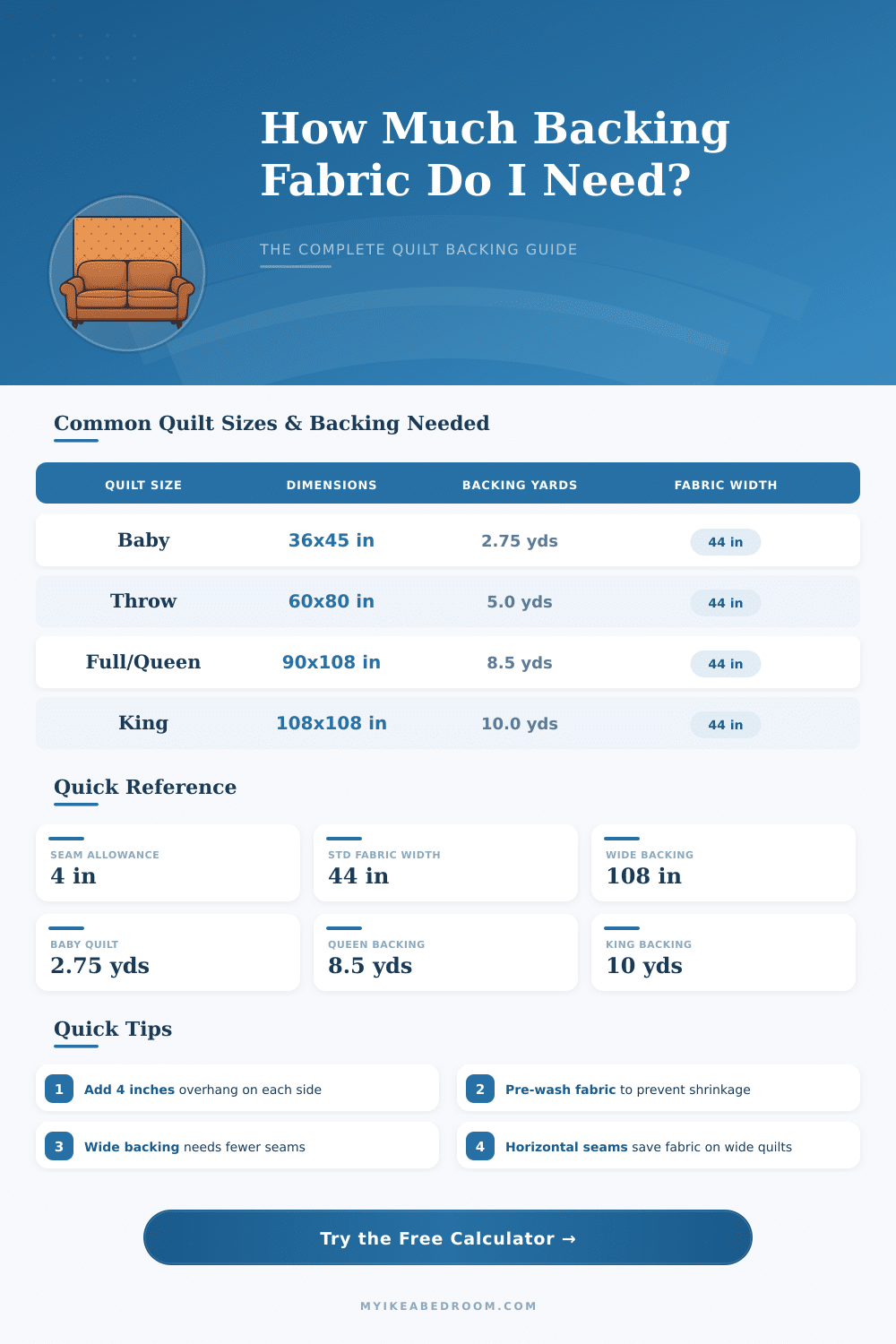
| Quilt Type | Finished Size (in) | Backing Needed (44 in) | Backing Needed (108 in) |
|---|---|---|---|
| Baby Quilt | 36 x 45 | 2.75 yards | 1.5 yards |
| Lap / Throw | 54 x 72 | 4.5 yards | 2.25 yards |
| Throw | 60 x 80 | 5.0 yards | 2.5 yards |
| Twin Bed | 66 x 90 | 5.5 yards | 2.75 yards |
| Full / Double | 84 x 90 | 7.75 yards | 2.75 yards |
| Queen Bed | 90 x 108 | 8.5 yards | 3.25 yards |
| King Bed | 108 x 108 | 10.0 yards | 3.25 yards |
| Cal. King | 108 x 120 | 11.0 yards | 3.5 yards |
| Fabric Width | Seam Direction | Panels Needed | Notes |
|---|---|---|---|
| 44 in | Horizontal | 2–3 panels | Best for quilts wider than 44 in |
| 44 in | Vertical | 2–3 panels | Seams run parallel to length |
| 60 in | Horizontal | 1–2 panels | Works for quilts up to 56 in wide |
| 108 in | None | 1 panel | No seams needed for most quilts |
| Yards | Inches | Centimeters | Meters |
|---|---|---|---|
| 0.25 yd | 9 in | 22.86 cm | 0.23 m |
| 0.5 yd | 18 in | 45.72 cm | 0.46 m |
| 1 yd | 36 in | 91.44 cm | 0.914 m |
| 1.5 yd | 54 in | 137.16 cm | 1.37 m |
| 2 yd | 72 in | 182.88 cm | 1.83 m |
| 3 yd | 108 in | 274.32 cm | 2.74 m |
| 5 yd | 180 in | 457.2 cm | 4.57 m |
| 10 yd | 360 in | 914.4 cm | 9.14 m |
Figuring out the size of the backing for a quilt is not as hard as it would seem at first. The secret is that every edge of your backing should extend at least 4 inches past the face of the quilt. This way you add entirely 8 inches to the width and to the length of your measures.
For instance, if the face measures 99 inches by width and 106 inches by length then the backing needs to be at least 103 by 110 inches, so that it works well.
How Much Backing Fabric You Need
Why do you need so much extra material? Well, if you skimp on the backing and the binding, you will risk problems during the quilt sewing process. It can turn out too short, what will force you to add extra bits later.
That is never nice. The most quilters that I talked to reckon, that around 4 to 6 inches of extra backing works best, while the binding usually needs 2 to 4 inches of space. For smallar works maybe only 2 inches is enough, even so.
Here the width of the fabric matters a lot. Most quilt fabrics come in around 42 inches of width, so if your needs for backing pass that, you will have to sew several strips won to the other. Happily for us, online calculators handle all the math on their own.
Enter your measurements, and it will show exactly how many yards you will need for the backing and for the binding.
What about wide backing, then? It changes the game entirely. You can find it in 108-inch or even 110-inch widths, what means no need to sew bits for most quilts.
For queen-size quilt usually almost 3 yards of 108-inch wide backing is enough. Some types reach even 120 inches of width, although for very big quilts sometimes you still must sew several bits together.
If your quilt is less than 34 inches on any side, one single piece of standard 42-inch fabric works well as backing, without any sewing. When you work with standard width and bigger quilt, cut three equal lengths and sew them together is a very common way.
Do not forget flat bed sheets as an option for backing, also. Double sets of sheets, after opening up, give surprisingly a lot of fabric. We talk about around 88 to 128 inches, what matches around 3.5 yards of 88-inch wide material.
Good sheets last surprisingly well through several washes. Anything in 60 inches of width or more is useful especially, because you can use it withoutany sewing.
The math can get tricky, when you handle various fabric widths and quilt sizes. Charts for backing yardage, made for standard quilts with 42-inch fabric, help a lot for quick advice. But for anything outside of those standard cases, a quilt calculator really saves the day.