😴 Sleep Efficiency Calculator
Calculate your sleep efficiency score and understand your sleep quality
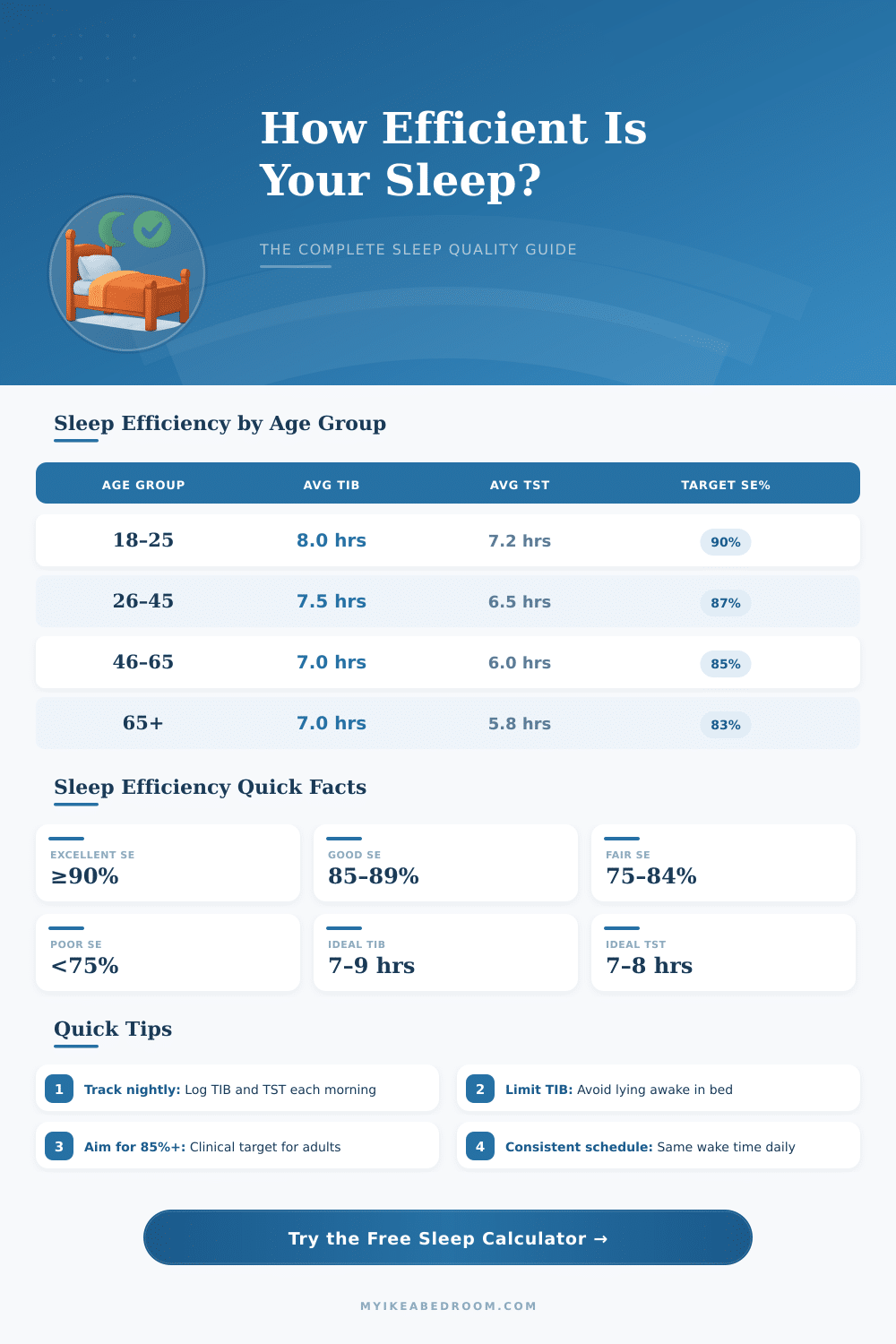
| Age Group | Recommended TST | Target SE% | Max Healthy WASO |
|---|---|---|---|
| Teen (14–17) | 8–10 hours | ≥88% | 20 min |
| Young Adult (18–25) | 7–9 hours | ≥90% | 25 min |
| Adult (26–64) | 7–9 hours | ≥85% | 30 min |
| Senior (65+) | 7–8 hours | ≥80% | 40 min |
| Component | Abbreviation | Healthy Range | Notes |
|---|---|---|---|
| Time in Bed | TIB | 7–9 hrs (adult) | Total time from lights out to rising |
| Total Sleep Time | TST | 7–8 hrs (adult) | Actual time asleep, not just in bed |
| Sleep Onset Latency | SOL | 10–20 min | Time taken to fall asleep |
| Wake After Sleep Onset | WASO | <30 min | Time awake after initially falling asleep |
| Sleep Efficiency | SE | 85–95% | TST ÷ TIB × 100 |
| Number of Awakenings | NWAK | <3 per night | Full arousals during sleep period |
| TIB \ TST | 6.0 hrs TST | 6.5 hrs TST | 7.0 hrs TST | 7.5 hrs TST | 8.0 hrs TST |
|---|---|---|---|---|---|
| 7.0 hrs TIB | 86% | 93% | 100% | — | — |
| 7.5 hrs TIB | 80% | 87% | 93% | 100% | — |
| 8.0 hrs TIB | 75% | 81% | 88% | 94% | 100% |
| 8.5 hrs TIB | 71% | 76% | 82% | 88% | 94% |
| 9.0 hrs TIB | 67% | 72% | 78% | 83% | 89% |
Sleep Efficiency points to that part of your time in bed you truly spend sleeping. The calculation is easy: you share the total Sleep by the time in bed then multiply by 100. For instance, if you lie down eight hours, but sleep only seven, that gives around 87.5 percent.
Always try to raise that value, because maybe we do not want to lose half of the night staring at the ceiling.
What Sleep Efficiency Is and How to Improve It
Widely, 85 percent or more is good Sleep Efficiency. If you reach 90 percent, then you do it very well. When it drops under 85, that commonly shows that your sleep becomes poor and broken.
Young, healthy adults commonly stay around 80 percent without big troubles. For adults above 40, aiming between 85 and 90 percent is mostly more reachable.
That measure commonly appears in studies about sleep, and for good reason. It focuses on the main problem of poor sleepers, spending too much time awake in bed. One number explains something surprising: why some sleep strongly six hours and feel rested, while another spends nine hours and yet feels tired.
Knowing how to control and improve your Sleep Efficiency does not only alter your nights, it alters also your feeling the next day.
Real rest stands on two causes: how much time you sleep and how well. Sleep Efficiency shows one of the best signs of Sleep quality. There is a big difference between seven hours of unbroken sleep and the case, when one lies ten hours in bed to get only seven hours with constant breaks.
Scientific studies confirm that for all ages.
Here is how it works in real life. Assume you need 7.5 hours of real sleep and have 85 percent Efficiency, then you must lie down around eight hours and 45 minutes. So, if you want too wake up at 6:30, turning the lights off should happen around 9:45.
Going to bed later than planned can quickly drop your Efficiency. If you stay awake 30 to 60 minutes past your planned bedtime, it commonly falls in the range of 76 to 82 percent. Also, late falling asleep usually causes higher heart rate and more tossing.
Rather, if you hit your bedtime and lie down seven or more hours, your Efficiency can reach 88 percent or even 95.
Many causes affect how easily you fall asleep and reach deep sleep. Food, exercise, stress, issues and whole lifestyle all play a role. Even so some effects are more hidden.
The bond that you formed with sleep during childhood, can decide what kind of sleeper you will be. Some folks simply have a talent to fall asleep right away. And it is a myth that everyone needs exactly eight hours.
That is not true. Some work with less, while others truly need eight or nine. If after 20 minutes you still do not sleep, rise, do something calm like read or listensoft music, and lie down again when you feel sleepy.