💤 REM Sleep Calculator
Find your optimal bedtime & wake-up time based on 90-minute sleep cycles
| Age Group | Recommended Sleep | Ideal Cycles | Bedtime Range |
|---|---|---|---|
| Newborn (0–3 mo) | 14–17 hours | 9–11 | Varies |
| Infant (4–11 mo) | 12–15 hours | 8–10 | 6–8 PM |
| Toddler (1–2 yr) | 11–14 hours | 7–9 | 7–9 PM |
| Preschool (3–5 yr) | 10–13 hours | 7–8 | 7–9 PM |
| School Age (6–13) | 9–11 hours | 6–7 | 8–9 PM |
| Teen (14–17) | 8–10 hours | 5–7 | 9–11 PM |
| Young Adult (18–25) | 7–9 hours | 5–6 | 10 PM–12 AM |
| Adult (26–64) | 7–9 hours | 5–6 | 10 PM–12 AM |
| Older Adult (65+) | 7–8 hours | 5–6 | 9–11 PM |
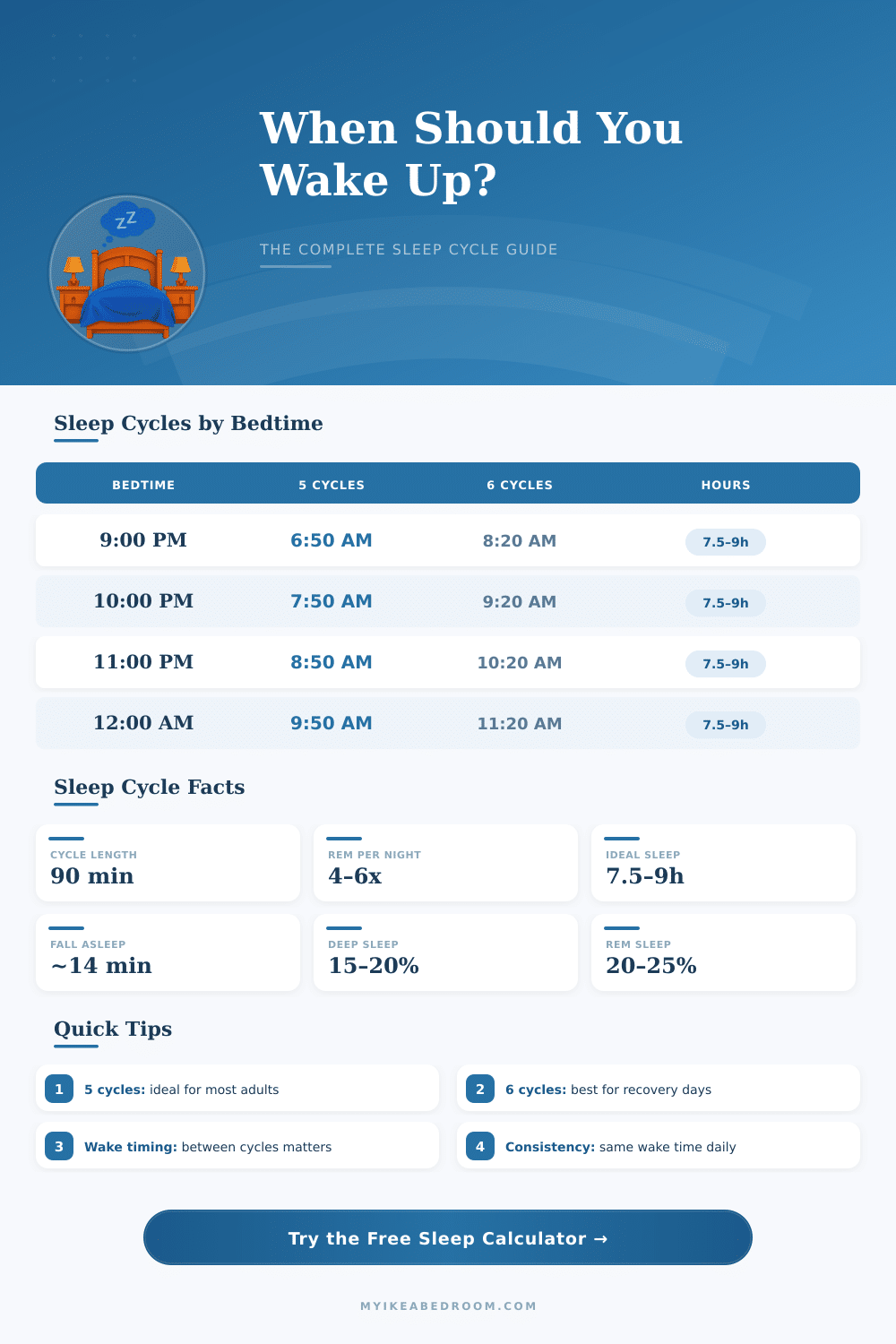
| Bedtime | 3 Cycles (4.5h) | 4 Cycles (6h) | 5 Cycles (7.5h) | 6 Cycles (9h) |
|---|---|---|---|---|
| 9:00 PM | 1:44 AM | 3:14 AM | 4:44 AM | 6:14 AM |
| 9:30 PM | 2:14 AM | 3:44 AM | 5:14 AM | 6:44 AM |
| 10:00 PM | 2:44 AM | 4:14 AM | 5:44 AM | 7:14 AM |
| 10:30 PM | 3:14 AM | 4:44 AM | 6:14 AM | 7:44 AM |
| 11:00 PM | 3:44 AM | 5:14 AM | 6:44 AM | 8:14 AM |
| 11:30 PM | 4:14 AM | 5:44 AM | 7:14 AM | 8:44 AM |
| 12:00 AM | 4:44 AM | 6:14 AM | 7:44 AM | 9:14 AM |
| 12:30 AM | 5:14 AM | 6:44 AM | 8:14 AM | 9:44 AM |
| 1:00 AM | 5:44 AM | 7:14 AM | 8:44 AM | 10:14 AM |
| Stage | Type | Duration per Cycle | % of Night |
|---|---|---|---|
| Stage 1 (N1) | Light NREM | 1–7 minutes | 2–5% |
| Stage 2 (N2) | Light NREM | 10–25 minutes | 45–55% |
| Stage 3 (N3) | Deep NREM | 20–40 minutes | 15–20% |
| REM Sleep | Rapid Eye Movement | 10–60 minutes | 20–25% |
| Nap Type | Duration | Sleep Stage | Best For |
|---|---|---|---|
| Micro Nap | 10–20 min | Stage 1–2 only | Quick alertness boost |
| Power Nap | 20–30 min | Stage 1–2 | Energy, focus |
| Slow-Wave Nap | 60 min | Enters deep sleep | Memory, learning |
| Full Cycle Nap | 90 min | Full cycle with REM | Creativity, recovery |
Sleep does not mean that the brain stays fully without activity. Although people pay less mind to the world around them, there happens a quiet wealth of hidden brain work. Those brain processes follow known rhythms, that experts split into phases.
Widely one sorts them in two main kinds: REM Sleep and non-REM Sleep.
REM Sleep: What It Is and Why We Need It
In a normal night the Sleep shifts between REM and non-REM through cycles around 90 minutes long. REM phases involve around 25 percent of the whole Sleep time, while non-REM takes the other 75 percent. If one gets the advised seven to nine hours of Sleep each night, that allows passing through five or six complete cycles.
REM Sleep forms the last, fourth stage of the Sleep.
REM Sleep is a special stage of rest, that apperas at mammals and birds. It shows through random fast eye motion, weak muscle tension in the whole body and strong leaning toward dreams. Although the eyes close, they still jump quickly.
During that phase the heartbeat, the blood pressure, the brain work and the breathing all rise. The main muscles actually freeze in REM, which stops people from acting out their dreams. Because of that some sensors for motion in fitness clocks count it as deep Sleep, people lie fairly still during REM.
Dreams in REM tend to be complex, colorful and emotional. When one wakes up from non-REM Sleep, one recalls fewer dreams, and those that happened are simpler and less vivid. The biggest part of dreams happens in the REM phase.
REM involves 20 to 25 percent of the Sleep cycle in adults, but more then 50 percent in children. That shows quite a clear difference. Also REM Sleep grows more in the second half of the overnight cycle.
The foods, drinks and remedies that people take can change the quality of the Sleep. And over-the-counter and prescribed medicines can break the Sleep cycles.
REM belongs to the two main Sleep types that the brain clearly wants to reach. The second is the slow-wave Sleep. Slow-wave Sleep drops with age, but REM does not as much.
It is truly hard for people to escape REM Sleep long-term, because the brain fights to receive it.
The body needs REM Sleep. The clearest way to force it to start would be to not allow Sleep in long enough stretches to normally reach REM. Outside factors like tiredness, remedies or habit can change how the single cycles of Sleep progress.
Time with a phone before bed can delay REM Sleep and even break the daily rhythm. Spending more time in bed usually helps toget more Sleep and better REM scores.