🚪 Door Rough Opening Size Calculator
Calculate the exact rough opening dimensions needed for any door type & size
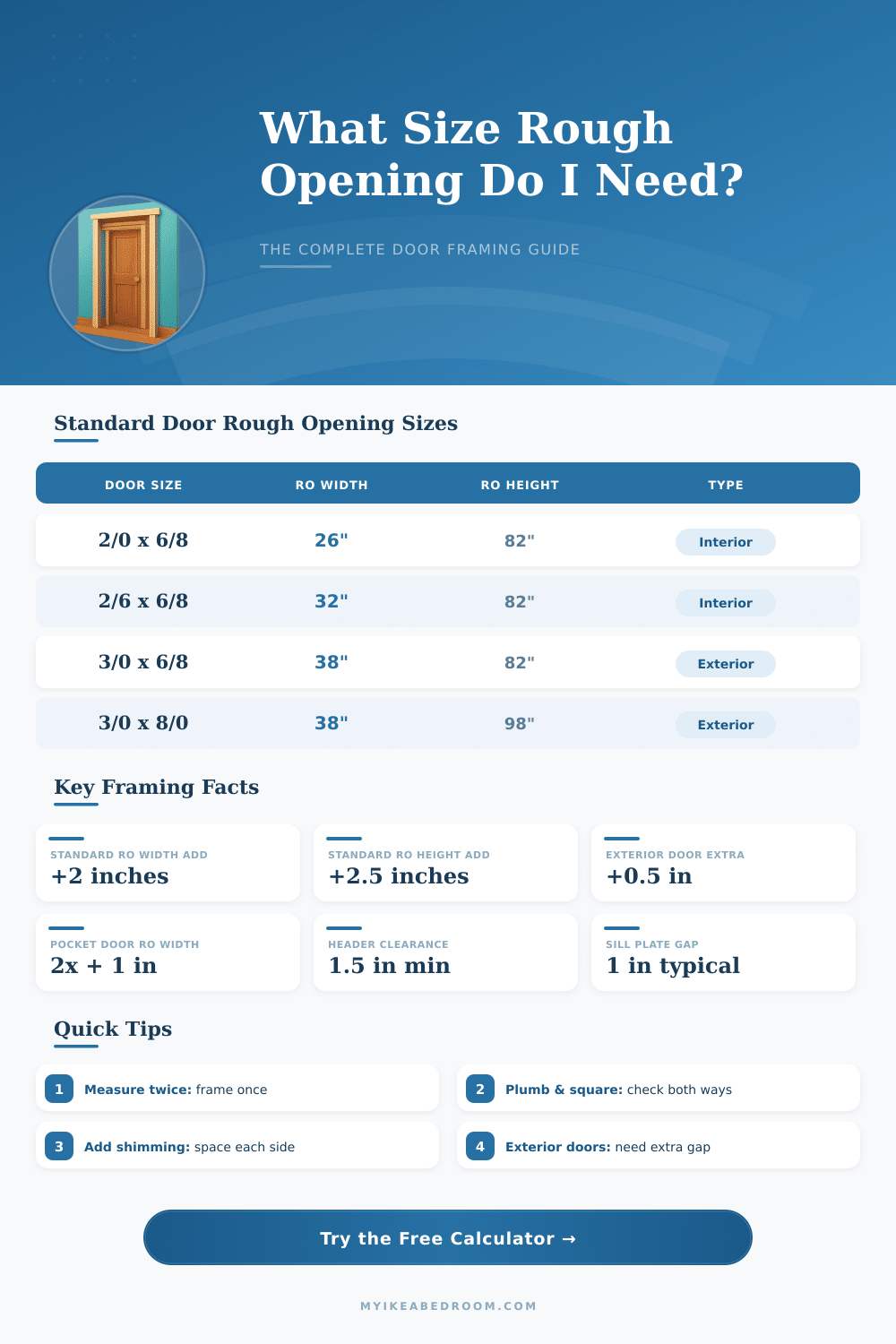
| Door Size (W x H) | RO Width | RO Height | Type | RO Width (mm) | RO Height (mm) |
|---|---|---|---|---|---|
| 24" x 80" (2/0 x 6/8) | 26" | 82.5" | Interior | 660 mm | 2096 mm |
| 28" x 80" (2/4 x 6/8) | 30" | 82.5" | Interior | 762 mm | 2096 mm |
| 30" x 80" (2/6 x 6/8) | 32" | 82.5" | Interior | 813 mm | 2096 mm |
| 32" x 80" (2/8 x 6/8) | 34" | 82.5" | Interior | 864 mm | 2096 mm |
| 36" x 80" (3/0 x 6/8) | 38" | 82.5" | Exterior | 965 mm | 2096 mm |
| 36" x 96" (3/0 x 8/0) | 38" | 98.5" | Exterior | 965 mm | 2502 mm |
| 60" x 80" Double | 62" | 82.5" | Exterior Double | 1575 mm | 2096 mm |
| 72" x 80" Double | 74" | 82.5" | Exterior Double | 1880 mm | 2096 mm |
| Door Width | RO Width (2x+1") | RO Height (+3") | Pocket Depth Needed |
|---|---|---|---|
| 24" | 49" | 83" | 26" min |
| 28" | 57" | 83" | 30" min |
| 32" | 65" | 83" | 34" min |
| 36" | 73" | 83" | 38" min |
| Opening Size | Door Panel Width | RO Width | RO Height |
|---|---|---|---|
| 24" (2 panels) | 12" each | 25" | 82" |
| 36" (2 panels) | 18" each | 37" | 82" |
| 48" (2 panels) | 24" each | 49" | 82" |
| 60" (4 panels) | 15" each | 61" | 82" |
| 72" (4 panels) | 18" each | 73" | 82" |
The Rough Opening is made up of the framed space in the wall, where later will go the Door. It is the basic structure that surrounds the whole Door. Get this size correctly especially during building or fixing of home.
The main rule is quite simple. Internal doors require that the Rough Opening be two inches wider than the Door leaf. Usual leaves for internal doors have widths of 30, 32, 34 or 36 inches, so the Rough Opening reaches 32, 34, 36 or 38 inches.
How to Measure a Rough Opening for a Door
For the height add two and half inches to the real height of the Door. That extra area leaves enough place to lay the frame above the bottom floor.
Why are those two inches more in width needed? Around three quarter inches per side must go to the Door jambs, and an extra quarter of inch per side provides play room. Thanks to that play room you can move the jambs, so that the Door works well.
The most common jambs measure almost one inch thcik, although they can reach one inch per side.
Here is a sample to explain. Assume that the Door is 36 inches wide. Then the Rough Opening width should be 38 inches.
The header above it cuts at 41 inches. Also, double or triple headers can be needed based on the starting width and the weight that the header bears.
Sometimes the Rough Openings are not fully perfect. For instance, one case showed 32 inches up, 31 and three quarters in the centre, and 31 and five eighths at the bottom. Also the concrete subfloor was a bit off level, namely around one eighth inches.
In old houses the walls commonly are not flat. After framing and adding finished floor can lower the vertical area and force you too adapt the jambs for a new Door.
A quarter inch too wide for the Rough Opening is totally fine. Real problems come when the space is too narrow. If the Rough Opening is too big, it needs to be framed smaller.
When it is only a bit more than one inch off, one can center the Door and shim both sides, then finish the cleanup.
If the walls are very solid, the Rough Opening can shrink a bit. Some folks set the hinge part of the frame right to the wall without shims, using one long screw for every hinge that enters the frame. The usual Rough Opening size gives lot of place for shimming and accounts for the walls not always being flat.
Fixing Rough Openings to the right size makes the Door install much more simple. Drywall cuts easily, and one can cover therough edges.
When Rough Openings need to get wider, one can use a saw to cut between the frame and the fresh drywall, removing the screws. Later the frame pulls out, and the drywall gets fixed. The depth of the Rough Opening relates to the thickness of the wall frame.