🌡️ Hydronic Baseboard Heat Loss Calculator
Calculate BTU heat loss per room and find the baseboard length needed for your hot water heating system
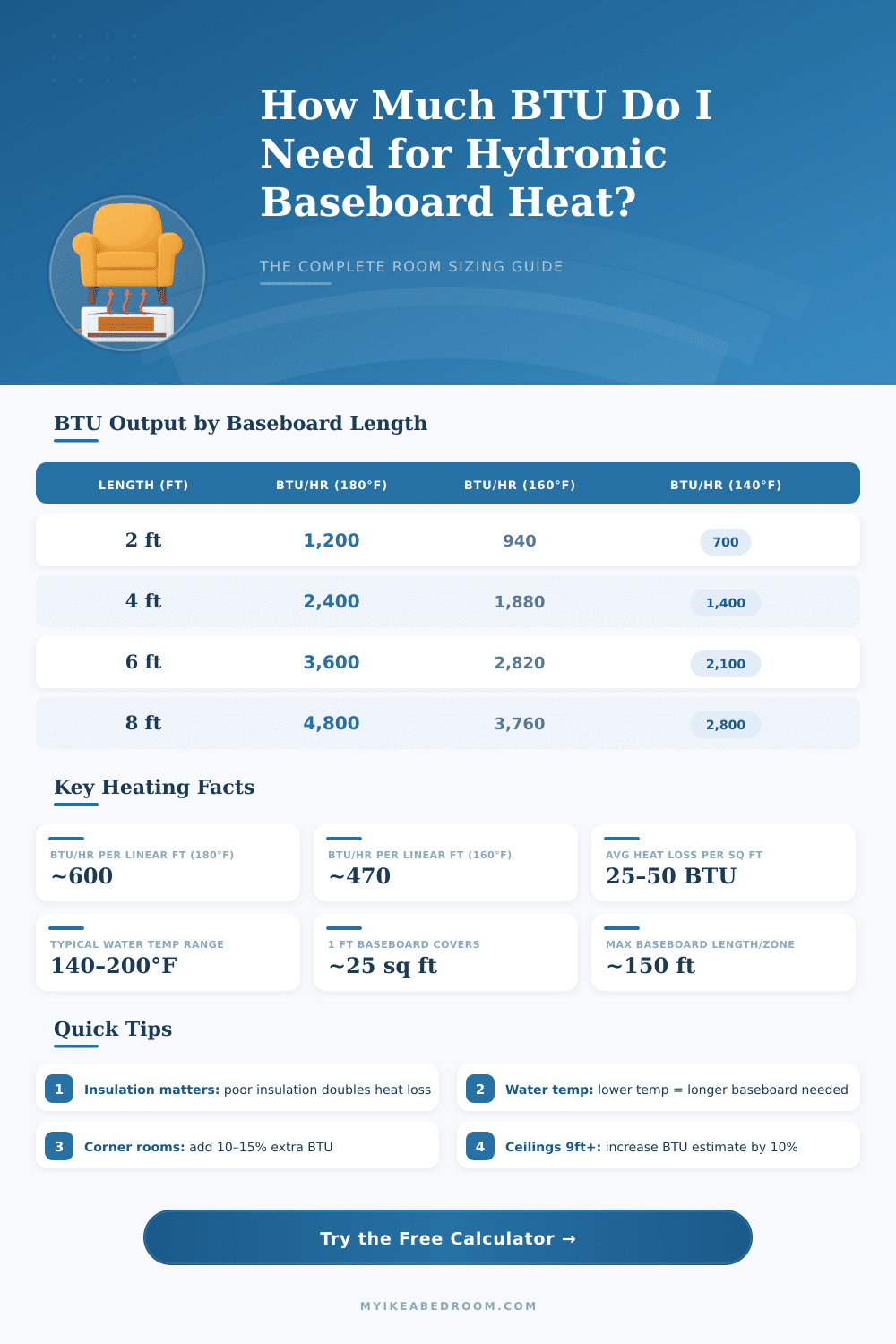
Standard fin-tube hydronic baseboard output at various water temperatures (BTU/hr per linear foot):
Standard Output
Mid Temp
Low Temp
High-Output
Low-Profile
High Temp
Avg Room Loss
Per Zone
| Length (ft) | @ 200°F | @ 180°F | @ 170°F | @ 160°F | @ 150°F | @ 140°F |
|---|---|---|---|---|---|---|
| 2 ft | 1,520 | 1,200 | 1,060 | 940 | 800 | 680 |
| 4 ft | 3,040 | 2,400 | 2,120 | 1,880 | 1,600 | 1,360 |
| 6 ft | 4,560 | 3,600 | 3,180 | 2,820 | 2,400 | 2,040 |
| 8 ft | 6,080 | 4,800 | 4,240 | 3,760 | 3,200 | 2,720 |
| 10 ft | 7,600 | 6,000 | 5,300 | 4,700 | 4,000 | 3,400 |
| 12 ft | 9,120 | 7,200 | 6,360 | 5,640 | 4,800 | 4,080 |
| 14 ft | 10,640 | 8,400 | 7,420 | 6,580 | 5,600 | 4,760 |
| 16 ft | 12,160 | 9,600 | 8,480 | 7,520 | 6,400 | 5,440 |
| Room Size | Poor Insul. | Average Insul. | Good Insul. | Excellent Insul. |
|---|---|---|---|---|
| 100 sq ft (10x10) | 4,000 BTU | 2,500 BTU | 1,400 BTU | 900 BTU |
| 150 sq ft (10x15) | 6,000 BTU | 3,750 BTU | 2,100 BTU | 1,350 BTU |
| 200 sq ft (12x17) | 8,000 BTU | 5,000 BTU | 2,800 BTU | 1,800 BTU |
| 300 sq ft (15x20) | 12,000 BTU | 7,500 BTU | 4,200 BTU | 2,700 BTU |
| 400 sq ft (20x20) | 16,000 BTU | 10,000 BTU | 5,600 BTU | 3,600 BTU |
| 480 sq ft (20x24) | 19,200 BTU | 12,000 BTU | 6,720 BTU | 4,320 BTU |
| Indoor Temp (°F) | Outdoor –20°F | Outdoor –10°F | Outdoor 0°F | Outdoor 10°F | Outdoor 20°F |
|---|---|---|---|---|---|
| 65°F | 85°F ΔT | 75°F ΔT | 65°F ΔT | 55°F ΔT | 45°F ΔT |
| 68°F | 88°F ΔT | 78°F ΔT | 68°F ΔT | 58°F ΔT | 48°F ΔT |
| 70°F | 90°F ΔT | 80°F ΔT | 70°F ΔT | 60°F ΔT | 50°F ΔT |
| 72°F | 92°F ΔT | 82°F ΔT | 72°F ΔT | 62°F ΔT | 52°F ΔT |
| Room / Project | Area (sq ft) | Est. Heat Loss | Baseboard Needed @ 180°F |
|---|---|---|---|
| Small Bedroom | 120 sq ft | 3,600 BTU | 6 ft |
| Average Bedroom | 180 sq ft | 5,400 BTU | 9 ft |
| Living Room | 300 sq ft | 9,000 BTU | 15 ft |
| Open-Plan Living/Dining | 480 sq ft | 14,400 BTU | 24 ft |
| Full Basement | 800 sq ft | 32,000 BTU | 53 ft |
| 2-Car Garage | 440 sq ft | 22,000 BTU | 37 ft |
Baseboard heaters work by moving warm water through tubes that have metal fins attached to them. The water carries the heat through the tubes to those fins, and from here it passes into the room. Valves control the flow of the water while thermostats normally handle the temperature.
In Baseboard heaters, the tubes carry many metal fins that provide bigger surface for efficient warming.
How Baseboard Heaters Work and Why They Are Good
There are some kinds that are worth knowing. A Baseboard heater can be a standalone electrical device that heats an internal tank of liquid. Or it connects to a central heating system with a home boiler.
Rather than electrical elements that heat the air directly, here the heating element heats the water or oil that later heats the air. A boiler usually powers a water-based system. Some boilers reach only 80 percent efficiency, but others pass 90 percent or even more.
Energy savings are one of the main benefits of Baseboard heaters. They greatly surpass forced-air Baseboard heaters in energy efficiency. The heated liquid keeps giving heat even when the device turns off.
Forced-air heaters widely cost little and install easily, and they quickly heat the upper part of the room. Even so they consume more energy. Comparing oil-filled electrical heaters with average strip heaters, there is no differnce in real efficiency, because electrical heat always is 100 percent.
The main benefit of water-based heat is that it feels gentler and pleasant, which allows you to lower the thermostat by some degrees.
Baseboard heaters offer silent mode and precise working. They deliver gentle heat and work well four homes and businesses, especially in cold regions. Radiant heaters give a more intense feeling when one stands directly before them; forced-air heaters warm the air more quickly, while water-based ones do that more cleverly, but more evenly through the whole space.
Some models serve as direct replacement for fin-tube or cast iron Baseboard units. Some versions work with water temperatures around 140 degrees Fahrenheit. Baseboard heaters meant for high water temperatures handle up to 220 degrees Fahrenheit.
For good performance, Baseboard heaters mostly need water at 120 to 150 degrees.
The covers of old Baseboard heaters commonly rust, break quickly and look bad over time. But the heaters mostly stay reliable. So it is worth renewing old Baseboard heaters instead of removing them entirely.
They do not reach heat that could burn wood, so furniture and buildings beside them do not create fire danger. When replacing Baseboard heaters, use models with same or fewer watts than the prior ones, toavoid overloading the circuits.