🖌️ Baseboard Paint Calculator
Calculate exactly how much paint you need for your baseboards & trim
| Profile Style | Height (in) | Height (cm) | Typical Use |
|---|---|---|---|
| Ranch / Colonial | 2.5 in | 6.4 cm | Low ceilings, small rooms |
| Standard Colonial | 3.5 in | 8.9 cm | Most common residential |
| Craftsman | 4.25 in | 10.8 cm | Craftsman / bungalow homes |
| Traditional Tall | 5.25 in | 13.3 cm | 8-9 ft ceilings |
| Victorian / Grand | 7 in | 17.8 cm | High ceilings, formal rooms |
| Custom / Stacked | 9–12 in | 22.9–30.5 cm | Luxury / estate homes |
| Room Size (ft) | Perimeter (lin ft) | Surface Area @ 3.5 in (sq ft) | Gallons Needed (2 coats, semi-gloss) |
|---|---|---|---|
| 8 x 10 | 36 ft | 10.5 sq ft | 0.06 gal |
| 10 x 12 | 44 ft | 12.8 sq ft | 0.07 gal |
| 12 x 14 | 52 ft | 15.2 sq ft | 0.09 gal |
| 12 x 16 | 56 ft | 16.3 sq ft | 0.09 gal |
| 14 x 18 | 64 ft | 18.7 sq ft | 0.11 gal |
| 15 x 20 | 70 ft | 20.4 sq ft | 0.12 gal |
| 20 x 22 | 84 ft | 24.5 sq ft | 0.14 gal |
| Container | Volume | Coverage @ 350 sq ft/gal | Best For |
|---|---|---|---|
| Sample Pot | 8 oz (0.25 qt) | ~21 sq ft | Testing color / touch-ups |
| Quart | 0.95 L | ~87 sq ft | Single small room trim |
| Half-Gallon | 1.9 L | ~175 sq ft | Medium room trim |
| Gallon | 3.79 L | ~350 sq ft | Whole-home baseboards |
| Spray Can | 12 oz | ~15–20 sq ft | Detail / touch-up spots |
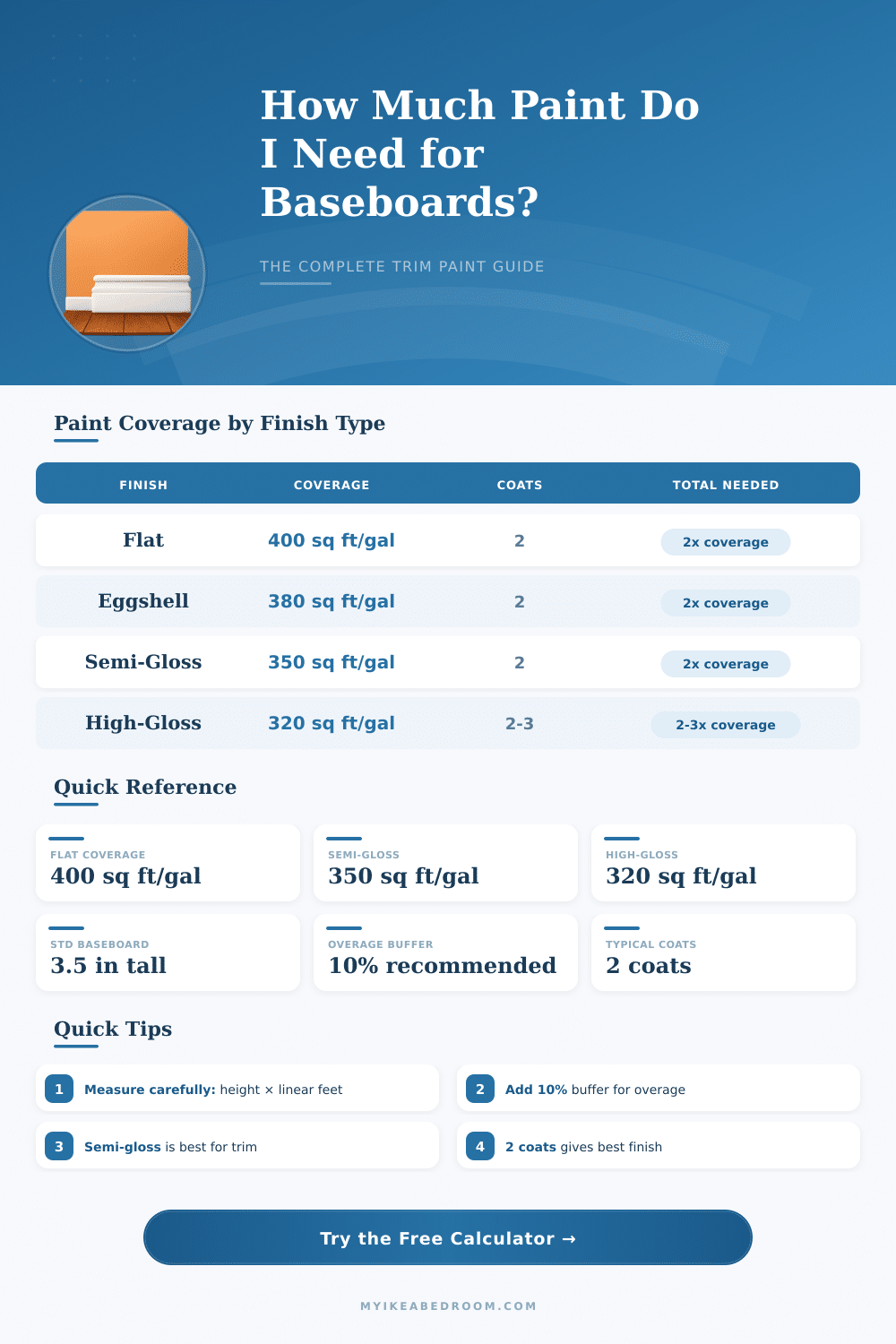
baseboard maybe seems something not important, but the final coat that you choose, really changes the whole impression of the room. The type of paint and its gloss has bigger influence than one thinks. Here the secret: for baseboard and trim, choose shiny or half shiny finish.
That is the best option for good work. They last well and you can clean them by simply wiping, without big effort. Although many folks reckon that too much gloss is a bit too showy, and favour something more flat, and well, that is entirely good style-choice.
How to Paint Baseboards: Finish, Prep and Tips
If for you matters easy cleaning later, even so low-gloss or high gloss stays the winners.
When dealing about paint, there are two main kinds. Water-based latex paint gives smoother surface and is easier to clean than oil-based. The downside?
It requires several coats and touch-ups that must be done more often over time. Oil-based paint, on the other hand, lasts more long and resists use much better. It shines especially on metal parts or covers of baseboard.
Moreover, if you care about matching with your walls, the most many paint shops mix oil-based paints to reach the right shade.
Sherwin Williams Emerald Urethane Trim Enamel is the main choice for fancy projects, it works for window frames, door frames, railings, chair rails, gates and baseboard, everything looks well with it. Benjamin Moore Advance and Sherwin Williams ProClassic work very well also. White trim paint appears everywhere, which makes it easy to find exactly what you need for molding, baseboard, attics and window sills.
Before even taking the brush, the preparation is key. Fill all nail holes with wood filler, then sand everything for smooth surface. When done, aim the dust and wipe with wet fabric, to catch what the vacuum missed.
Use caulk too close the splits, where the baseboard meets the wall. That detail really is worth the effort. To reach smooth and polished result, depend on sanding, preparation and cleaning.
The most many folks use two coats of paint, sometimes three, with enough drying time between them. For the base coat even so you need only one coat.
During the real painting, start from up and go down. First the crown molding, then window and door frames, finally the baseboard. Dip your brush one third in the tin and tap the excess against the edge.
Little roller works well also, if you like that way. When you paint beside the floor, stick plastic film partly under the baseboard to protect. Use knife to cut the line in that narrow space, tohelp keep everything without marks.
Black or other dark shade looks surprising on baseboard, especially in rooms like home cinema, where you want fewer visible distractions. Matching the color of your baseboard with that of the walls gives unique atmosphere, while using dark red or more black tones creates other style. You can also choose bold contrast to add strong visual impression to the space.