🧱 Subway Tile Layout Calculator
Calculate exactly how many subway tiles you need for any wall or floor — with overage, grout joints, and layout patterns included.
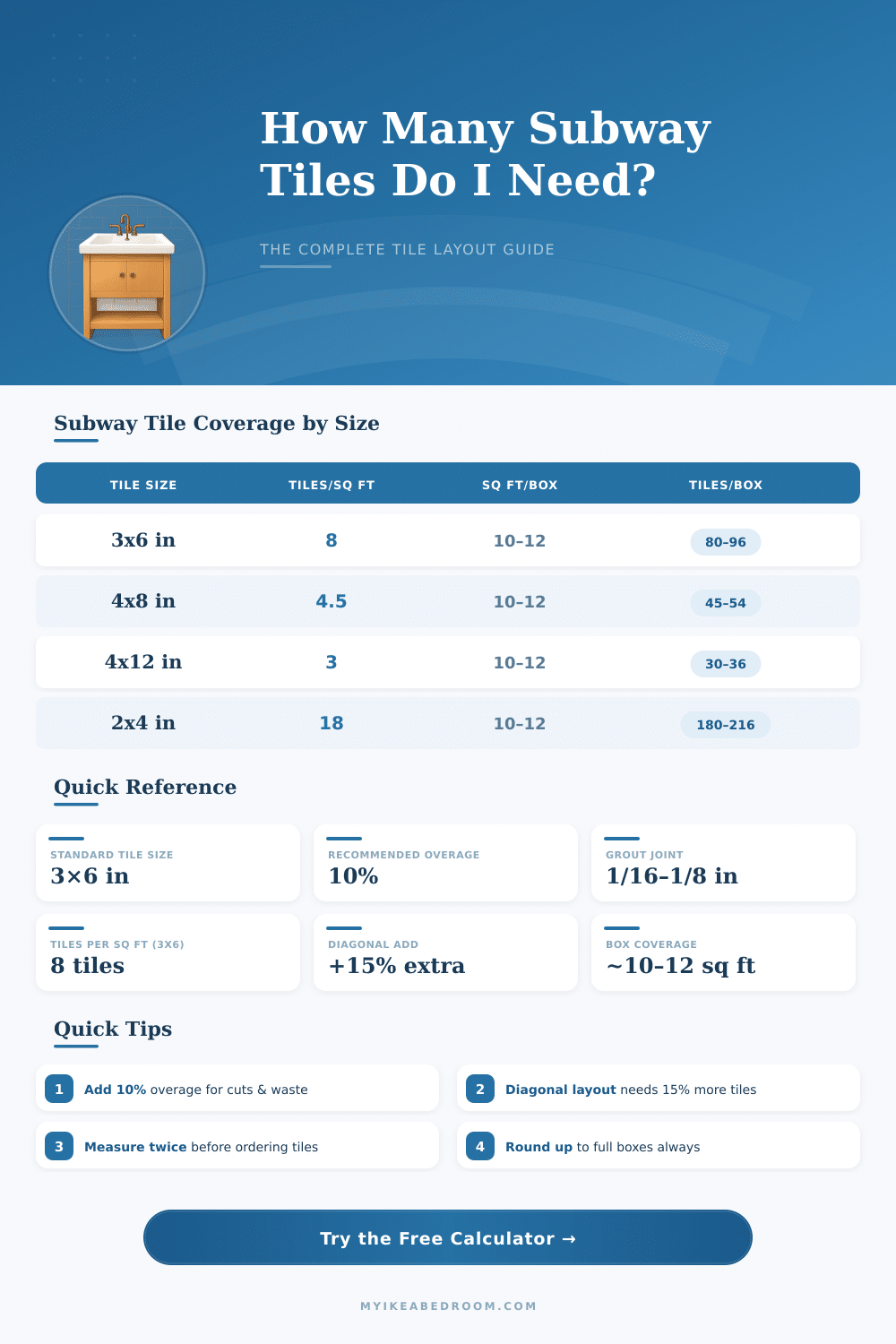
| Tile Size | Tiles per Sq Ft | Sq Ft per Box (~80 tiles) | Metric Size (cm) |
|---|---|---|---|
| 2 x 4 in | 18.0 | 4.4 | 5 x 10 cm |
| 2 x 6 in | 12.0 | 6.7 | 5 x 15 cm |
| 2 x 8 in | 9.0 | 8.9 | 5 x 20 cm |
| 3 x 6 in | 8.0 | 10.0 | 7.5 x 15 cm |
| 4 x 8 in | 4.5 | 17.8 | 10 x 20 cm |
| 3 x 12 in | 4.0 | 20.0 | 7.5 x 30 cm |
| 4 x 12 in | 3.0 | 26.7 | 10 x 30 cm |
| 6 x 12 in | 2.0 | 40.0 | 15 x 30 cm |
| Project | Typical Area | Tiles (3x6 in) | Boxes (10 sq ft) |
|---|---|---|---|
| Kitchen Backsplash (small) | 20 sq ft | 176 | 2 |
| Kitchen Backsplash (standard) | 40 sq ft | 352 | 4 |
| Bathroom Wall (half) | 50 sq ft | 440 | 5 |
| Shower Surround (3-wall) | 80 sq ft | 704 | 8 |
| Powder Room (full walls) | 120 sq ft | 1,056 | 11 |
| Laundry Niche | 15 sq ft | 132 | 2 |
| Fireplace Surround | 30 sq ft | 264 | 3 |
| Mudroom Floor | 35 sq ft | 308 | 4 |
| Entryway Floor | 45 sq ft | 396 | 5 |
| Bathroom Floor | 55 sq ft | 484 | 6 |
| Grout Joint | Coverage Impact | Best For | Notes |
|---|---|---|---|
| 1/16 in (tight) | Minimal loss | Rectified tiles | Very precise cuts needed |
| 1/8 in (standard) | ~2% area loss | Most subway tile | Most common choice |
| 3/16 in (wide) | ~4% area loss | Handmade tiles | Adds character |
| 1/4 in (rustic) | ~6% area loss | Vintage / rustic | More grout needed |
The original subway tile measured 3 by 6 inches and one installed them in 50-percent offset arrangement (practically), the centre of every tile attaches to the edges of the tiles up and below. This layout has yet one name: the running bond. It copies the look of brickwork where every row slips relative to the prior.
There is something natural and timeless in that design, that fits well to almost every room. Add a bit of strong grout lines or color differences, and the whole sharply seems full of life.
How to Arrange Subway Tiles
When deal about actual layout, you have seven main ways to arrange tiles: stacked bond in both directions, running bond, herringbone, basketweave and mixed setups that combine two them. Each gives its own distinct charm. Stacked designs, where tiles rise in perfect rows without any offset.
Tend to smoother, modern style. On the other hand, classical offset or stacked mode usually is the easiest effect, because they do not require like this much accuracy or measuring.
And later comes the third-offset, that adds new spine to the usual. Instead of half of the tile length, one moves in third, fourth or any bit that answers your notion. The impression gives more movement and energetic impression, even so it yet seems ruled and tidy.
It works well to add discreet visual charm, especially when you work with white or plain subway tile in a middle bathroom or kitchen. As bonus, that mode helps against lippage, that sad unevenness that rises upward, especially at longer forms.
Lippage itself happens because of that, that tiles can a bit bend when they dry. Do half offset above perfectly flat wall, and sharply it looks as if lippage, because the bloated part of one tile ends up sitting right over the thinnest edge of the next.
Vertical uses deserve attention also. Setting subway tile directly with vertical offset, spaces feel higher, what answers for empty showers. Turn tiles in ninety degrees give fresh and modern feeling.
Direct vertical pile reads as high, well ordered and clean. Some people find vertical tiles a bit bothering, while horizontal layout only seem more soothing. When you work with higher parts as showers, mix vertical and horizontal arrangements escape one big tension that swings the eye.
The charm of subway tile lies in its size. One can use it four kitchen and bathroom backsplashes, full walls or shower areas. Backsplashes would sit between counter and bottom of cabinets or climb the whole height above open shelf.
Tile sizes grew now, you find 2 by 8, 3 by 12 or 4 by 16 bit. Stacked layout means less issue about grout attention, what is not less. Tiles with soft color game looks especially good with third-offset designs.
Running bonds, chevron and herringbone arrangements all answer well with subway tile. Truly, the layout that you choose deeply alters thecharacter of the whole space.