🩷 Hardwood Flooring Weight Calculator
Calculate the total weight of hardwood flooring for any room — by species, thickness, and area
| Thickness | lbs / sq ft | kg / m² | Notes |
|---|---|---|---|
| 3/8" Engineered | 1.60 | 7.81 | Thin engineered, floating floor |
| 1/2" Engineered | 2.13 | 10.40 | Standard engineered thickness |
| 3/4" Solid | 3.20 | 15.63 | Most common solid hardwood |
| 1" Solid | 4.27 | 20.83 | Heavy-duty solid plank |
| 1-1/4" Solid | 5.33 | 26.04 | Industrial / commercial grade |
| 1-1/2" Solid | 6.40 | 31.25 | Specialty thick plank |
| Room | Area (sq ft) | Area (m²) | Weight (lbs) | Weight (kg) |
|---|---|---|---|---|
| Small Bedroom | 120 | 11.1 | 384 | 174 |
| Standard Bedroom | 168 | 15.6 | 538 | 244 |
| Master Bedroom | 224 | 20.8 | 717 | 325 |
| Living Room | 300 | 27.9 | 960 | 435 |
| Large Living Room | 400 | 37.2 | 1,280 | 581 |
| Full Floor (1,000 sq ft) | 1,000 | 92.9 | 3,200 | 1,451 |
| Species | Janka Hardness | Density (lbs/ft³) | lbs/sq ft (3/4") | kg/m² (3/4") |
|---|---|---|---|---|
| Southern Yellow Pine | 1,225 | 38.4 | 2.40 | 11.72 |
| Douglas Fir | 660 | 33.0 | 2.06 | 10.06 |
| American Cherry | 950 | 35.0 | 2.19 | 10.70 |
| Black Walnut | 1,010 | 38.0 | 2.38 | 11.62 |
| Red Oak | 1,290 | 44.0 | 2.75 | 13.43 |
| White Oak | 1,360 | 47.0 | 2.94 | 14.35 |
| Ash | 1,320 | 41.0 | 2.56 | 12.50 |
| Hard Maple | 1,450 | 44.5 | 2.78 | 13.57 |
| Hickory | 1,820 | 51.0 | 3.19 | 15.58 |
| Bamboo (Strand) | 3,000 | 42.0 | 2.63 | 12.84 |
| Brazilian Cherry | 2,350 | 55.0 | 3.44 | 16.80 |
| Ipe | 3,510 | 69.0 | 4.31 | 21.05 |
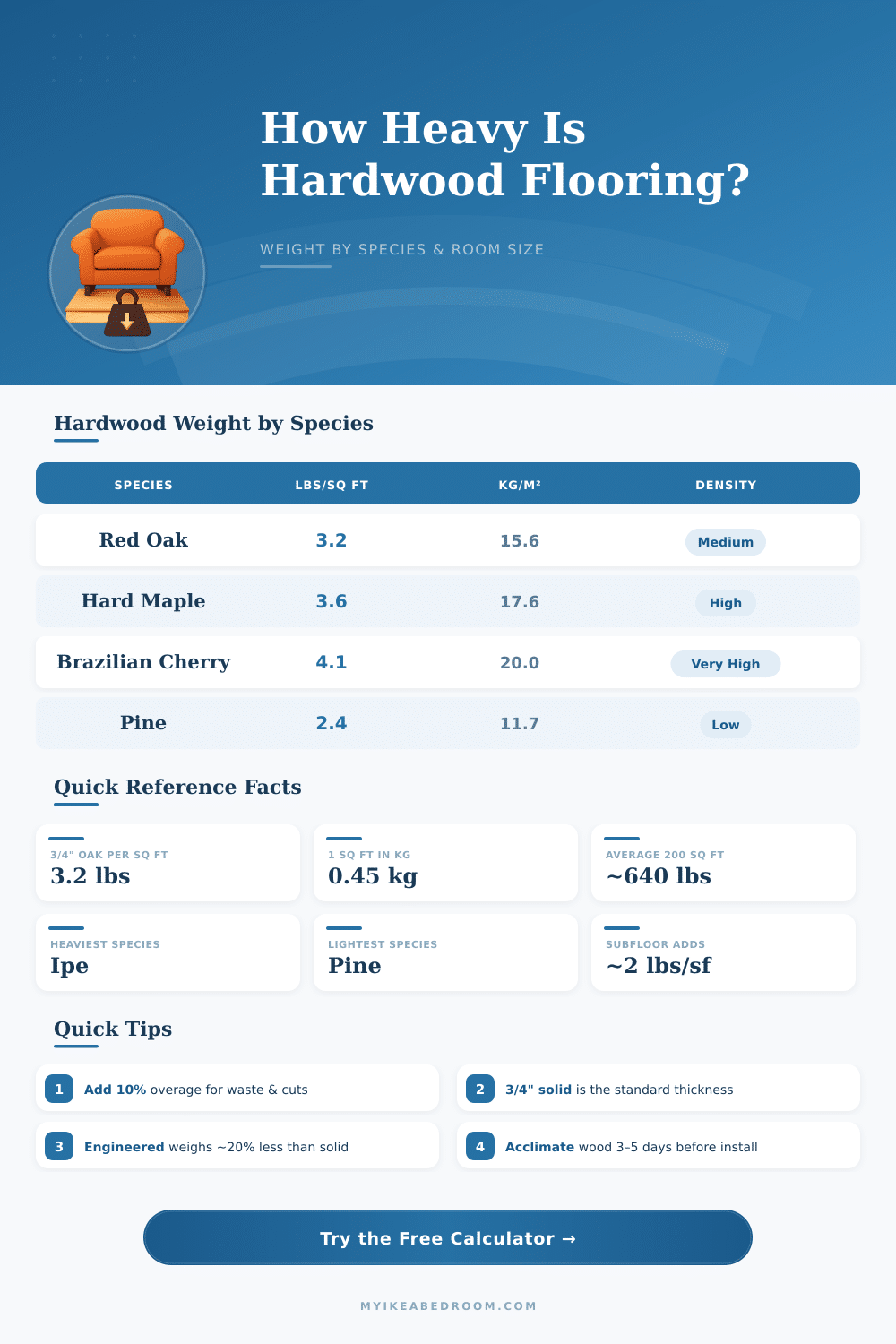
The weight of hardwood flooring depends on some elements. Naturally, the kind of tree matters, but also the thickness of the boards and the level of humidity, something that commonly passes without notice. Usual solid hardwood normally has 3/4-inch thickness and then one usually finds between 3 and 4.5 pounds per square foot.
On the other hand, you can choose more lightweight options. According to the wood type and the mode, as one cuts the boards, it is possible to strip hardwood flooring that weighs only 1.5 pounds per square foot. The density of wood ranges a lot according to the exact type and even the place in the tree from that it comes.
How Much Does Hardwood Flooring Weigh?
Other matter entirely is the exotic hardwoods. They come with wonderful shades and impressive grain textures, except that they have extreme density, everything that pushes them also heavy. These species commonly reach around 4 to 6 puonds per square foot, so they belong to the heaviest possible choices for purchase.
Thanks to that density, they keep their look especially well over years.
When buying hardwood, the spec sheet helps most. It explains the content of the box according too square feet, how much weight enters every package and the whole mass of the whole. About Bruce hardwood especially, the most boxes weigh around 40 to 55 pounds; good to know, if you prepare delivery or transport yourself.
One alone Bruce board weighs about 1.5 pounds. Some makers sell their products in packages of 20 square feet, and those usually reach 30 pounds each. Widely, a box with hardwood flooring weighs between 40 and 80 pounds, according to what one chooses.
Here it becomes real. Recently some had to transport 1200 square feet of 3/4-inch hardwoods from the garage into the house for adjusting; truly tough task. A full pallet can reach around 2000 pounds.
Red oak, that has 45 pounds per cubic foot, quickly counts to almost 3375 pounds for a big load. That matches almost 2 tons of materials. Better scatter it through theempty space than pile everything in one spot.
Your floor must last certain loads. In homes one usually can bear at least 40 pounds per square foot for live load, so folks, furniture and everyday objects. In bedrooms the limit is 30 pounds per square foot.
Also, there is dead load (the building itself and the hardwood flooring) between 10 and 20 pounds per square foot. Before you install hardwood, well check, whether your floor truly fits to bear that weight.
The subfloor matters also a lot. Concrete or plywood subfloor, or even board, are the most reliable options. Hardwoods spread the weight more effectively than soft woods, and thick boards help too.
The size of your support beams, the gap between them and the thickness of the subfloor (everything affects), how the floor holds.