📏 Grid Accent Wall Calculator
Calculate boards, spacing & linear footage for your grid accent wall project
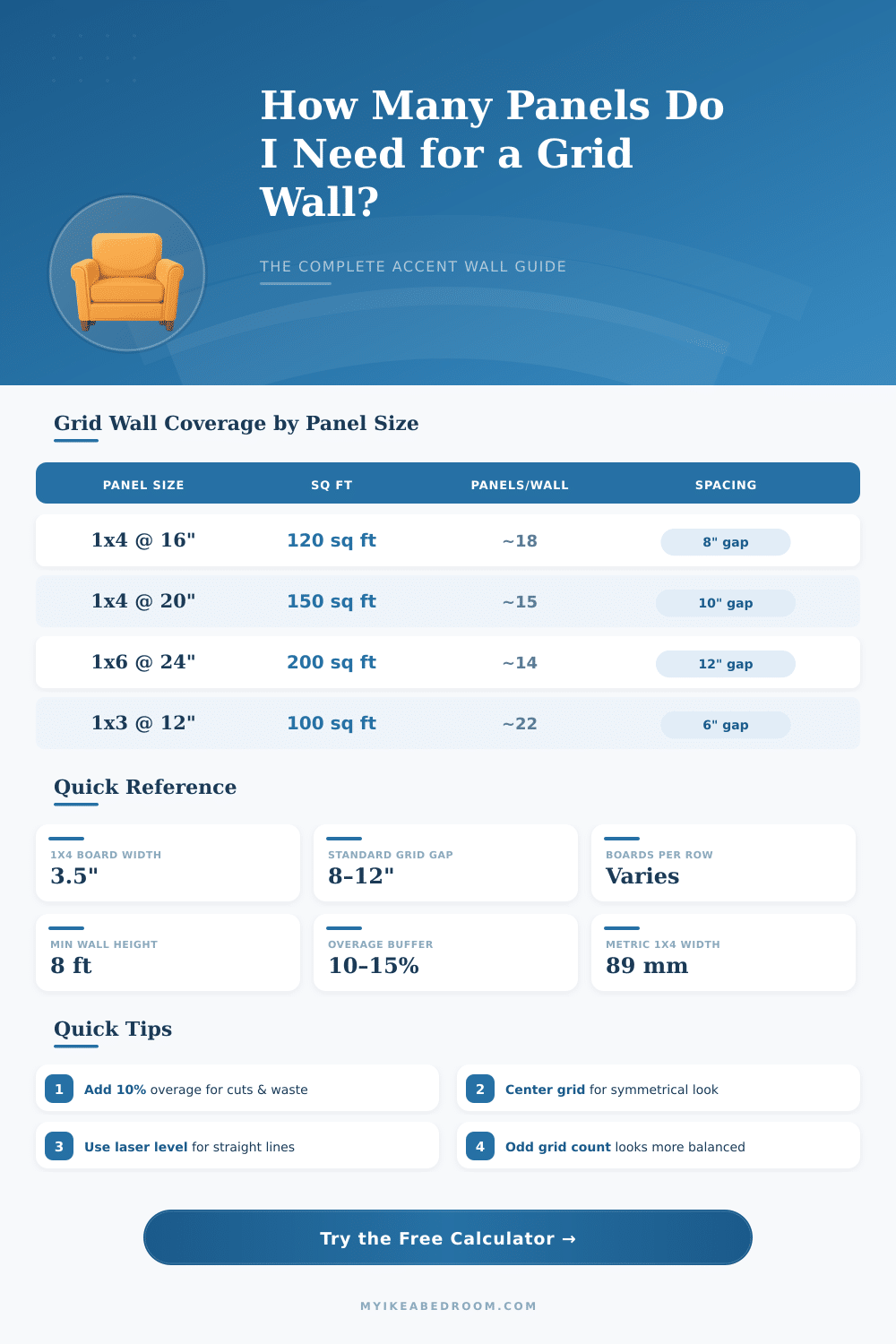
| Board Width | Gap (in) | Module (in) | Boards per 8 ft | Boards per 12 ft | Boards per 16 ft |
|---|---|---|---|---|---|
| 1x3 (2.5") | 6" | 8.5" | ~11 | ~17 | ~22 |
| 1x3 (2.5") | 8" | 10.5" | ~9 | ~14 | ~18 |
| 1x4 (3.5") | 6" | 9.5" | ~10 | ~15 | ~20 |
| 1x4 (3.5") | 8" | 11.5" | ~8 | ~12 | ~17 |
| 1x4 (3.5") | 10" | 13.5" | ~7 | ~11 | ~14 |
| 1x4 (3.5") | 12" | 15.5" | ~6 | ~9 | ~12 |
| 1x6 (5.5") | 8" | 13.5" | ~7 | ~11 | ~14 |
| 1x6 (5.5") | 12" | 17.5" | ~5 | ~8 | ~11 |
| Wall Size | Wall Area | Total Lin. Ft (1x4 @ 8") | 8 ft Boards Needed | 12 ft Boards Needed |
|---|---|---|---|---|
| 8x8 ft | 64 sq ft | ~80 lf | 10 | 7 |
| 10x9 ft | 90 sq ft | ~110 lf | 14 | 10 |
| 12x9 ft | 108 sq ft | ~132 lf | 17 | 11 |
| 14x9 ft | 126 sq ft | ~154 lf | 20 | 13 |
| 16x9 ft | 144 sq ft | ~176 lf | 22 | 15 |
| 20x10 ft | 200 sq ft | ~243 lf | 31 | 21 |
| Nominal Size | Actual Width | Actual Width (mm) | Best Use | Typical Thickness |
|---|---|---|---|---|
| 1x2 | 1.5" | 38 mm | Thin grid / modern | 3/4" |
| 1x3 | 2.5" | 64 mm | Sleek minimal grid | 3/4" |
| 1x4 | 3.5" | 89 mm | Standard grid (most popular) | 3/4" |
| 1x6 | 5.5" | 140 mm | Bold / farmhouse grid | 3/4" |
| 1x8 | 7.25" | 184 mm | Wide panel / wainscot | 3/4" |
A grid accent wall is not hard. You set raised strips to the wall, so that they create a pattern, usually from squares, that covers the whole surface. What happens?
Right away appears depth and visual charm that totally changes the room.
Make a Grid Accent Wall in One Afternoon
Do you know what helps with that project? It is this easily doable. You can finish it in one afternoon, without spending too much money.
It works especially for the wall behind the bed in the main bedroom or as a main focal spot in the room. Also in the kitchen it works well. The idea mixes board and cross trim, but instead of only vertical simple strips, you form a complete grid from separate box-shaped spaces.
Start the setup along all the edges, left side, right, top and bottom. Later choose the size of your boxes and the gap that you want between them. It is important to outline that on paper first, using real measures, before you cut any bit.
There is even an online calculator, made just for that (it works like those for boards and crosses). Type in your material and the wall sizes, and it handles the rest of the math.
Best use 1×3 strips for the spaces. 1×4 is possible in some cases, but really it depends on the sizes of your room. Honestly, many rooms do not suit the bigger option.
Before touching anything, try playing with different strip sizes and gap combos.
Here comes the real game changer: prime and paint your strips before you attach them too the wall. That saves a lot of time, because later, when the squares already are set, you would struggle with hard corners and narrow places everywhere. You still will need to apply some final coats after everything is done, but the prior prep makes everything much more simple.
Deep, dark colors usually are the best for grid accent wall setups. Jasper by Sherwin Williams, a dark green tone, gives the space a warm and nice feeling. Hale Navy by Benjamin Moore forms another solid option, it stays real deep blue, without going into black or faded area.
For something lighter, White Shade (an old Frazee color, that Sherwin Williams still has) works well. Using a dark shade on a grid accent wall seems bold and strong.
Squares rather than rectangles give you a clean, modern and minimal feel. A simple 4×3 grid accent wall layout creates a classy panel look. One person finished the whole thing for around 150 dollars of materials and one weekend of work.
Add some framed pictures, spread above the grid, and it looks even more carefully picked. Really, it is one of those ideas thatentirely changes the feeling and the look of the room.