📐 Baseboard Height Calculator
Find the ideal baseboard height & calculate linear footage for any room
| Material | Best For | Paintable | Moisture Resistant |
|---|---|---|---|
| MDF (Painted) | General use, smooth finish | Yes | No — avoid wet areas |
| Pine (Paint Grade) | Budget friendly, easy to cut | Yes | Moderate |
| Oak (Stain Grade) | Stain finish, high-end look | Yes | Good |
| Poplar | Paint grade, stable, smooth | Yes | Moderate |
| PVC / Vinyl | Bathrooms, laundry rooms | Yes | Excellent |
| Finger Joint Pine | Economy paint grade | Yes | Low |
| Pre-Primed MDF | Ready to paint, saves time | Yes | Low |
| Solid Hardwood | Premium stain/paint grade | Yes | Good |
| Room Size | Perimeter (ft) | Net After Doors (ft) | With 10% Overage (ft) |
|---|---|---|---|
| 10 x 10 ft | 40 ft | 37 ft | 40.7 ft |
| 10 x 12 ft | 44 ft | 41 ft | 45.1 ft |
| 12 x 14 ft | 52 ft | 49 ft | 53.9 ft |
| 12 x 16 ft | 56 ft | 53 ft | 58.3 ft |
| 14 x 18 ft | 64 ft | 61 ft | 67.1 ft |
| 15 x 20 ft | 70 ft | 67 ft | 73.7 ft |
| 20 x 25 ft | 90 ft | 87 ft | 95.7 ft |
| Linear Footage | 8 ft Sticks | 12 ft Sticks | 16 ft Sticks |
|---|---|---|---|
| 40 ft | 5 sticks | 4 sticks | 3 sticks |
| 50 ft | 7 sticks | 5 sticks | 4 sticks |
| 60 ft | 8 sticks | 5 sticks | 4 sticks |
| 70 ft | 9 sticks | 6 sticks | 5 sticks |
| 80 ft | 10 sticks | 7 sticks | 5 sticks |
| 100 ft | 13 sticks | 9 sticks | 7 sticks |
baseboard might seem like something not important, but it really affects the look and the feel of the room. In most houses, one ends the walls with baseboard in height between 3.25 inches and 8 inches. What heights happen most commonly?
Here 3.25 inches, 4.25 inches and 5.25 inches. Even so, the makers offer many other options; from 3 inches at the bottom end until 12 inches, if one wants something truly bold.
How High Should Baseboards Be?
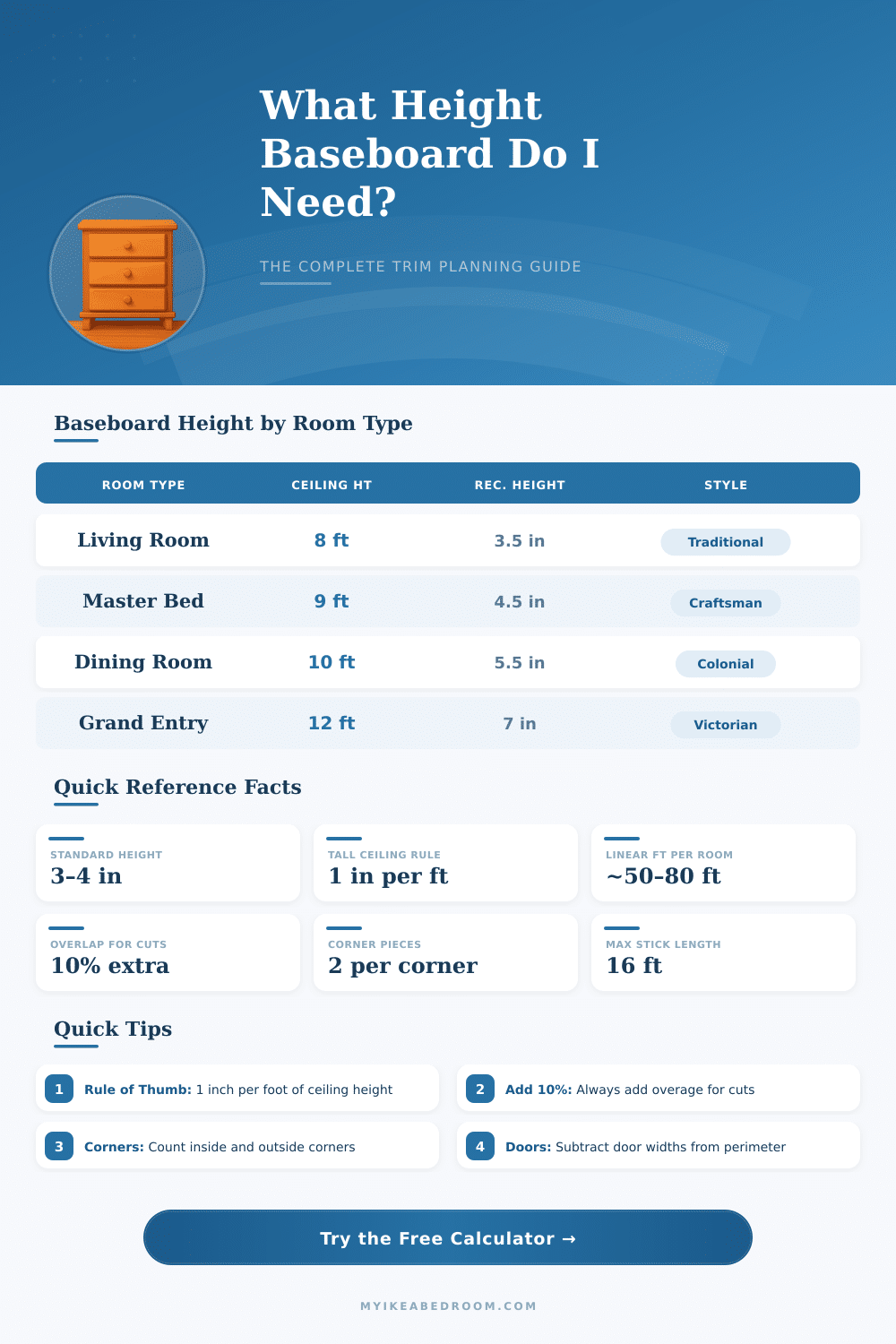
Here is practical advice, that commonly helps: the rule of 7 percent. In short words, the baseboard should ideally be 7 percent of the ceiling height. For a typical ceiling of 8 feet, that most houses have, that results in around 7 inches, what looks quite good.
Another way to approach the question is to consider the baseboard almost as the tenth part of the ceiling height. It is not a strict and fast rule, but it provides a reliable starting point, when one stands heer without a clear notion.
For ceilings of 12 feet, something around 10 inches or higher usually looks well balanced. Typical walls of 8 feet normally combine with baseboard between 3 and 5 inches. Ceilings of 10 feet need almost 5 until 7 inches.
I saw a sample with 5-inch baseboard at a wall of 10 feet, and it looked perfect. With ceilings of 9 feet, baseboard of 5.25 inches became very liked over the years.
The style does matter a lot hear. In traditional rooms one commonly chooses baseboard of 5 until 7 inches for standard ceilings of 8 feet. Modern places favor slimmer forms…
Around 3 until 4 inches. For that simple, minimal atmosphere. Transitional styles sit also, in 4 until 6 inches.
Rustic rooms tend to heavier options, in the range of 5 until 6 inches. Interestingly, in traditional houses one commonly stayed at 3.5 until 4 inches as standard. The mid-century modern style went the other way, with very low baseboard of 1.5 until 2 inches.
And the modern houses today? They range a lot, some entirely drop baseboard, others reach 8 inches.
The door trim changes the situation in this case. Standard width of door trim is between 2.25 and 3 inches. If one has internal doors or closet doors with trim, it is good to think whether to match its width with the height of the baseboard for good looks.
The door trim usually is thinner than baseboard. Thicker trim only appears around big doors and windows, where it looks right.
Carpet adds extra detail to the question. Most installers leave half an inch of space between the baseboard and average carpet. For thick carpet, a third of an inch is more usual.
Using half an inch of wooden base board as a base during the install helps to keep those spaces permanent. The carpet sits under the baseboard, while the turning parts stay before it. Funny enough, baseboard became taller over time partly because of that, that folks wanted to hide marks of paint, that stayed from smaller baseboard, that they replaced.
While you measure, remember that the height of baseboard includes both the mainboard itself andsome basic cap up.