🎨 Accent Wall Calculator
Calculate exact paint coverage for any accent wall shape — get gallons, coats & quarts needed
Coverage rates are per single coat on smooth drywall. Textured or porous surfaces reduce coverage by 15–25%.
| Surface Type | Coverage Multiplier | Reason | Extra Paint Needed |
|---|---|---|---|
| Smooth Drywall | 1.00× (baseline) | Sealed, non-porous | None |
| Textured / Orange Peel | 0.85× | Surface area increased | ~15% more |
| Exposed Brick | 0.65× | Highly porous & uneven | ~35% more |
| Wood Paneling / Shiplap | 0.80× | Grooves absorb paint | ~20% more |
| Concrete / Plaster | 0.75× | Porous surface | ~25% more |
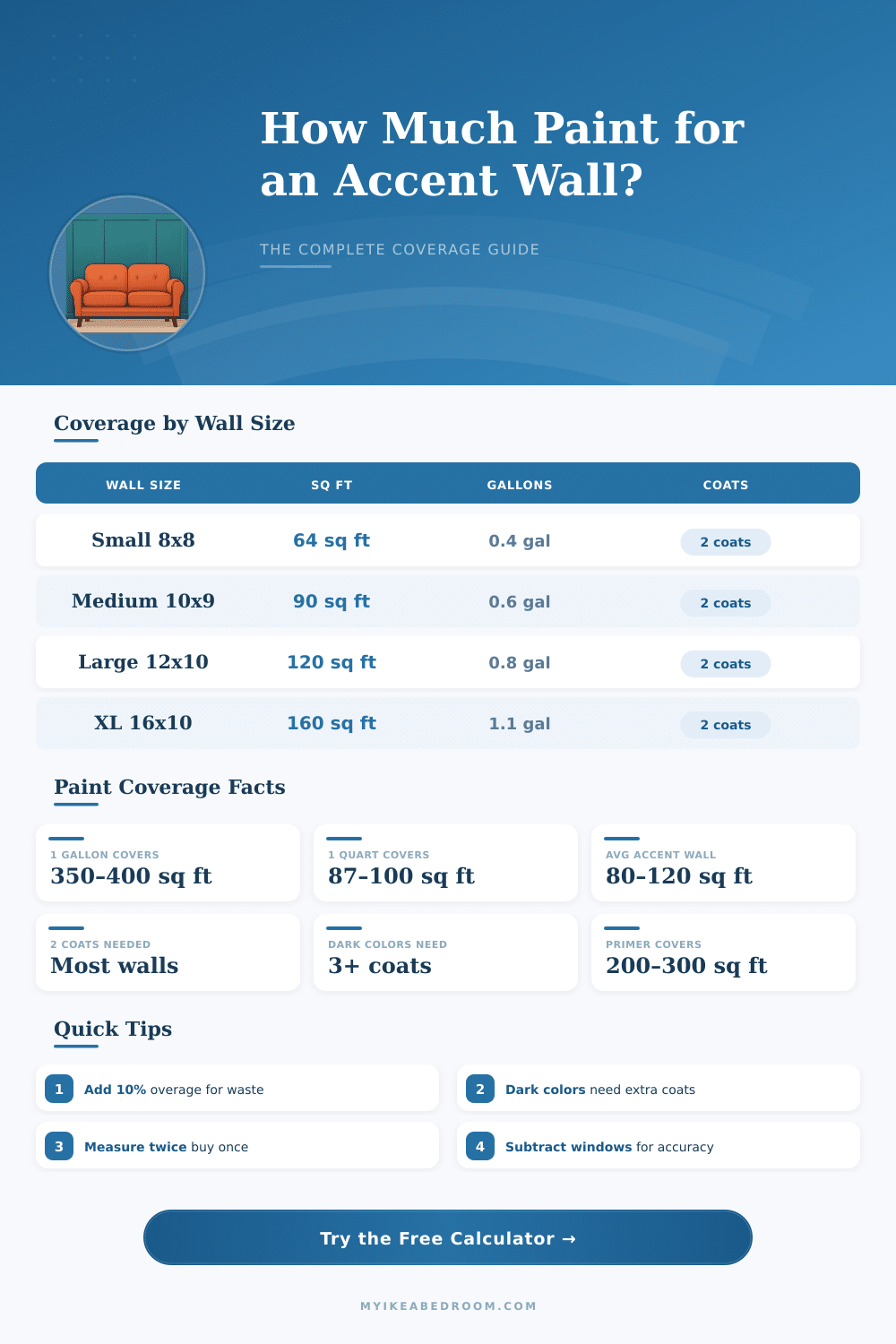
| Room / Wall | Wall Size (W × H) | Area (sq ft) | Gallons (1 coat) | Gallons (2 coats) | Metric (m²) |
|---|---|---|---|---|---|
| Small Bedroom | 8 × 8 ft | 64 sq ft | 0.18 gal | 0.36 gal | 5.95 m² |
| Standard Bedroom | 12 × 9 ft | 108 sq ft | 0.30 gal | 0.60 gal | 10.03 m² |
| Master Bedroom | 15 × 10 ft | 150 sq ft | 0.42 gal | 0.83 gal | 13.94 m² |
| Living Room | 16 × 10 ft | 160 sq ft | 0.44 gal | 0.89 gal | 14.86 m² |
| Great Room | 20 × 10 ft | 200 sq ft | 0.56 gal | 1.11 gal | 18.58 m² |
| Home Office | 10 × 9 ft | 90 sq ft | 0.25 gal | 0.50 gal | 8.36 m² |
| Hallway Feature | 6 × 8 ft | 48 sq ft | 0.13 gal | 0.27 gal | 4.46 m² |
| Dining Room | 14 × 9 ft | 126 sq ft | 0.35 gal | 0.70 gal | 11.70 m² |
Based on flat paint at 360 sq ft per gallon on smooth drywall.
| Container | Volume | Coverage (1 coat) | Coverage (2 coats) | Best For |
|---|---|---|---|---|
| Sample Pot | 8 fl oz (0.25 qt) | ~25 sq ft | ~12 sq ft | Swatch testing |
| Quart | 32 fl oz (0.95 L) | ~90 sq ft | ~45 sq ft | Small accent walls |
| Gallon | 128 fl oz (3.79 L) | ~360 sq ft | ~180 sq ft | Medium walls |
| 2-Gallon Pail | 256 fl oz (7.57 L) | ~720 sq ft | ~360 sq ft | Large walls |
| 5-Gallon Bucket | 640 fl oz (18.93 L) | ~1,800 sq ft | ~900 sq ft | Multiple rooms |
An accent wall simply is that, that stands out from the rest in the room. One can give it a different colour, a stronger shade or even another visual style. The main idea consists in creating a close focus, that right away attracts your look to that part of the space.
Over years designers and homeowners liked accent walls, because they allow to take risks by means of brave colour or pattern on only one wall, while the rest stay simple and neutral.
How to Choose and Use an Accent Wall
Choosing the wall has bigger influence, than many think. Usually, the first wall, that one sees entering through the door, is the best choice, or that, that naturally attracts the most attention. In a bedroom, the wall behind the headboard commonly works.
It works best when the accent wall lines up with the layout of your furniture. The clearest advice? Stick to one alone.
If you start to colour several walls by means of the accent wall style, the whole plan filas and the effect fades.
Choosing the colour is actually very easy. When your other walls are light, use a bright tone on the accent wall to create wonderful contrast. Clear, soft walls?
Then one can risk deeper and brave shades. Mind also, what already exists in the space. Choose colour from a painting or cushions too tie everything together.
For instance, beige walls nicely go with fresh tones, something in that warm beige simply charms. Brown gives a richer impression, that leaves a lasting visual mark.
Colour is not the only way, of course. Shiplap, boards with strips, wallpaper or wooden panels all work for a good accent wall. Wallpapers right now are very trendy, what sadly makes them quickly outdated.
A simple painted wall with some framed images stays always current. If you live there only for now? Use peel-and-stick wallpaper or big art, because they go easily without traces.
Important note that: your accent wall does not have to be a real wall. The ceiling also works well as an accent wall. Think about grass-cloth wallpaper up in a colour, that repeats the room’s palette.
That gives a strong look, without any regrets.
Designers disagree about whether accent walls are still current. Some insist, that they ended. Others say, that they shine, if one uses them carefully.
Deep red walls had their peak before, while panelled walls and ceiling-high wallpapers are the current hit. Bare brick, concrete-like panels and bright wooden shelves naturally fit in modern or industrial spaces. On the other hand, matte white paint with a simple framed image gives a minimal style.
Floating shelves, photo collections andhousehold items make the accent wall truly personal and unique.