🌡️ Baseboard Heater Calculator
Find the right wattage and heater length for any room — instant, accurate results
per sq ft
per sq ft
per sq ft
per sq ft
| Heater Length | Wattage (240V) | BTU/hr | Amps (240V) | Room Coverage (avg) |
|---|---|---|---|---|
| 2 ft | 500W | 1,706 | 2.1A | ~50 sq ft |
| 3 ft | 750W | 2,559 | 3.1A | ~75 sq ft |
| 4 ft | 1,000W | 3,412 | 4.2A | ~100 sq ft |
| 5 ft | 1,250W | 4,265 | 5.2A | ~125 sq ft |
| 6 ft | 1,500W | 5,118 | 6.3A | ~150 sq ft |
| 8 ft | 2,000W | 6,824 | 8.3A | ~200 sq ft |
| 10 ft | 2,500W | 8,530 | 10.4A | ~250 sq ft |
| 12 ft | 3,000W | 10,236 | 12.5A | ~300 sq ft |
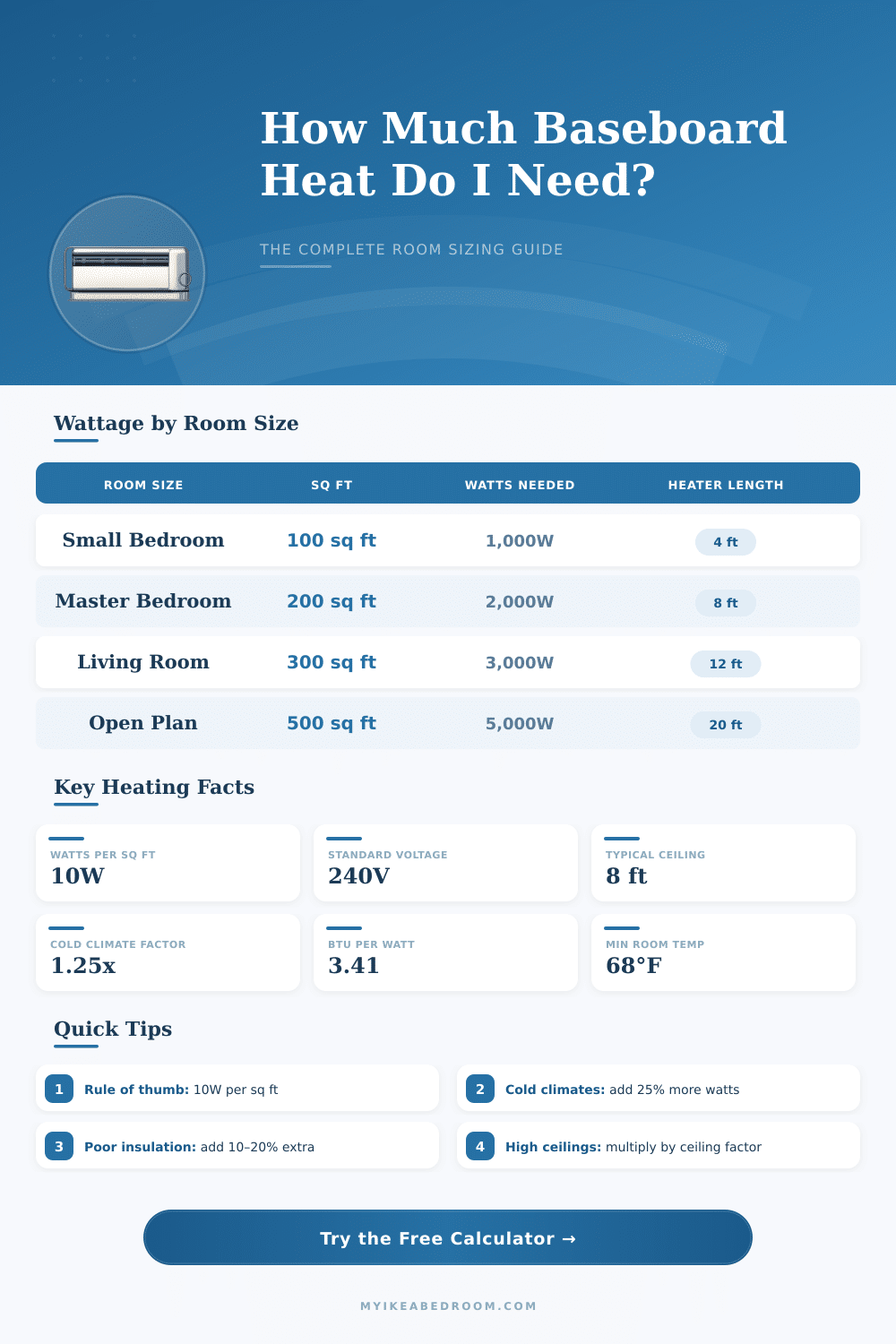
| Room Type | Dimensions | Area (sq ft) | Watts Needed | Heater Length |
|---|---|---|---|---|
| Small Bathroom | 5 × 8 ft | 40 sq ft | 400W | 2 ft |
| Small Bedroom | 10 × 10 ft | 100 sq ft | 1,000W | 4 ft |
| Average Bedroom | 12 × 14 ft | 168 sq ft | 1,680W | 6–8 ft |
| Master Bedroom | 14 × 18 ft | 252 sq ft | 2,520W | 10 ft |
| Living Room | 15 × 20 ft | 300 sq ft | 3,000W | 12 ft |
| Open Plan | 20 × 25 ft | 500 sq ft | 5,000W | Two 10 ft |
| Wattage Range | Voltage | Amperage | Breaker Size | Wire Gauge |
|---|---|---|---|---|
| Up to 1,500W | 240V | 6.3A | 15A | 14 AWG |
| 1,500 – 2,000W | 240V | 8.3A | 15A | 14 AWG |
| 2,000 – 3,000W | 240V | 12.5A | 20A | 12 AWG |
| 3,000 – 4,000W | 240V | 16.7A | 20A | 12 AWG |
| 4,000 – 6,000W | 240V | 25.0A | 30A | 10 AWG |
Baseboard Heater units work by warming air at the level of the floor, and the warm air naturally rises upward to move around your room. They work well to add extra heat in places where it is most needed. The way Baseboard Heater units work is pretty simple, they pull fresh air from near the floor pass it over electrically heated metal fins and then release the heated air into the room.
This whole process of air flow? Here it is, heat movement in practice.
How Baseboard Heaters Work and Simple Tips
You have two main choices to pick from. Electric Baseboard Heater units make heat using electricity directly, while water-based Baseboard Heater units work differently, moving warm water through tubes with fins. The water travels warmly through the tubes itself, then spreads from those fins into your spaces.
Worth noting is that water-based models tend to feel more comfrotable, because they have a heat storage advantage; the Baseboard Heater keeps spreading heat even when the thermostat turns off the system.
For owners of homes that want something more quick and steady than carrying around portable heaters for spaces, Baseboard Heater units hit the ideal place. They are easily installed, do not require vents or ductwork and work well with a thermostat to control the temperature. You find them working well in bedrooms, rooms, kitchens, bathrooms, basements, offices, hallways and even meeting rooms.
What owners of homes commonly like most is how quietly and reliably they give steady, even heat.
Here is something that commonly surprises folks: every electric heater puts out the same amount of heat per watt, whether you talk about ceramic heaters, fan models, Baseboard Heater units or oil-filled devices. All that electric energy turns directly into heat. No waist happens.
Even so, heat from electric Baseboard Heater units usually ends up being the most costly way to warm spaces. Most Baseboard Heater units are connected to 220 volts and use more watts than average plug-in heaters, which allows them to serve bigger rooms.
Before installing any unit, you will want to figure out the right size and power in watts. From my experience, around ten watts per square foot works as a good starting spot. A room of a hundred square feet needs around a thousand watts.
One spot that commonly confuses folks is that Baseboard Heater units count as a constant load, so you must increase the size of the safety by around 25 percent.
The issue with furniture gets a bit tricky though. Most Baseboard Heater units need at least one or two feet of free space for breathing, for safety and efficiency. I saw folks build platforms to raise shelves over the Baseboard Heater units or hang wall-mounted cabinets at the right height to clear them.
Another way is to cut a section where the Baseboard Heater stands. Adding a grate behind trim or coverings helps so that the air flows flat. The main concern here is risk of fire (those devices can get very warm).
If you want to upgrade, small splits canbe even three times more efficient.