🪟 Wainscoting Calculator
Estimate panels, rails, stiles, and linear footage for any room — imperial or metric
| Height Style | Height (in) | Height (cm) | Best For |
|---|---|---|---|
| Low / Baseboard | 18–24 in | 46–61 cm | Modern minimal look |
| Standard Dado | 30–36 in | 76–91 cm | Most rooms, classic look |
| Chair Rail | 32–38 in | 81–97 cm | Dining rooms, hallways |
| Tall Panel | 42–48 in | 107–122 cm | Formal rooms, foyers |
| Full Height | 84–96 in | 213–244 cm | Libraries, grand spaces |
| Panel Width | Panels per 8 ft Wall | Linear Ft Used | Typical Style |
|---|---|---|---|
| 12 in (30 cm) | 8 panels | 8 lf | Beadboard, narrow |
| 18 in (46 cm) | 5–6 panels | 8 lf | Shaker, flat panel |
| 24 in (61 cm) | 4 panels | 8 lf | Standard raised panel |
| 30 in (76 cm) | 3–4 panels | 8 lf | Wide panel, craftsman |
| 36 in (91 cm) | 3 panels | 8 lf | Bold, oversized style |
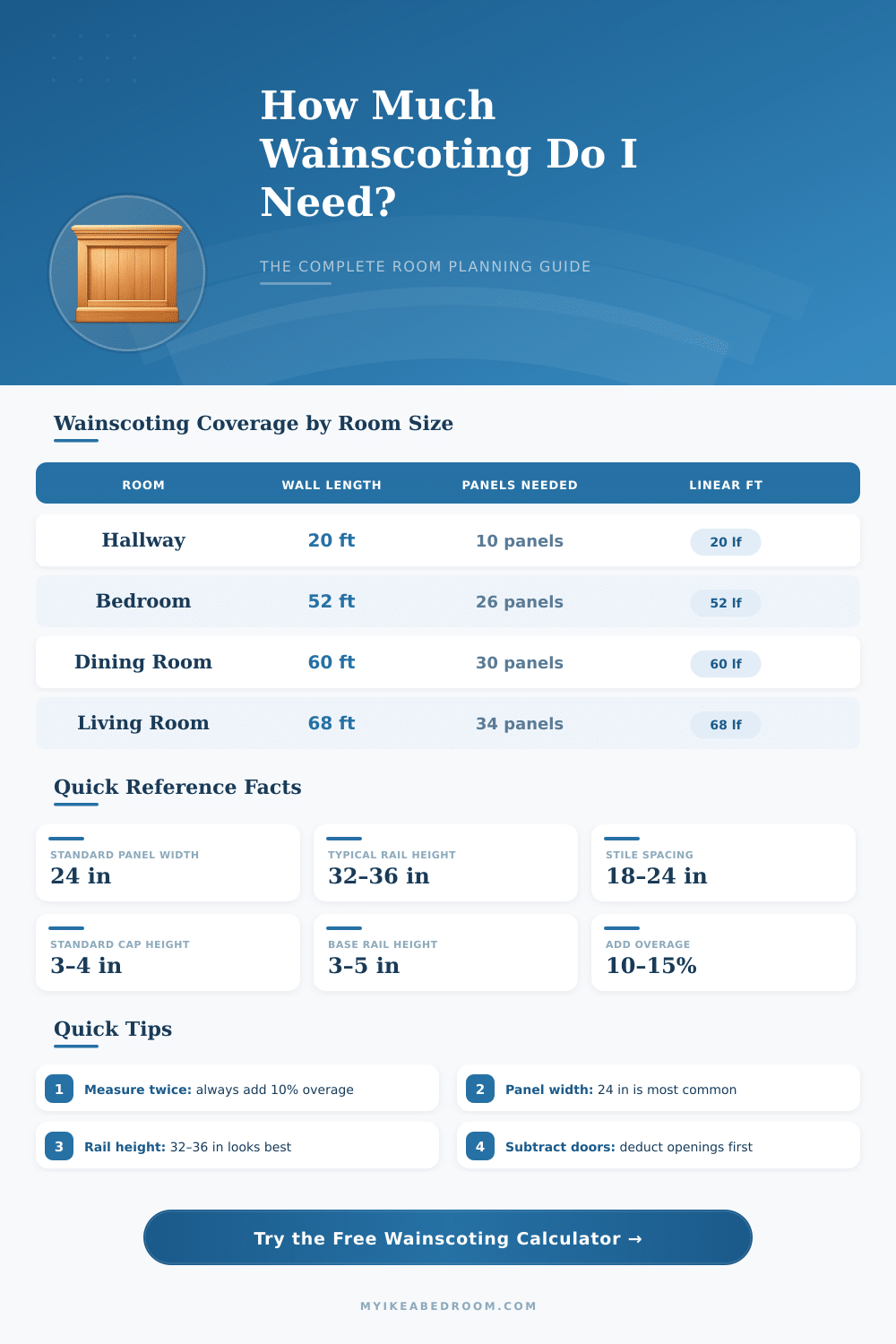
| Room | Perimeter | Wall Area | Panels (24 in) |
|---|---|---|---|
| Small Bath (8x6) | 28 lf | 84 sq ft | 14 panels |
| Hallway (13x5) | 36 lf | 108 sq ft | 18 panels |
| Bedroom (12x10) | 44 lf | 132 sq ft | 22 panels |
| Living Room (15x12) | 54 lf | 162 sq ft | 27 panels |
| Dining Room (14x12) | 52 lf | 156 sq ft | 26 panels |
| Great Room (20x18) | 76 lf | 228 sq ft | 38 panels |
Wainscoting probably comes from the 14th century in the Netherlands, where it did two useful functions. It not simply decorated for visible pleasure. Also it protected the lower parts of walls against wear and tears, while it kept heat in the houses.
The word probably comes from a German expression for “wall-board” and that one sees: it first related to a particular kind of oak called wainscot oak. Although woodworkers used other materials, that old name never entirely disappeared.
What Is Wainscoting?
At the base, wainscoting simply is fancy paneling on the bottom part of a wall. It gives visual richness and texture to otherwise poor surfaces by means of wooden panels. One can choose minimal…
Cover only a quarter of the wall… Or go more boldly and cover three quarters or even more. Here counts a rough rule: when the panels involve at least a third of the vertical height of floor to ceiling and stand equally, then you probably deal with wainscoting.
The choices of style are almost endless. Beaded board, raised panels, flat panels, board with rails, and cottage style, choose according to taste. “Flat panels” commonly are mentioned, but honest, the word wainscoting itself stays a bit loose when one tries to set a precise definition.
It existed as anything wooden, what covered the sides of walls four heat. Over time, that grew into clear designs.
Here a funny cause: decorators close to budget found creative ways to copy the look. Some used picture frames from IKEA to reach the beauty, what beats the expense of a professional craftsman. That way can cost a lot, especially in lands like Italy.
One folk takes VIRSERUM photo frames and picture rails, and tied them into framed wainscoting for a fraction of the price. The final product looked genuinely elegant. Another clever method is made up of buying leftover wainscoting from big stores and use it to decorate upper kitchen island onIKEA-basic furniture.
Wainscoting works in zones with a lot of motion, like hallways, staircases and corridors, places where walls suffer from bumps and fingerprints. It works as a guard against scratches and blows. Padded wainscoting offers an option, if one wants a soft cushion against shocks.
It answers also in calm areas like a home office, where it adds a refined, careful feel to the room. Genuinely, sometimes it seems old, but fresh coats of colour revive it without the trouble of removing. Removing it creates a lot of extra work and damage to walls.
Because wainscoting yet does its original task, it will not disappear soon.
Modern panels commonly are done from moisture-resistant MDF. If one is handy with a saw and has a pocket-jig, the installation is entirely worthwhile. Online design tools even allow you to customize the panels in moments.