📚 Bookshelf Spacing Calculator
Find the ideal shelf spacing, number of shelves, and shelf count for any bookcase or shelving unit
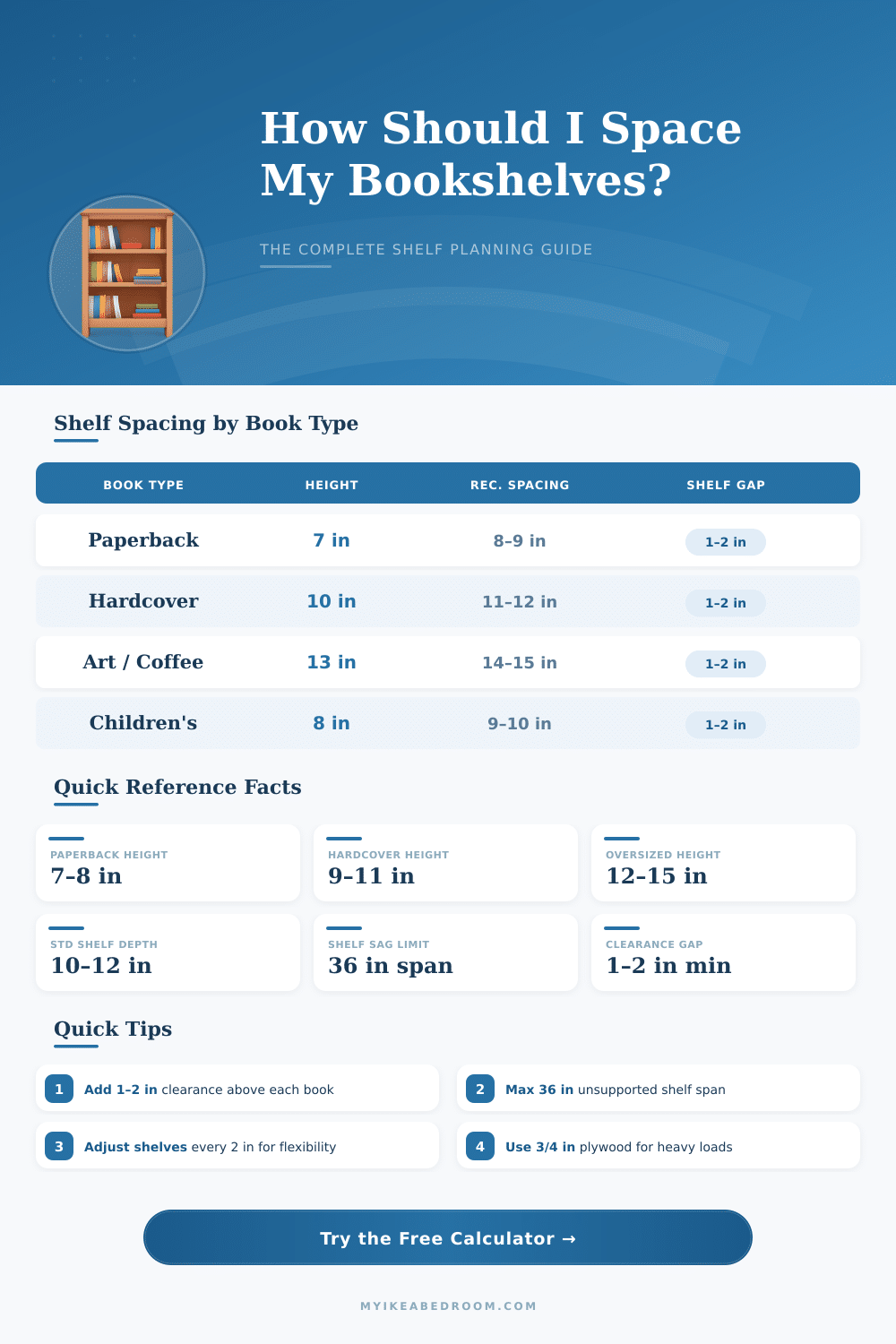
| Item Type | Avg Height | Rec. Clear Spacing (in) | Rec. Clear Spacing (cm) | Min Clearance |
|---|---|---|---|---|
| Mass Market Paperback | 6.75 in | 8 – 9 in | 20 – 23 cm | 1 in |
| Trade Paperback | 9 in | 10 – 11 in | 25 – 28 cm | 1 in |
| Standard Hardcover | 9.5 in | 11 – 12 in | 28 – 30 cm | 1.5 in |
| Oversize Hardcover | 11 in | 12.5 – 13 in | 32 – 33 cm | 1.5 in |
| Coffee Table / Art Book | 13 in | 14.5 – 15 in | 37 – 38 cm | 1.5 in |
| Children's Picture Book | 8 in | 9.5 – 10 in | 24 – 25 cm | 1 in |
| Magazines | 11 in | 12 – 13 in | 30 – 33 cm | 1 in |
| DVD Cases | 7.5 in | 8.5 – 9 in | 22 – 23 cm | 1 in |
| Binders / Folders | 12 in | 13 – 14 in | 33 – 36 cm | 1 in |
| Display / Decor Items | Varies | +2 – 3 in above item | +5 – 8 cm | 2 in |
| Unit Height | 9 in Spacing | 11 in Spacing | 13 in Spacing | 15 in Spacing |
|---|---|---|---|---|
| 48 in (122 cm) | 4 shelves | 3 shelves | 2 shelves | 2 shelves |
| 60 in (152 cm) | 5 shelves | 4 shelves | 3 shelves | 3 shelves |
| 72 in (183 cm) | 6 shelves | 5 shelves | 4 shelves | 3 shelves |
| 84 in (213 cm) | 7 shelves | 6 shelves | 5 shelves | 4 shelves |
| 96 in (244 cm) | 8 shelves | 7 shelves | 6 shelves | 5 shelves |
| Material | Thickness | 24 in Span | 36 in Span | 48 in Span |
|---|---|---|---|---|
| 3/4 in Plywood | 3/4 in | 80 lb | 50 lb | 30 lb |
| 3/4 in MDF | 3/4 in | 60 lb | 30 lb | 15 lb |
| Solid Pine | 3/4 in | 70 lb | 40 lb | 20 lb |
| Solid Oak | 3/4 in | 100 lb | 70 lb | 45 lb |
| Melamine | 3/4 in | 55 lb | 25 lb | 12 lb |
| Tempered Glass (3/8 in) | 3/8 in | 40 lb | 20 lb | N/A |
| Bamboo | 3/4 in | 85 lb | 55 lb | 35 lb |
The spacing between the shelves of a bookshelf matter more than many folks believe. It affects the general look of the setup and the use of the whole. Although it seems only a small thing even so it fits to change the feel of the room and the use of the shelves themselves.
One of the main reasons for care about that is the visual harmony.
How to Space Shelves on a Bookshelf
A bookshelf looks best when between the top of a book and the shelf above is only little space. If the spaces are too big, the spacing seems messy and chaotic. Of course, everything depends at the end on personal taste.
For adjustable shelves, a useful method is to add one or two levels with less space for average pamphlets. Later, one lays one shelf with bigger height for large books or decorative objects. For the rest one uses average spacing.
That mode of different spaces allows to store more books than evenly arranged shelves. Around thirteen inches wroks for big illustrated books, while nine to ten inches suit for most of the others.
Shelves that are too short for the books on them look bad. And too high spaces create a weird look that does not match with the rest of the room. When one reads more than only poetry and small pamphlets, tiny or space-saving bookshelves commonly end up too shallow.
To store more books, one can separate the shelves a bit more and lay a block behind the books to raise them. Like this a second row fits in front, so at least half of every spine shows. Even so, that requires more space above the raised row, so one must consider that.
Some favour a smooth grade of less tall shelves up until broader below. For instance, the two bottom shelves with fifteen inches of space, and later same spaces for the next, give a nice look. Others like that the bottom shelf sits fourteen inches from the upper, to fit big kids’ books, with different spaces for the rest.
Add two higher spaces on a bookshelf to help with sculptures and decorations. Shelves meant only for books usually have only one foot of depth. Most bookshelves leave one to six inches from the floor before the first shelf.
Wider shelves bend under weight of books, so keeping every part to two feet of span is a wise idea. Laying backing support or vertical dividers in gaps helps with bigger shelves and stops theirwarp over time.