🪟 Wainscoting Spacing Calculator
Calculate panel count, equal spacing, rail heights & stile widths for any wall
| Wall Width | Typical Panels | Ideal Panel Width | Stile Width |
|---|---|---|---|
| 48" (4ft) | 2–3 | 14"–18" | 2.5" |
| 72" (6ft) | 3–4 | 14"–18" | 2.5" |
| 96" (8ft) | 4–5 | 14"–18" | 3" |
| 120" (10ft) | 4–6 | 16"–20" | 3" |
| 144" (12ft) | 5–7 | 16"–22" | 3.5" |
| 168" (14ft) | 6–8 | 16"–22" | 3.5" |
| 192" (16ft) | 7–9 | 18"–24" | 4" |
| 240" (20ft) | 8–11 | 18"–24" | 4" |
| Style | Rail Width | Stile Width | Min Panel Width |
|---|---|---|---|
| Raised Panel | 3.5"–4" | 3"–3.5" | 14" |
| Flat Panel | 3"–3.5" | 2.5"–3" | 12" |
| Beadboard | 3"–4" | 2.5"–3" | N/A |
| Board & Batten | 4"–5" | 1.5"–2" | N/A |
| Shiplap | 3.5"–4.5" | N/A | N/A |
| Tongue & Groove | 3"–4" | N/A | N/A |
| MDF Craftsman | 3.5"–4.5" | 2.5"–3.5" | 12" |
| Overlay / Picture Frame | 3"–4" | 2.5"–3" | 10" |
| Wall Height | 33% (Low) | 38% (Standard) | 50% (Tall) |
|---|---|---|---|
| 84" (7ft) | 28" | 32" | 42" |
| 96" (8ft) | 32" | 36" | 48" |
| 108" (9ft) | 36" | 41" | 54" |
| 120" (10ft) | 40" | 46" | 60" |
| 132" (11ft) | 44" | 50" | 66" |
| 144" (12ft) | 48" | 55" | 72" |
Get right spacing for wainscoting can be difficult, especially when the walls in the room have different lengths. That is the main problem that many folks struggle with. In dining rooms, for instance, one wall maybe has a big window, other a sliding door, and the third little windows.
Because of that, every wall requires its own arrangement.
How to Space Wainscoting Panels and Styles
A calculator for wainscoting really is useful this way. Entering the width of panel it computes the exact size that can be well spaced on the wall. It shows also where the styles must go for those planned panel sizes.
Such tools allow you to estimate the spaces between panels and styles, together with the edge measures that you must have so that everything looks equal and nice. If you already know the wanted width of panel, you can count also the width of styles.
Here is something that surprises many folks. The spacing does not necessarily have to be the same on every wall. A difference of one to two inches between the walls is almost unnoticeable.
So one wall can end with spacing of around 28 inches between styles, while another is nearer to 31 inches. That tiny difference simply blends with the whole.
wainscoting on every wall has a different number of panels and styles. Here is the reason: you must start with a style and end with a style. The spaces between the boxes or frames can range between two and three-quarter inches to three and half inches.
Preserve the same spacing around the hole room to make it a linking element. Even if the panels end with a bit different sizes, it still looks well.
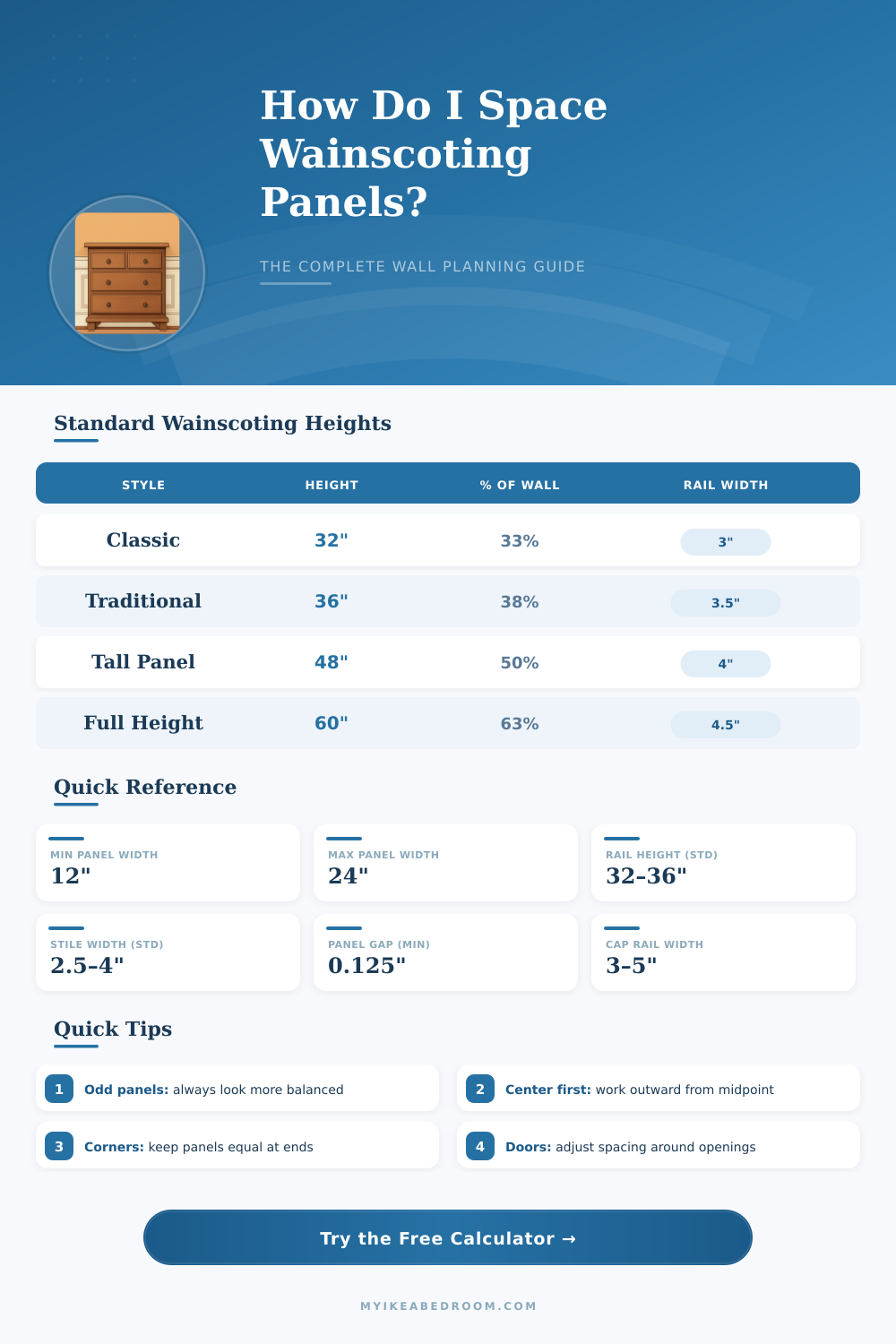
About height, the wainscoting panels usually cover the wall to the height of chair rail, which is around 30 to 42 inches above the floor. This works well in kitchens, breakfast rooms and dining rooms, where the panels protect the wall and look nice. Traditional paneling commonly reaches the chair rail height or around three-quarters of the wall height.
Choosing a random height most commonly does not look right. The rail mold up top should be less broad than the base, and the styles with rails must line up between themselves. There are not strict rules for height against length of panels, even so.
The spacing between styles can vary. Some rooms work with 3-inch spacing, others with 4 inches or even 4.5 to 5 inches. Something above 8 inches looks strange.
The panels themselves also can have different sizes, when folks mix for instance 24-inch widths with 36-inch. Always make sure that the base is level before you start, because everything builds upward from that. Alwaysmeasure the wall in inches for the most exact results.