🔧 Garage Door Spring Size Calculator
Find the correct torsion or extension spring for your garage door — enter door measurements and weight for instant specs.
~75–95 lbs
~95–115 lbs
~115–135 lbs
~135–155 lbs
~155–175 lbs
~175–200 lbs
~200–225 lbs
225+ lbs
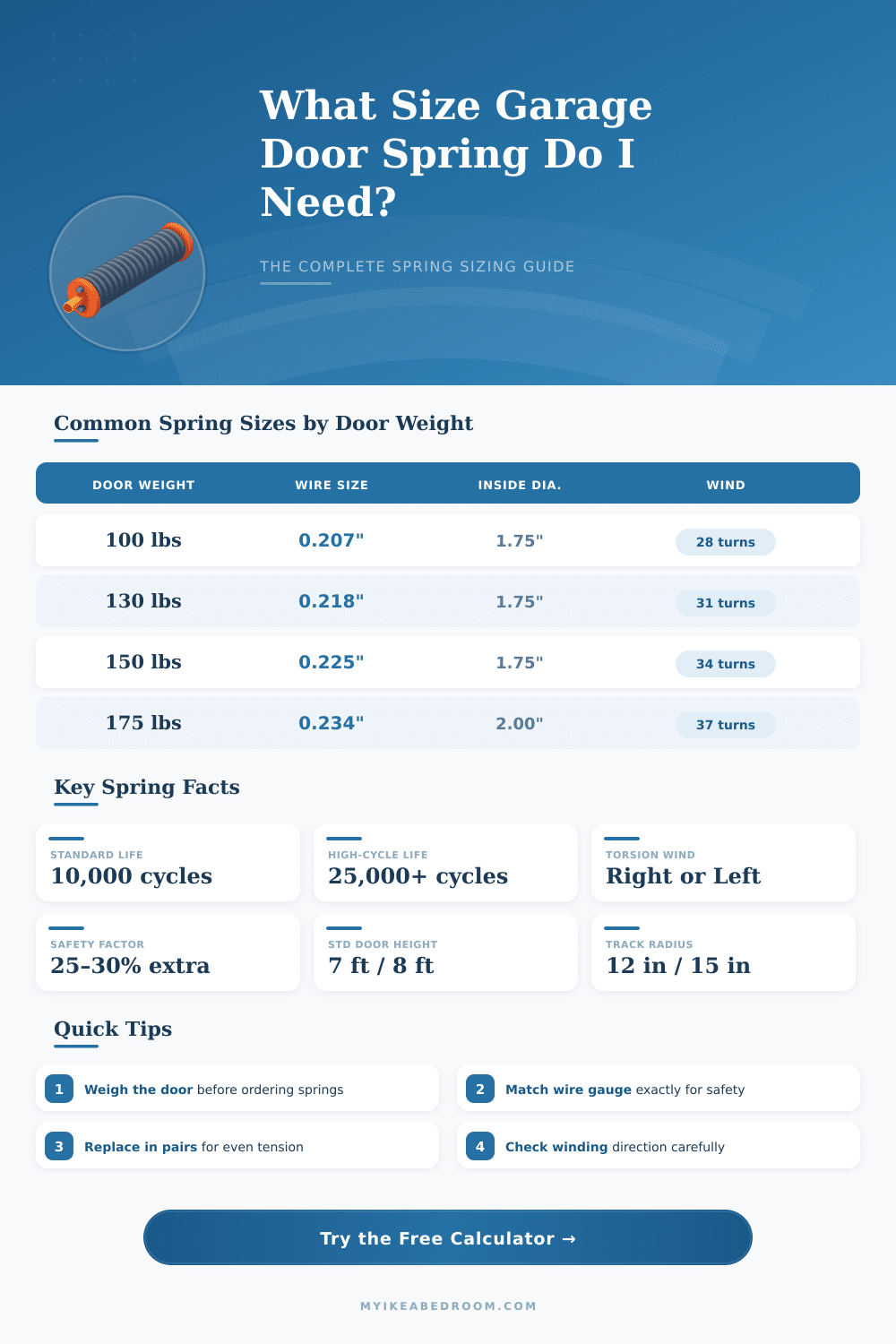
| Door Weight | Wire Size | Inside Dia. | Spring Length | Turns (7ft) | Turns (8ft) |
|---|---|---|---|---|---|
| 75–95 lbs | 0.192" | 1.75" | 22–24" | 25 | 28 |
| 95–115 lbs | 0.207" | 1.75" | 24–26" | 28 | 31 |
| 115–135 lbs | 0.218" | 1.75" | 26–28" | 31 | 34 |
| 135–155 lbs | 0.225" | 1.75" | 28–30" | 34 | 37 |
| 155–175 lbs | 0.234" | 2.00" | 30–32" | 37 | 40 |
| 175–200 lbs | 0.243" | 2.00" | 32–34" | 40 | 43 |
| 200–225 lbs | 0.250" | 2.00" | 34–36" | 43 | 46 |
| 225+ lbs | 0.262" | 2.00" | 36–40" | 46 | 50 |
| Material Type | Single Door Wt. | Double Door Wt. | Weight / sq ft |
|---|---|---|---|
| Steel Single-Layer | 90–115 lbs | 150–180 lbs | ~1.2 lbs |
| Steel Double-Layer | 110–135 lbs | 175–210 lbs | ~1.6 lbs |
| Steel Triple-Layer | 130–160 lbs | 200–250 lbs | ~2.0 lbs |
| Solid Wood | 200–300 lbs | 350–500 lbs | ~3.5 lbs |
| Wood Carriage Style | 175–250 lbs | 300–450 lbs | ~3.0 lbs |
| Aluminum | 80–100 lbs | 130–165 lbs | ~1.0 lbs |
| Fiberglass | 75–95 lbs | 120–155 lbs | ~0.9 lbs |
| Vinyl | 85–110 lbs | 140–175 lbs | ~1.1 lbs |
| Track Radius | Door Height 7ft | Door Height 8ft | High-Lift Adj. |
|---|---|---|---|
| 10" (Low Headroom) | 31 turns | 34 turns | +3 turns/ft |
| 12" (Standard 7ft) | 28 turns | 31 turns | +3 turns/ft |
| 15" (Standard 8ft) | 25 turns | 28 turns | +3 turns/ft |
| 18" (High Lift) | 22 turns | 25 turns | +3 turns/ft |
| Spring Inside Dia. | Drum Size | Cable Size | Common Use |
|---|---|---|---|
| 1.75" | 4" standard drum | 1/8" cable | Light to medium doors |
| 2.00" | 4" standard drum | 3/16" cable | Medium to heavy doors |
| 2.25" | 6" high-lift drum | 3/16" cable | Heavy/high-lift doors |
| 3.00" | Commercial drum | 1/4" cable | Commercial heavy doors |
Choosing the right size for garage door spring genuinely matters a lot. When springs break, the openers of the garage door will not work, and the door will not open correctly. Broken springs form the second most common repair for garage doors here.
The size of torsion spring determines the weight of the garage door itself. Here the main point that one must keep in mind. The length of the door does not have big influence, except for count, as far as long springs fit between the drums.
How to Choose the Right Garage Door Spring
Like this, for door of 16×7 or 16×8, the size of springs depends on the weight of the door.
To find the weight of the door, one can simply use a heavy scale from the bathroom. Raise the garage door two inches and lay under its center an average bathroom scale. For instance, sectional door of 18 feet by 7 feet can weigh around 176 pounds.
A separate door of 8×16 can raech 180 pounds or even more. A single garage door commonly weighs around 165 pounds. Those values change a lot according to the material of the door and whether it carries insulation or windows.
To measure torsion spring, some details help to reach the write result. One measures the length of ten or twenty coils in inches. Later, one compares this length with chart of torsion springs to find the right wire size.
Measure ten coils to the nearest 1/16 of inch, convert the fraction to decimal and divide by ten. Like this one gets the wire size. Also the internal diameter of the spring plays a role.
Common wire sizes are.225,.235,.243 and many others, that range to bigger or smaller values.
The length, diameter and strength of springs must match the weight of the door and the system to raise it. Springs that do not match can be genuinely dangerous. During replacement, best to swap both and use identical ones.
There are hundreds of different springs for garage doors. A pair of springs must not always be entirely same. Sometimes the total force of the pair matches the weight of the door in the way that it needs to run.
The spring of garage door helps to balance the weight of the door, which makes it more simply open and close. In the industry, the standard life of cycles is 10,000. Springs under that limit are considered too stretched and not advised.
Bigger wire size allows more cycles. If one wants more than 10,000 cycles, the new springs need bigger wire size. Also the diameter of the spring affects its length.
For door of seven feet high, a 34-inch spring from.250 wire would stretch in eight coils during wind and tension. Springs usually tighten an extra 1/8 of inch. A 28-inch spring rather than a 25-inch on same door needs fewer turns for good balance.
Some folks try to replace thespring themselves, but others strongly advise to leave that to expert technicians, because even old or too small spring can cause serious wound.