📐 Crown Molding Calculator
Calculate linear feet, stick counts, miter angles & overage for any room shape
Most paintable
Easy to paint
Moisture resistant
Best for bathrooms
Stainable grain
Budget-friendly
Heaviest option
Archways
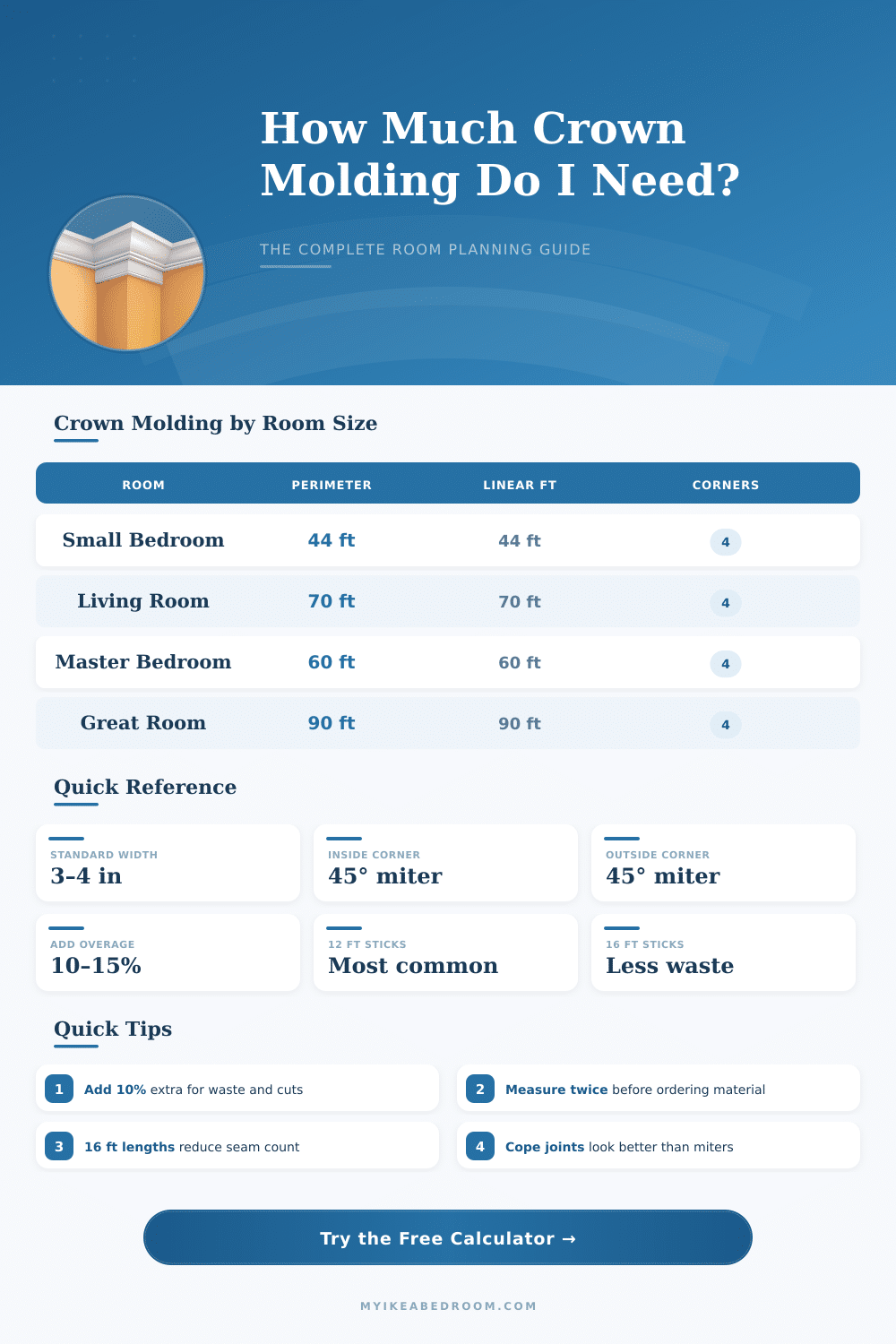
| Room Size | Perimeter (ft) | Net Lin Ft | +10% Total |
|---|---|---|---|
| 8 x 8 | 32 ft | 26 ft | 28.6 ft |
| 10 x 10 | 40 ft | 34 ft | 37.4 ft |
| 12 x 12 | 48 ft | 42 ft | 46.2 ft |
| 12 x 14 | 52 ft | 46 ft | 50.6 ft |
| 14 x 16 | 60 ft | 54 ft | 59.4 ft |
| 15 x 20 | 70 ft | 64 ft | 70.4 ft |
| 18 x 20 | 76 ft | 70 ft | 77 ft |
| 20 x 25 | 90 ft | 84 ft | 92.4 ft |
* Net assumes 1 door (3 ft wide) deducted.
| Lin Footage | 8 ft Sticks | 12 ft Sticks | 16 ft Sticks |
|---|---|---|---|
| 30 ft | 4 | 3 | 2 |
| 40 ft | 5 | 4 | 3 |
| 50 ft | 7 | 5 | 4 |
| 60 ft | 8 | 5 | 4 |
| 70 ft | 9 | 6 | 5 |
| 80 ft | 10 | 7 | 5 |
| 90 ft | 12 | 8 | 6 |
| 100 ft | 13 | 9 | 7 |
* Includes 10% overage. Always round up.
| Corner Type | Wall Angle | Miter Cut | Bevel Cut |
|---|---|---|---|
| Inside 90° | 90° | 45° | Flat (coped) |
| Outside 90° | 90° | 45° | 45° |
| Inside 135° | 135° | 22.5° | 22.5° |
| Outside 135° | 135° | 22.5° | 22.5° |
| Butt Joint | 180° | 90° | 0° |
| Cathedral | Varies | Custom | Custom |
| Project | Lin Ft | 12 ft Sticks | Inside Corners |
|---|---|---|---|
| Small Bath | 22 ft | 2 | 4 |
| Home Office | 37 ft | 4 | 4 |
| Bedroom | 46 ft | 5 | 4 |
| Living Room | 64 ft | 6 | 4 |
| Open Concept | 90 ft | 9 | 6+ |
| Full Floor | 180 ft | 17 | 12+ |
Crown molding is a kind of decoration that installs at the upper part of an inner wall. One can also lay it above gates, windows, pillars and cabinets. The writing style ranges according to the place.
In British and American language one commonly writes it as “crown molding”. Anyhow, it relates to the same object.
Crown Molding: What It Is and How to Use It
One finds many different styles to choose. Dental crown molding shows a series of equally spaced rectangular blocks, that stick out. Egg-dart molding has a repeating pattern from egg-shaped ovals with a mix of arrow-pointed elements.
There are also Art Deco styles and moldings designed for soft lighting. The range goes from entirely simple to genuinely fancy.
Crown molding applies to whole rooms, to create a clean and tied look. One can stain or paint it, to match with any decoration. The main idea is that the ceiling sticks out, and creates a nice shift from the wall to the ceiling.
White crown molding is popular, because it stresses the color instead of blending with it, which gives a rich look with a clear line between vertical wall and horizontal ceiling.
A practical reason for using crown molding is, that houses move over time. Wall changes and cracks can appear, especially at the joint, wear wall meets ceiling. Crown molding hides those flaws.
It became purely fancy around the 1950s, when drywall came in, because that created smooth joints. After that, cheaper buildings commonly dropped it, although in fancier homes one still used it.
Crown molding does not always work for everything. If the room has a cathedral ceiling or sloped ceilings, normal crown molding probably will not look right. It works better with ceilings higher than usual.
On the other hand, it can give a finished look to any space, even modern. There are many profiles in various heights, widths and depth.
Installing crown molding is one of the harder trim jobs. Setting it in corners instead of cutting miter joints, one favors that method. It requires patience.
Some companies now offer systems friendly to do-it-yourself work, that need almost no skill in woodworking. There are even patented cutting systems, that make the installation much simpler for newcomers. Foam and light variants are available, and they can look almost like painted wood, unless someone touches themfrom close up.
Crown molding works well also on cabinets. Adding it on top of kitchen cabinets gives them a built, custom look. Pre-made crown molding can cost a lot, but building it from basic panels and thinner trim pieces is a more affordable option.