🪵 Pressure Treated Lumber Weight Calculator
Calculate total weight of pressure treated lumber by board size, species, quantity & moisture content
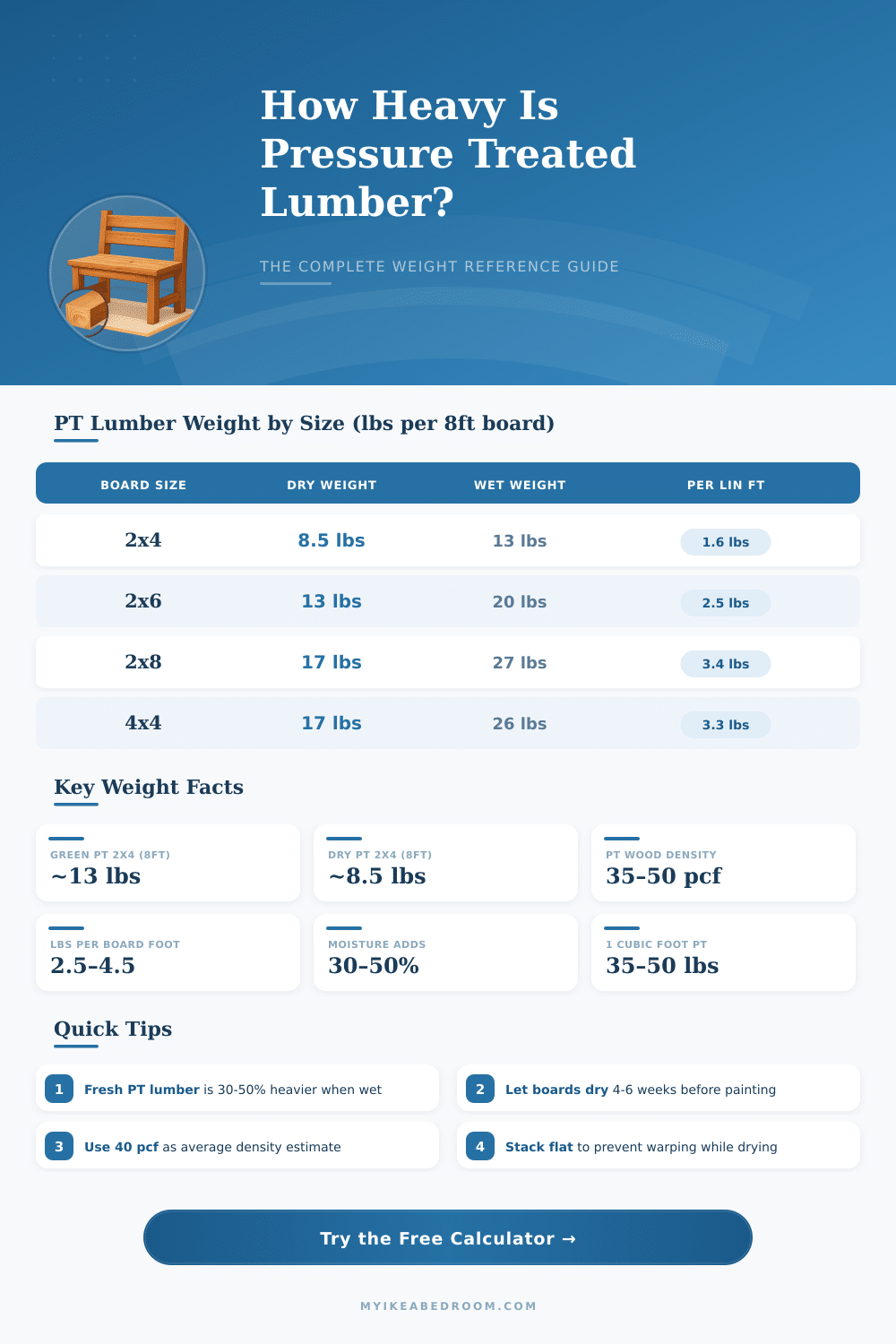
| Board Size | 8 ft (Green) | 8 ft (Dry) | 12 ft (Green) | 16 ft (Green) |
|---|---|---|---|---|
| 2x4 | 13 lbs | 8.5 lbs | 19.5 lbs | 26 lbs |
| 2x6 | 20 lbs | 13 lbs | 30 lbs | 40 lbs |
| 2x8 | 27 lbs | 17 lbs | 40 lbs | 53 lbs |
| 2x10 | 33 lbs | 21 lbs | 50 lbs | 66 lbs |
| 2x12 | 40 lbs | 25 lbs | 60 lbs | 80 lbs |
| 4x4 | 26 lbs | 17 lbs | 39 lbs | 52 lbs |
| 4x6 | 39 lbs | 25 lbs | 58 lbs | 78 lbs |
| 6x6 | 59 lbs | 38 lbs | 88 lbs | 118 lbs |
| Nominal Size | Actual Width (in) | Actual Thickness (in) | Cross-Section (sq in) |
|---|---|---|---|
| 2x4 | 3.5 | 1.5 | 5.25 |
| 2x6 | 5.5 | 1.5 | 8.25 |
| 2x8 | 7.25 | 1.5 | 10.875 |
| 2x10 | 9.25 | 1.5 | 13.875 |
| 2x12 | 11.25 | 1.5 | 16.875 |
| 4x4 | 3.5 | 3.5 | 12.25 |
| 4x6 | 5.5 | 3.5 | 19.25 |
| 6x6 | 5.5 | 5.5 | 30.25 |
| 6x8 | 7.5 | 5.5 | 41.25 |
| 4x8 | 7.25 | 3.5 | 25.375 |
| Board Size | 8 ft | 10 ft | 12 ft | 16 ft |
|---|---|---|---|---|
| 2x4 | 5.33 BF | 6.67 BF | 8 BF | 10.67 BF |
| 2x6 | 8 BF | 10 BF | 12 BF | 16 BF |
| 2x8 | 10.67 BF | 13.33 BF | 16 BF | 21.33 BF |
| 2x10 | 13.33 BF | 16.67 BF | 20 BF | 26.67 BF |
| 4x4 | 10.67 BF | 13.33 BF | 16 BF | 21.33 BF |
| 6x6 | 24 BF | 30 BF | 36 BF | 48 BF |
Pressure treated lumber seems much more heavy than other types of wood, and there is a simple reason for that. Most of such wood comes from southern yellow pine, that already has a bit of natural weight. However the main cause of that extra mass is the water that goes deeply in the fibers of the wood during the process of treatment.
Here is how the pressure treatment works: chemicals for keeping mix with water and are pumped in the wood under strong pressure. That method puts a big amount of moisture in the material. New pressure treated lumber, that one calls “green” wood, holds a whole ton of free water, what pushes it much more heavy than one would hope.
Why Pressure Treated Wood Is Heavy
Undried board can weigh almost three pounds more each foot than untreated wood of same type.
The level of moisture really matters, as far as heavy is the wood. As the water slowly dries out, the weight drops and the wood gets lighter over time. Because of that, board sent directly from the treatment place feels much more heavy than one that was stacked outside for some months to dry.
There is a product called dried in kiln after treatment, or KDAT, that is worth knowing. After the treatment, that wood passes through a controlled process of drying. Because most of the free water is removed, KDAT weighs much less than the wet version right after treatment.
Also, it much better resists warp and twisting. One can also paint or color it soon, something what you cannot really do with wet pressure treated lumber without problems.
The weight depends also on the amount of chemicals applied during the treatment. For wood used above ground, usually one adds around 0.25 pounds of preservative each cubic foot. If the wood is meant for contact with ground.
Like soil; that amount goes to about 0.40 pounds each cubic foot. For marine grade, one lays even more chemicals, what naturally raises the weight.
Here is something what surprises many people: the wait of pressure treated lumber can range strongly even in same packet. Two boards, lying right one beside the other, can differ by fifty percent or more in mass, according to how much water they absorbed during the treatment. Basically, it is not possible to recognize the heavier one only looking at them.
A common 2x10x8 board from pressure treated lumber yellow pine weighs around 41 pounds, although the species and the moisture affects the precise weight each foot. For 4×4 wood, the length, moisture and species determine the mass, with the treatment adding only modest extra. Using pressure treated lumber in places like wall cover, where one does not really need resistance against decay, only raises the project costs and adds extra weight.
It makes sense most for usage under the sky, where thatresistance really matters.