🖼️ Picture Hanging Height Calculator
Find the perfect nail position & hanging height for any artwork or frame
⚡ Quick Presets
⚙️ Unit System
📏 Frame & Wall Details
📊 Hanging Height Reference Guide
📋 Hanging Hardware Reference
| Hardware Type | How to Measure | Nail Position Formula | Best For |
|---|---|---|---|
| Wire (D-ring) | Pull wire taut; measure sag from top of frame | Center Height – (Frame H/2) + Sag | Most frames, adjustable |
| Sawtooth Bracket | Measure bracket distance from top of frame | Center Height – (Frame H/2) + Hook-from-top | Lightweight frames, easy level |
| Keyhole Slot | Measure slot center from top of frame | Center Height – (Frame H/2) + Slot distance | Heavy frames, secure hold |
| French Cleat | Measure cleat center from top of frame | Center Height – (Frame H/2) + Cleat offset | Very heavy / gallery walls |
| Direct Hook | Top of frame sits on hook | Center Height + (Frame H/2) | Lightweight, no hardware |
📐 Common Frame Sizes Reference
| Frame Size (in) | Frame Size (cm) | Nail Height at 57 in Center | Nail Height at 60 in Center |
|---|---|---|---|
| 8 x 10 | 20 x 25 cm | 52 in (+ wire sag) | 55 in (+ wire sag) |
| 11 x 14 | 28 x 36 cm | 50 in (+ wire sag) | 53 in (+ wire sag) |
| 16 x 20 | 41 x 51 cm | 47 in (+ wire sag) | 50 in (+ wire sag) |
| 18 x 24 | 46 x 61 cm | 45 in (+ wire sag) | 48 in (+ wire sag) |
| 24 x 36 | 61 x 91 cm | 39 in (+ wire sag) | 42 in (+ wire sag) |
| 30 x 40 | 76 x 102 cm | 37 in (+ wire sag) | 40 in (+ wire sag) |
| 36 x 48 | 91 x 122 cm | 33 in (+ wire sag) | 36 in (+ wire sag) |
📏 Above-Furniture Placement Guide
| Furniture Type | Typical Height | Min Gap to Art Bottom | Recommended Art Center |
|---|---|---|---|
| Standard Sofa | 33–36 in | 6–8 in | 52–60 in from floor |
| Console Table | 28–34 in | 6–8 in | 50–57 in from floor |
| Dining Table | 29–30 in | 6–10 in | 50–57 in from floor |
| Bed (Queen) | 25–36 in incl. headboard | 4–6 in | 54–64 in from floor |
| Fireplace Mantel | 48–60 in | 4–6 in | 64–72 in from floor |
| Sideboard / Buffet | 34–38 in | 6–8 in | 54–60 in from floor |
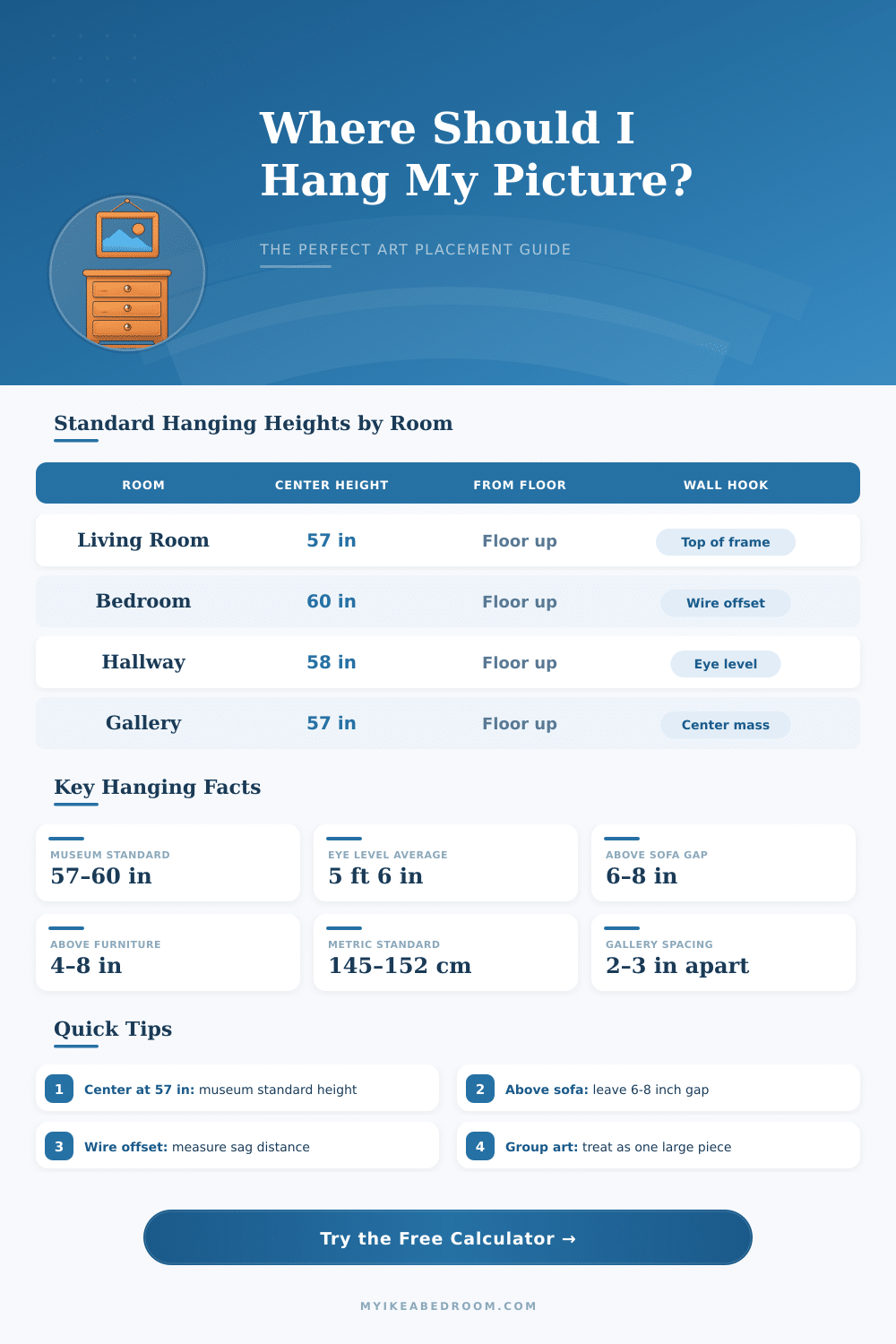
To find wire sag, hold the frame face-down and pull the wire taut toward the top. Measure the distance from the wire to the top edge of the frame. This is your sag value. Typical wire sag ranges from 1.5 to 3 inches depending on frame size and wire tension.
When hanging multiple pieces together, treat the entire group as one large frame. Find the visual center of the arrangement and hang so that center sits at 57 inches. Space individual pieces 2–3 inches apart. Lay out the arrangement on the floor first to plan spacing before marking the wall.
Hanging images at the right Height can improve the general look of the room. Usually one lays the centre of the artwork at 57 to 60 inches above the floor. That almost matches the eye level of average folk.
57 inches also form the standard gallery Height in museums and showrooms of art across the whole land. Using this Height at home can give the space a feeling of bigger comfort.
How High to Hang Pictures
Some tips offer slightly higher position. According to various sources, the centre of the image ideally finds itself somewhere between 57 and 63 inches from the floor. For art of standard size, laying the centre at 60 to 64 inches also works well, especially if the ceiling is high.
In rooms with low ceiling, hanging the images a bit more below commonly creates an illusion of wider space.
There is a simple way to exactly determine where to set the nail. One takes the Height of the Picture and divides it by two, then subtracts the distance from the frame top to the hook or wire for hanging. One adds that result to 57, 58, 59 or 60 inches, and that points the precise Height for the nail on the wall.
For instance, for a Picture of 15 inches tall, the half matches 7.5 inches, what marks the real centre of the Pictrue.
The rules change if below stands furniture. When a Picture rests above a sofa, bed or table, it must be at least 6 to 8 inches above that surface. Above a TV for big art, distance of 4 to 8 inches from the surface usually looks great.
Even so consider this: art hanged too low above a sofa can force folks to lean backwards and strike there head against the Picture. This is especially a problem for images on heavy canvas, because the canvas risks getting damaged.
A common human mistake consists in hanging the images too high. In many houses one finds them almost beside the ceiling, what blocks their enjoyment. Images and also televisions deserve a Height that comfortably allows to look at them while sitting.
Kitchens and gateways are a bit different from other spaces. Because folks here usually stand, the ideal hanging Height one lays slightly more up than in living rooms. For big images, using two nails or screws proves a clever fix, because it keeps the frame level and stops its motion.
If you lean artwork on a shelf or ledge instead of hanging it, leave 2 to 6 inches ofspace behind the Picture to add depth.