🪵 Wood Shrinkage Calculator
Calculate lumber dimensional movement based on species, grain orientation, and moisture content change
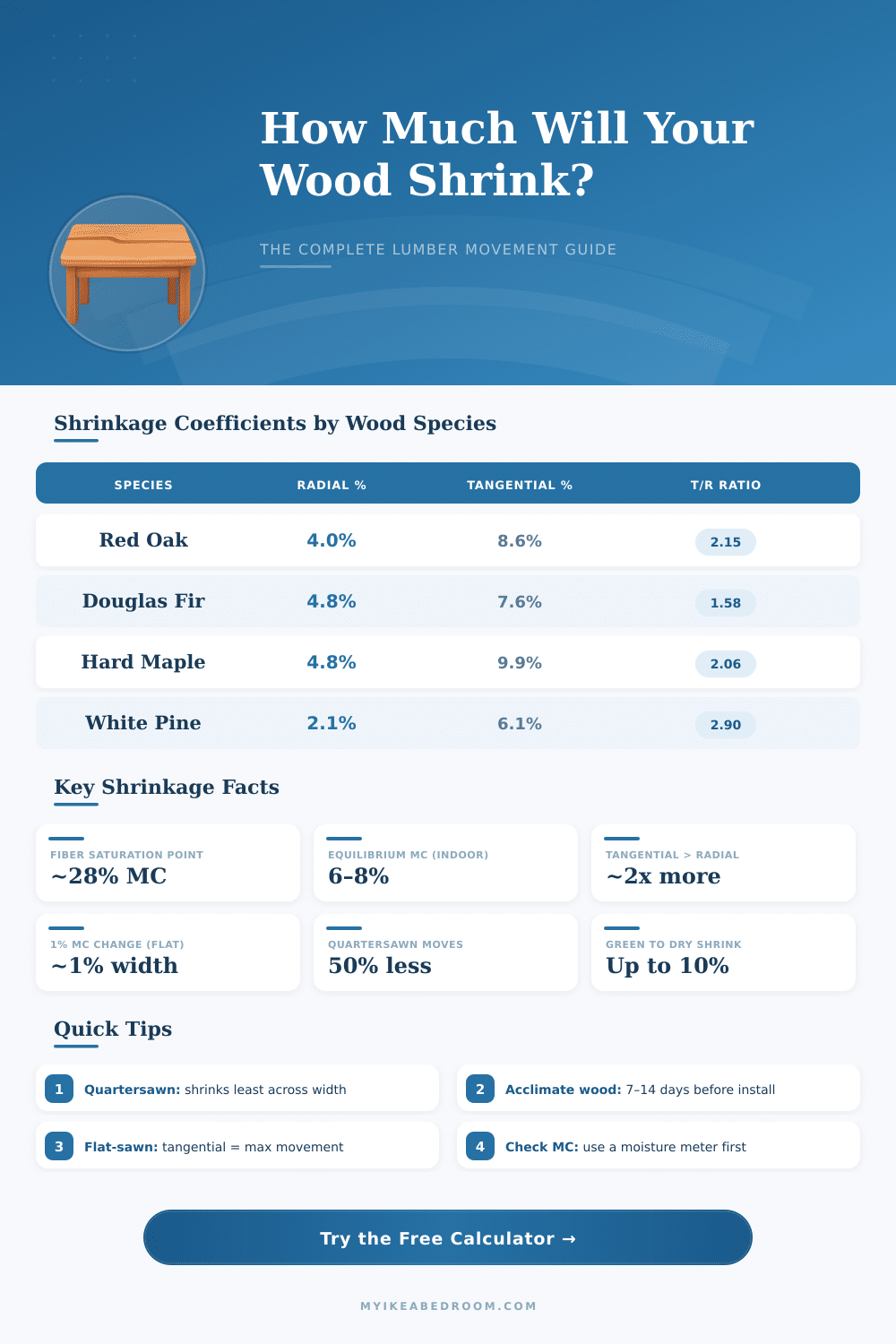
| Species | Radial (R%) | Tangential (T%) | T/R Ratio | Shrinkage Class |
|---|---|---|---|---|
| Red Oak | 4.0% | 8.6% | 2.15 | High |
| White Oak | 5.6% | 10.5% | 1.88 | Very High |
| Hard Maple | 4.8% | 9.9% | 2.06 | High |
| Yellow Birch | 7.3% | 9.5% | 1.30 | High |
| Black Cherry | 3.7% | 7.1% | 1.92 | Medium |
| Black Walnut | 5.5% | 7.8% | 1.42 | Medium-High |
| Douglas Fir | 4.8% | 7.6% | 1.58 | Medium |
| Eastern White Pine | 2.1% | 6.1% | 2.90 | Low-Medium |
| Sitka Spruce | 4.3% | 7.5% | 1.74 | Medium |
| Western Red Cedar | 2.4% | 5.0% | 2.08 | Low |
| MC Change (%) | Shrinkage (in) | Shrinkage (mm) | % of Width |
|---|---|---|---|
| 1% | 0.031" | 0.78 mm | 0.51% |
| 2% | 0.062" | 1.57 mm | 1.03% |
| 4% | 0.123" | 3.13 mm | 2.06% |
| 6% | 0.185" | 4.70 mm | 3.08% |
| 8% | 0.247" | 6.27 mm | 4.11% |
| 10% | 0.309" | 7.84 mm | 5.14% |
| 15% | 0.463" | 11.76 mm | 7.71% |
| Environment | Avg. EMC | RH Range | Notes |
|---|---|---|---|
| Heated interior (winter) | 6% | 25–35% | Most shrinkage risk |
| Interior year-round avg. | 8% | 40–50% | Target for flooring |
| Interior (humid summer) | 11% | 65–70% | Expansion risk |
| Covered outdoor (dry) | 12% | 60–70% | Decks, pergolas |
| Uncovered outdoor | 15% | 75–85% | High movement |
| Green / freshly cut | 28%+ | >95% | Above FSP, no shrinkage yet |
When wood loses moisture, it contracts. Here the main idea. Although already dropped and cut, the wood does not truly die, its cells still react to changes in temperature and humidity.
The substance takes or gives water according to what surrounds it. If one removes the water it becomes more small. If it absorbs it, then it rises again.
Why Wood Shrinks and What to Do About It
Here the part, where it becomes interesting; wood does not contract equally in all directions. It is uneven, so it acts differently according to three different axes: tangential (according to the ring lines), radial (straight to the core) and lengthwise (along the length). The strongest move happens according to the annual rings in tangential direction.
The radial shrinkage reach around half of taht amount. About the lengthwise shrinkage along the fibers? It is so small, that it almost does not matter.
Hence typical wooden cover or ceiling beam shrinks in width and thickness, but every long bit stays almost just as long.
Yet before the shrinkage of wood starts, it must go below a certain moisture limit; the fiber saturation point. We talk about 28 to 30 percentages of moisture. Above that level wood stays stable.
When it falls below, the shrinkage starts and grows steady during the drying process. “Green” wood, recently cut, has the highest humidity. When it reaches oven-dry state, it already reached its smallest size.
The whole change from green too oven-dry shows the maximum shrinkage.
Wide tables move and shift more than narrow, certainly. Surrounding humidity can cause serious effects. Different species react otherwise.
Oak, beech and hickory are known because of their big shrinkage, while teak, mesquite and cedar much better resist it.
The golden rule is easy: if the moisture content stays same, no shrinkage or warp happens. Use well dried wood before building makes big difference. Ideally the humidity be under 15 percentages, even more good, if one can reach 7 or 8 percentages.
Sealing of the finish does not fully close wood against humidity, but it slows the absorption. Hence traditional woodwork uses designs like grooves and floating panels, that leaves space for motion of wood without the whole bit splits or breaks.
Rating of wood shrinkage is not difficult. Just multiply some numbers. Here are fast calculations, if you want a rough idea about how framed building will move.
Planning for such movementearly helps to escape ugly splits or visible damage, that appears months later.