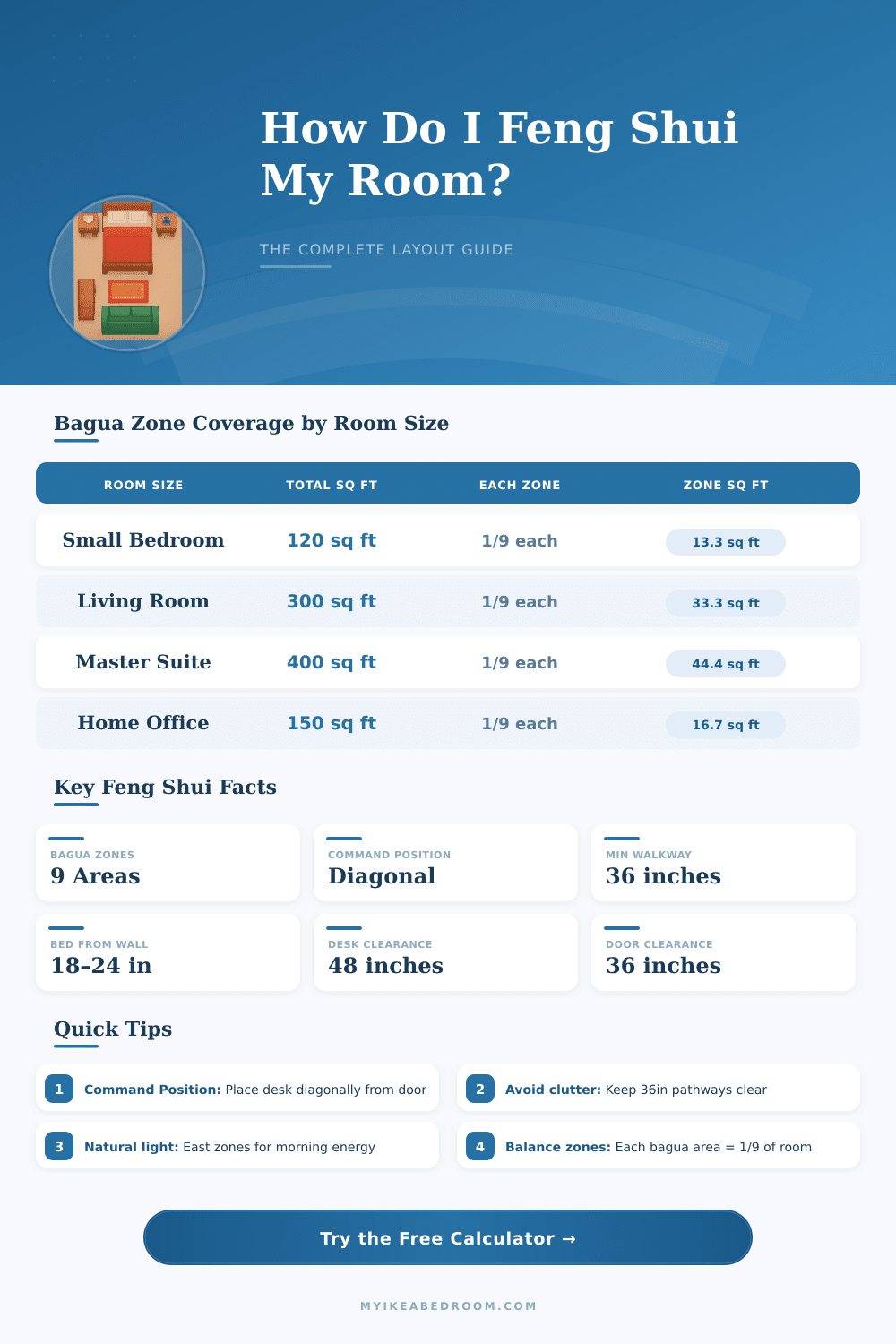
🧭 Feng Shui Room Layout Calculator
Calculate bagua zone areas, walking clearances, and furniture placement ratios for any room
| Bagua Zone | Direction | Life Area | Element | Ideal Colors |
|---|---|---|---|---|
| Wealth & Prosperity | Southeast | Abundance | Wood | Purple, Green, Gold |
| Fame & Reputation | South | Recognition | Fire | Red, Orange |
| Love & Relationships | Southwest | Partnership | Earth | Pink, Red, White |
| Family & Health | East | Vitality | Wood | Green, Blues |
| Center & Wellbeing | Center | Balance | Earth | Yellow, Brown |
| Creativity & Children | West | Joy | Metal | White, Gray |
| Knowledge & Self | Northeast | Wisdom | Earth | Blue, Green |
| Career & Life Path | North | Purpose | Water | Black, Navy |
| Helpful People | Northwest | Support | Metal | Gray, White |
| Furniture Type | Min Clearance (in) | Min Clearance (cm) | Feng Shui Reason |
|---|---|---|---|
| Bed (sides) | 18 in | 46 cm | Chi flow around sleeping area |
| Desk (behind chair) | 48 in | 122 cm | Command position, space for energy |
| Sofa (to TV wall) | 96 in | 244 cm | Balanced viewing and flow |
| Dining table | 36 in | 91 cm | Ease of movement, prosperity flow |
| Main walkways | 36 in | 91 cm | Unobstructed chi pathways |
| Door swing radius | 36 in | 91 cm | Never block door with furniture |
| Nightstand to bed | 2 in | 5 cm | Grounding energy near rest |
| Plants to furniture | 12 in | 30 cm | Wood element breathing room |
| Room Type | Typical Size (ft) | Total Sq Ft | Each Bagua Zone | Open Space (30%) |
|---|---|---|---|---|
| Small Bedroom | 10 x 10 | 100 sq ft | 11.1 sq ft | 30 sq ft |
| Standard Bedroom | 12 x 14 | 168 sq ft | 18.7 sq ft | 50 sq ft |
| Master Bedroom | 14 x 18 | 252 sq ft | 28.0 sq ft | 76 sq ft |
| Small Living Room | 12 x 16 | 192 sq ft | 21.3 sq ft | 58 sq ft |
| Standard Living Room | 15 x 20 | 300 sq ft | 33.3 sq ft | 90 sq ft |
| Large Living Room | 20 x 24 | 480 sq ft | 53.3 sq ft | 144 sq ft |
| Home Office | 10 x 10 | 100 sq ft | 11.1 sq ft | 30 sq ft |
| Dining Room | 10 x 12 | 120 sq ft | 13.3 sq ft | 36 sq ft |
| Ceiling Height | Chi Effect | Recommended Use | Volume per 100 sq ft |
|---|---|---|---|
| 7 ft (low) | Grounding, focused | Meditation, office | 700 cu ft |
| 8 ft (standard) | Balanced flow | All room types | 800 cu ft |
| 9 ft | Uplifting, social | Living rooms, dining | 900 cu ft |
| 10 ft | Expansive, creative | Studios, living rooms | 1,000 cu ft |
| 12 ft (high) | Grand, inspiring | Great rooms, studios | 1,200 cu ft |
Create a plan for a room can seem like heavy work but there are ways to make it simpler. Most programs for planning rooms allow you to picture your ideas about design, without you needing to actually move heavy furniture around. Online tools for arranging rooms let you lay furniture almost actually, and many of them include useful features like 3D views, changeable furniture and guided lessons to help you during the whole process.
Some famous tools deserve attention. Floorplanner is a widely used program for designing floor plans, that is free for personal use and allows you to choose from more than 260 000 objects. With 5D Planner you can design your room online and preview it in 3D. One can form a floor plan, add doors and windows and freely place furniture in its places.
Simple Room Planning with Online Tools
Also Planyourroom.com exists, that helps you rearrange every part of the room by means of selection of furniture fit for your special area. One can build a room according to your exact needs, use the furniture offered on the website, and if you already have own furniture, you can measure them and search similar bits according to size for playing with close versions.
A floor plan delivers a bird’s eye view, that shows where rooms, walls, doors, windows, bathroom devices and storage space sit in the whole building. Such visual tools help you seize the ties and the flow between various parts, as well as how folks could move threw them. By means of room layout programs you can add even exact elements like windows, outlets and tubes in the technical designs of your area.
Before you place any furniture, think about the main spot in the room. Mind where your look naturally turns when you enter the space, maybe a big television, a focused fire, nice artwork or a window with natural light through it. After the focal element is found, then arranging the rest of the furniture around it becomes much more simple and forms a nice, tied look.
The use of the room is the most important thing when you plan the layout. Before adding furniture, list all activities and needs that the space must serve, resting, meals, fun, working, sleep or games for children, if they are around. Think where in the room each of those activities best fits, so that each has its own area.
The spot of the television is commonly the first thing folks care about in the room. Placing a television on a wall that faces a big window means a struggle against light and keeping the curtains closed almost always. The sofa does not need to stand against the wall close to the television, sometimes that ends with too big a distance that blocks the ways.
In long rectangular rooms with elements like a central fire or glass doors, it is useful to think about the traffic ways and use dividers to share the area. Simply place only the needed furniture and avoidoverloading a little room only because there are extra chairs or little forms.