🎸 Guitar Cabinet Size Calculator
Calculate internal volume, external dimensions, and baffle area for your custom guitar speaker cabinet build.
per 4x8 sheet
per 4x8 sheet
per 4x8 sheet
per 4x8 sheet
per 4x8 sheet
per 4x8 sheet
per 4x8 sheet
per 4x8 sheet
| Speaker Size | Nominal Dia. | Typical Cutout | Mounting Hole PCD | Min. Baffle Area |
|---|---|---|---|---|
| 8" Driver | 8 in / 203mm | 7.125 in / 181mm | ~7.875 in | ~80 sq in |
| 10" Driver | 10 in / 254mm | 9.125 in / 232mm | ~9.875 in | ~120 sq in |
| 12" Driver | 12 in / 305mm | 11.125 in / 283mm | ~11.875 in | ~168 sq in |
| 15" Driver | 15 in / 381mm | 13.875 in / 352mm | ~14.875 in | ~240 sq in |
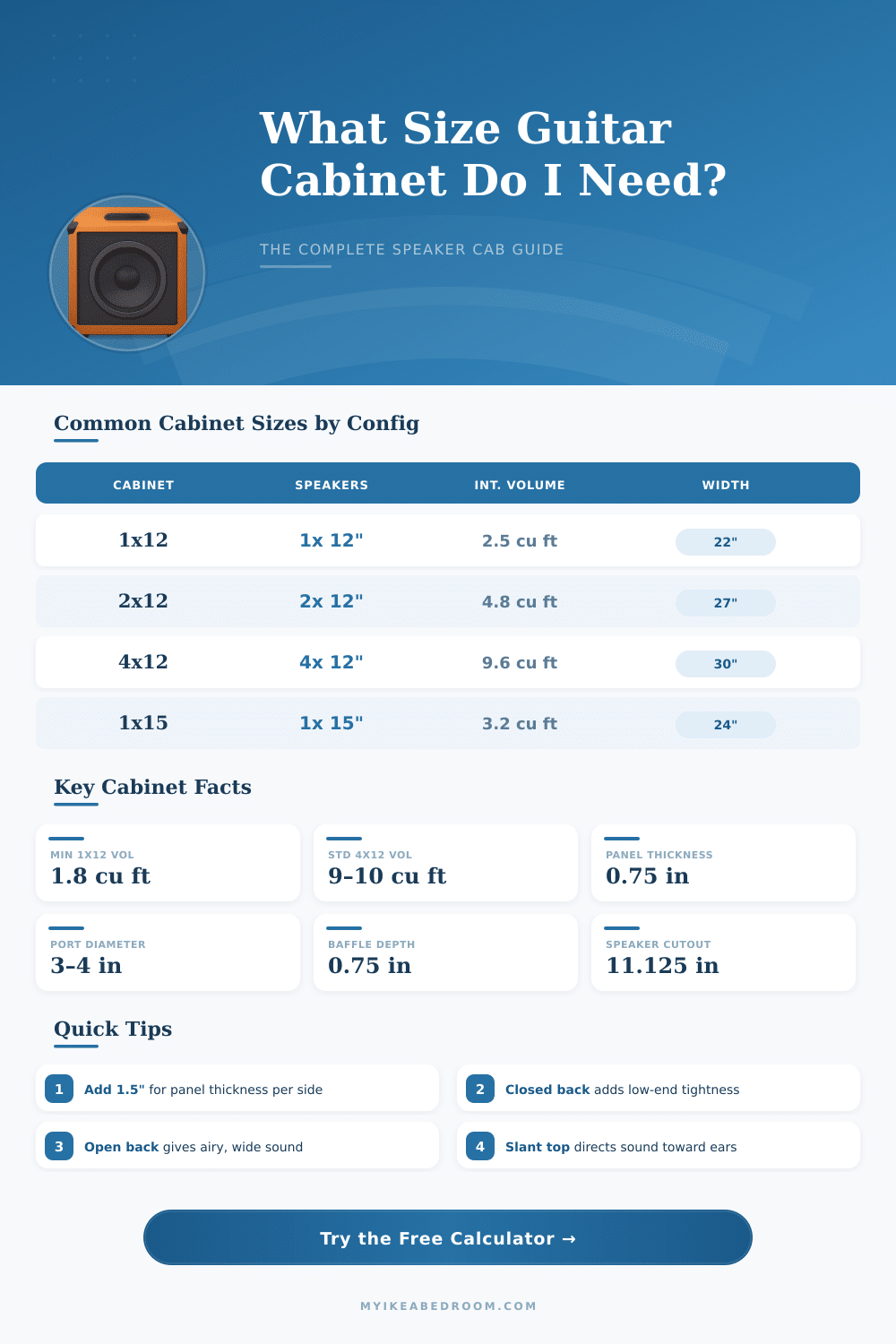
| Cabinet | Ext. W x H x D (in) | Int. Volume (cu ft) | Int. Volume (liters) | Typical Use |
|---|---|---|---|---|
| 1x8 Mini | 14 x 12 x 8 | ~0.65 | ~18.4 L | Practice / recording |
| 1x10 Combo | 17 x 15 x 9 | ~1.1 | ~31.1 L | Small gigs, practice |
| 1x12 Open | 22 x 20 x 11 | ~2.5 | ~70.8 L | Studio, small gigs |
| 1x12 Closed | 22 x 20 x 12 | ~2.8 | ~79.3 L | Tight low-end, studio |
| 2x12 Open | 27 x 20 x 11 | ~3.6 | ~102 L | Medium gigs, stage |
| 2x12 Closed | 27 x 20 x 13 | ~4.4 | ~125 L | Stage, tight punch |
| 4x12 Straight | 29 x 30 x 14 | ~9.0 | ~255 L | Full-stack, arena |
| 4x12 Slant | 29 x 30 x 14 | ~9.0 | ~255 L | Marshall-style stage |
| 1x15 Bass | 24 x 26 x 14 | ~4.5 | ~127 L | Bass guitar, keys |
| Speaker | Closed Min | Closed Max | Open Back Min | Open Back Max |
|---|---|---|---|---|
| 8" Guitar | 0.35 cu ft / 10 L | 0.7 cu ft / 20 L | 0.5 cu ft / 14 L | 1.0 cu ft / 28 L |
| 10" Guitar | 0.7 cu ft / 20 L | 1.3 cu ft / 37 L | 0.9 cu ft / 25 L | 1.8 cu ft / 51 L |
| 12" Guitar | 1.8 cu ft / 51 L | 2.8 cu ft / 79 L | 2.0 cu ft / 57 L | 3.5 cu ft / 99 L |
| 15" Bass | 3.0 cu ft / 85 L | 5.0 cu ft / 142 L | 3.5 cu ft / 99 L | 6.0 cu ft / 170 L |
The size of guitar cabinet plays a lead role in shaping the tone that comes from the speakers. The build and size of the guitar cabinet is just as important as the speakers themselves, because they deeply affect the final sound. When a guitar cabinet is too small, the sound can become harsh and thin.
Too big a guitar cabinet on the other hand causes too much buzz and lack of focus. Finding the right balance is the key.
How Guitar Cabinet Size Affects Sound
For a 1×12 guitar cabinet with different setups, a good internal volume is between 1.5 and 2.5 cubic feet. Even so, guitar speakers work differently than other kinds. They do not stay linear even at low levels, so average measures of speakers have little weight in actual use.
Doubling or halving the size of a guitar cabinet changes the response only a bit for a typical guitar spekaer.
Designs of open-back and closed-back differ in the area of size. For open-back guitar cabinets, the right sizes are not that critical. Depth of 9 to 11 inches works well for open-back guitar cabinets.
Some makers choose smaller forms because of better portability, because such designs are more forgiving. With closed-back guitar cabinets the cause adjusts. The famous Marshall guitar cabinet was born from the need of practical size for four 12-inch speakers.
That ties also to whole physical weight and size, which affects production, shipping and ultimately the user.
A 4×12 guitar cabinet stays the most powerful and big kind of amp guitar cabinet on the market. For heavy rock tones, one commonly chooses the 4×12. The sound of a 4×12 spreads more evenly through the space, so it is ideal four large places. Even so not everyone requires such a giant.
A home-level musician maybe will choose a 1×12 or 2×12, instead of turning the volume way up on a big guitar cabinet to get the sound.
Also the size of a speaker has its role. A 12-inch speaker can copy the sound of a smaller 8-inch, which gives typical tone of a guitar cabinet. At low volumes, a bigger speaker does not help.
A 10-inch speaker should be good and deliver everything needed at quiet levels. Some like old 4×10 cabinets, and 15-inch speakers are used for guitar, although they are rare and most commonly relate to bass.
One maker noted that a big 2×12 guitar cabinet lacked midtones and wanted to make a smaller version. On the other hand, a modest guitar cabinet with a Jensen 8-inch speaker in a full 16x20x10 pine cabinet sounded great despite its simple speaker. Sometimes thefrequencies come out simply in unusual ways.