🎨 How Long to Paint a Room Calculator
Estimate painting time based on room size, number of coats, painters, and surface type
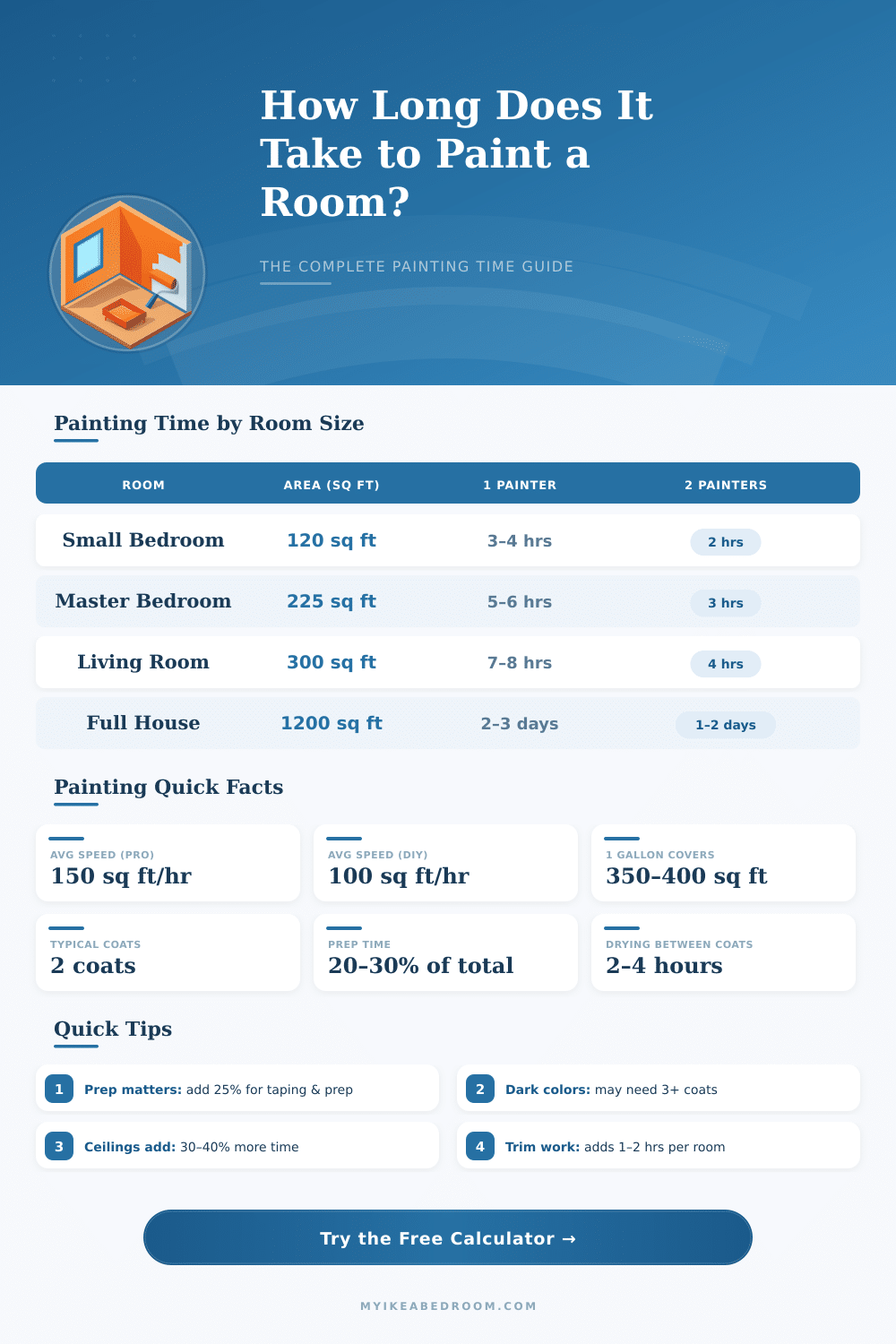
| Room Type | Floor Area | Wall Area (8 ft ceiling) | Painting Time | With Prep |
|---|---|---|---|---|
| Small Bathroom | 40 sq ft | 160 sq ft | 2.0 hrs | 2.5 hrs |
| Small Bedroom | 100 sq ft | 352 sq ft | 4.4 hrs | 5.5 hrs |
| Average Bedroom | 168 sq ft | 476 sq ft | 6.0 hrs | 7.5 hrs |
| Master Bedroom | 225 sq ft | 572 sq ft | 7.2 hrs | 9.0 hrs |
| Living Room | 300 sq ft | 680 sq ft | 8.5 hrs | 10.6 hrs |
| Large Living Room | 500 sq ft | 1000 sq ft | 12.5 hrs | 15.6 hrs |
| Open Plan | 600 sq ft | 1160 sq ft | 14.5 hrs | 18.1 hrs |
| Finish Type | Coverage (sq ft/gal) | Relative Speed | Typical Coats | Best For |
|---|---|---|---|---|
| Flat / Matte | 350–400 | Fast | 1–2 | Ceilings, low-traffic rooms |
| Eggshell | 350–400 | Fast | 2 | Living rooms, bedrooms |
| Satin | 300–400 | Moderate | 2 | Kitchens, hallways |
| Semi-Gloss | 300–350 | Moderate | 2 | Trim, bathrooms, kitchens |
| High Gloss | 250–350 | Slower | 2–3 | Doors, cabinets |
| Primer | 200–300 | Slower | 1 | New drywall, stain block |
| Textured | 100–200 | Slowest | 2–3 | Rough / popcorn surfaces |
| Dark / Bold Color | 300–350 | Slower | 3–4 | Accent walls |
| Painters | Small Room (100 sq ft walls) | Medium Room (400 sq ft walls) | Large Room (800 sq ft walls) | Efficiency |
|---|---|---|---|---|
| 1 Painter (DIY) | 2.5 hrs | 5.0 hrs | 10.0 hrs | Baseline |
| 2 Painters (DIY) | 1.25 hrs | 2.5 hrs | 5.0 hrs | 2× faster |
| 1 Painter (Pro) | 1.3 hrs | 2.7 hrs | 5.3 hrs | ~2× faster |
| 2 Painters (Pro) | 0.7 hrs | 1.3 hrs | 2.7 hrs | 4× faster |
| 3 Painters (Pro) | 0.4 hrs | 0.9 hrs | 1.8 hrs | 6× faster |
Painting the Room is between the simplest ways to bring freshness to a Room without spending a lot of money. The materials cost almost nothing, and if you do it yourself, you avoid paying for workers. Honestly the first time can seem a bit scary, but really?
It is not that difficult. The main challenge lies in the preparation, if you do that well, the result will genuinely impress you.
How to Paint a Room
Empty the Room as much as possible. Remove the small objects entirely and move the heavy furniture to the centre of the space. This way you get more freedom to move and less risk that spurts of Paint land on your stuff.
When that is done, go along the walls and pull out nails or screws that stick out. Scratch away the bumps or dullness of the old Paint. Fill the nail holes, smooth over gaps and sand the rough patches.
Later, cover the floor and heavy furniture with sheets to protect them.
Take blue tape and stick it along the baseboard and everywhere where Paint should not reach. For a clear limit between wall and ceiling, a Paint brush usually works better then those cutting tools; that I learnt from my own experience. Do not forget to unscrew and remove the covers of the outlets before you start to Paint.
The order of painting matters more than one usually believes. Paint first the ceiling, later the walls, end with the baseboard. That simplifies the task, because the baseboard itself helps as a natural guide when you touch the edges.
Start with a brush in all corners, later take the roller for the main wallspace.
Here is the main tip in painting that messes up many newcomers: it is not only wearing colour, but keeping the same texture. If you go over an already half done part, you will ruin the surface and will end with marks that show like a sore thumb. The same happens if you touch up a missed place later with a different tool…
It will not blend well.
The type of Paint finish also matters a lot. Matte Paint works better for newcomers, because it dries more slowly, so you can cut the whole Room before you roll. Eggshell finish needs you to work more quickly, wall after wall, while it is still wet.
Shiny finishes are tougher and easier to clean, which is useful in commonly used places, but they show every roughness of the wall. Investing in better Paint genuinely is worth the cost.
When the first coat dries, take a light and check for dust or fibers that stay in the Paint. Sand the visible bumps, wipe everything away, later apply the second coat. The third coat the next day?
That makes the difference between good work and genuinely professional look. It takes time, butthe reward is worth it.