🔊 Speaker Cabinet Size Calculator
Calculate the ideal enclosure volume for your speaker driver — sealed, ported, or bandpass designs.
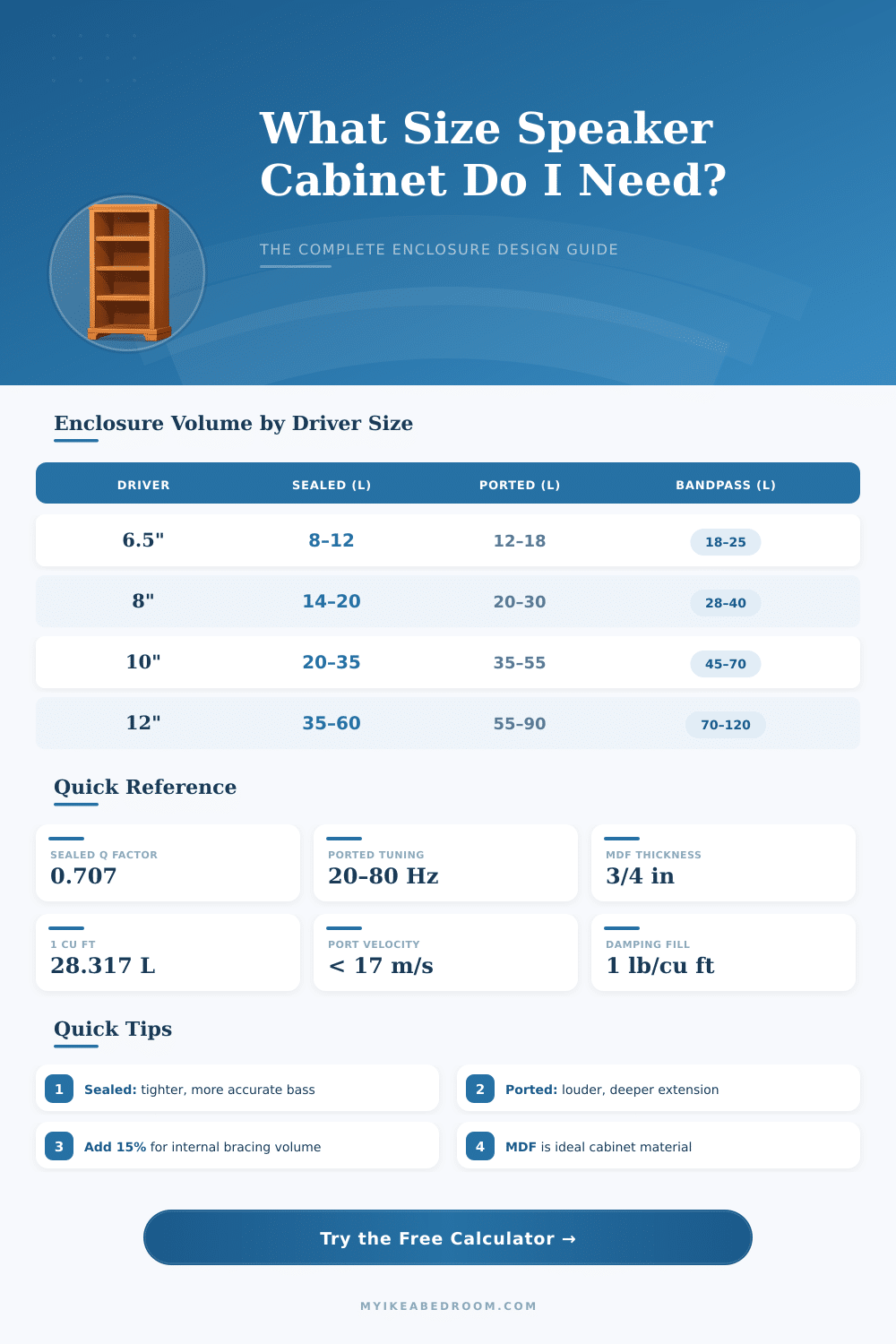
| Driver Size | Sealed (cu ft) | Ported (cu ft) | Bandpass (cu ft) | Sealed (L) | Ported (L) |
|---|---|---|---|---|---|
| 4" (10 cm) | 0.10 – 0.20 | 0.20 – 0.40 | 0.30 – 0.50 | 2.8 – 5.7 | 5.7 – 11.3 |
| 5.25" (13 cm) | 0.15 – 0.30 | 0.30 – 0.60 | 0.45 – 0.80 | 4.2 – 8.5 | 8.5 – 17.0 |
| 6.5" (16.5 cm) | 0.28 – 0.50 | 0.50 – 0.90 | 0.70 – 1.20 | 7.9 – 14.2 | 14.2 – 25.5 |
| 8" (20 cm) | 0.50 – 1.00 | 0.90 – 1.50 | 1.20 – 2.00 | 14.2 – 28.3 | 25.5 – 42.5 |
| 10" (25 cm) | 0.75 – 1.50 | 1.50 – 2.50 | 2.00 – 3.50 | 21.2 – 42.5 | 42.5 – 70.8 |
| 12" (30 cm) | 1.25 – 2.50 | 2.00 – 4.00 | 3.00 – 5.50 | 35.4 – 70.8 | 56.6 – 113.3 |
| 15" (38 cm) | 2.50 – 5.00 | 3.50 – 7.00 | 5.00 – 9.00 | 70.8 – 141.6 | 99.1 – 198.2 |
| 18" (46 cm) | 4.00 – 8.00 | 6.00 – 12.00 | 8.00 – 14.00 | 113.3 – 226.5 | 169.9 – 339.8 |
| Material | Density (lbs/cu ft) | Density (kg/m³) | Resonance | Machining | Best Use |
|---|---|---|---|---|---|
| MDF | 44 – 51 | 705 – 816 | Very Low | Excellent | All enclosures |
| Baltic Birch Plywood | 34 – 38 | 544 – 608 | Low | Good | High-end builds |
| Pine Plywood | 28 – 32 | 448 – 512 | Medium | Good | Budget builds |
| Oak Hardwood | 42 – 46 | 672 – 736 | Low | Moderate | Audiophile cabinets |
| Particleboard | 40 – 46 | 640 – 736 | Medium | Fair | Budget subwoofers |
| Acrylic | 70 – 80 | 1120 – 1280 | Low | Difficult | Display builds |
| ABS Plastic | 63 – 69 | 1008 – 1104 | Medium | Moderate | Portable cabinets |
| Fiberglass | 94 – 106 | 1504 – 1696 | Very Low | Difficult | Custom shapes |
| Port Diam. | Tuning 25 Hz | Tuning 35 Hz | Tuning 45 Hz | Tuning 60 Hz | Min Area (cm²) |
|---|---|---|---|---|---|
| 1.5" (3.8 cm) | Very long | 18 cm | 10 cm | 5 cm | 11.3 |
| 2" (5.1 cm) | Very long | 28 cm | 16 cm | 8 cm | 20.3 |
| 3" (7.6 cm) | 55 cm | 48 cm | 28 cm | 14 cm | 45.6 |
| 4" (10.2 cm) | 80 cm | 62 cm | 38 cm | 20 cm | 81.1 |
| 6" (15.2 cm) | 150 cm | 110 cm | 68 cm | 36 cm | 182.4 |
| Target Volume | Volume (L) | W x H x D (in) | W x H x D (cm) | Panel Count (3/4") |
|---|---|---|---|---|
| 0.35 cu ft | 9.9 L | 9 x 9 x 9 | 22.9 x 22.9 x 22.9 | 6 panels |
| 0.50 cu ft | 14.2 L | 10 x 10 x 10.4 | 25.4 x 25.4 x 26.4 | 6 panels |
| 1.00 cu ft | 28.3 L | 12 x 12 x 15 | 30.5 x 30.5 x 38.1 | 6 panels |
| 1.50 cu ft | 42.5 L | 14 x 14 x 16 | 35.6 x 35.6 x 40.6 | 6 panels |
| 2.00 cu ft | 56.6 L | 15 x 15 x 18 | 38.1 x 38.1 x 45.7 | 6 panels |
| 2.50 cu ft | 70.8 L | 16 x 16 x 20 | 40.6 x 40.6 x 50.8 | 6 panels |
| 3.50 cu ft | 99.1 L | 18 x 18 x 22 | 45.7 x 45.7 x 55.9 | 6 panels |
| 5.00 cu ft | 141.6 L | 20 x 20 x 26 | 50.8 x 50.8 x 66.0 | 6 panels |
The size of the Speaker Cabinet is much more important than most folks believe. The shape and measurements of the Speaker Cabinet do affect the sound. Usually bigger Speaker Cabinet delivers deeper bottom and center.
Moreover the maximum possible size commonly gives the strength and the lowest bass, whether it has a port or is a closed box.
How Speaker Cabinet Size Affects Guitar Sound
Guitar speakers differ a bit from those for high fidelity. One intends by means of them to add character through breakup and distortion, instead of perfect sound reproduction. The move of the cones and the internal structure of the Speaker Cabinet causes the feel of the tone more than precise setup for low frequencies.
Most 1×12 Speaker Cabinets are so small that they naturally lose bass frequencies.
2×12 forms a good everyday solution. It catches something of the richness and scope from multi-speaker Speaker Cabinets. It will not sound empty and boxy as some 1x12s.
Rather, 4×12 commonly overwhelms many musicians. Those Speaker Cabinets sound louder and usually sharper. Even so even a single 1×12 with a more powerful speaker moves enough heir for you to physically feel it.
For Speaker Cabinets opened at the back, depth between nine and eleven inches works well. An old booklet from Celestion offers size 600 mm by 390 mm by 290 mm for one 12-inch or two 10-inch speakers. Jim Marshall, who created iconic guitar Speaker Cabinets, said that the measurements for his Speaker Cabinets were set by the final practical space for four 12-inch speakers.
Also the size of the speaker matters. Eight-inch guitar speakers commonly give boxy sound with many midtones, which delivers funny lo-fi blues or garage rock. Harmonica players do like eight-inch speakers.
For practice at low sound even so no truly useful bigger speaker is needed. A 10-inch speaker simply must be good.
If a closed box is too big, the speaker will sound almost the same but with higher move of the cones at low frequencies. The deep rolls happen at higher frequency with a smaller box and one can get a peak of resonant tone. The relation between diameter of the speaker and size of the Speaker Cabinet is very important.
They go together. Even a change of one or two inches on a small speaker can make a big difference in how one must build the Speaker Cabinets.
Bigger Speaker Cabinets usually give much more solid sound than smaller ones. That does not deal with technology, whether older or newer. Speaker Cabinets range from simple homemade rectangular boxes to complex computer designed high-fidelity Speaker Cabinets that use synthetic material, internal supports, horns, bass-reflective ports and acoustic isolation.
They can be as small asbookshelf speakers with four-inch drivers or much bigger.