🍵 Rug Size for Dining Table Calculator
Find the perfect rug dimensions for your dining table — enter your table size and get instant recommendations
| Rug Size (ft) | Metric (m) | Area (sq ft) | Best For |
|---|---|---|---|
| 5' x 8' | 1.5 x 2.4 m | 40 sq ft | Small 4-seat table |
| 6' x 9' | 1.8 x 2.7 m | 54 sq ft | Standard 4-seat table |
| 8' x 10' | 2.4 x 3.0 m | 80 sq ft | 6-seat rectangular table |
| 9' x 12' | 2.7 x 3.7 m | 108 sq ft | 8-seat dining table |
| 10' x 14' | 3.0 x 4.3 m | 140 sq ft | 10-12 seat table |
| 6' round | 1.8 m dia | 28 sq ft | Small round 4-seat |
| 8' round | 2.4 m dia | 50 sq ft | Standard round 4–6 seat |
| 9' round | 2.7 m dia | 64 sq ft | Large round 6-seat |
| 2.5' x 8' runner | 0.76 x 2.4 m | 20 sq ft | Narrow dining space |
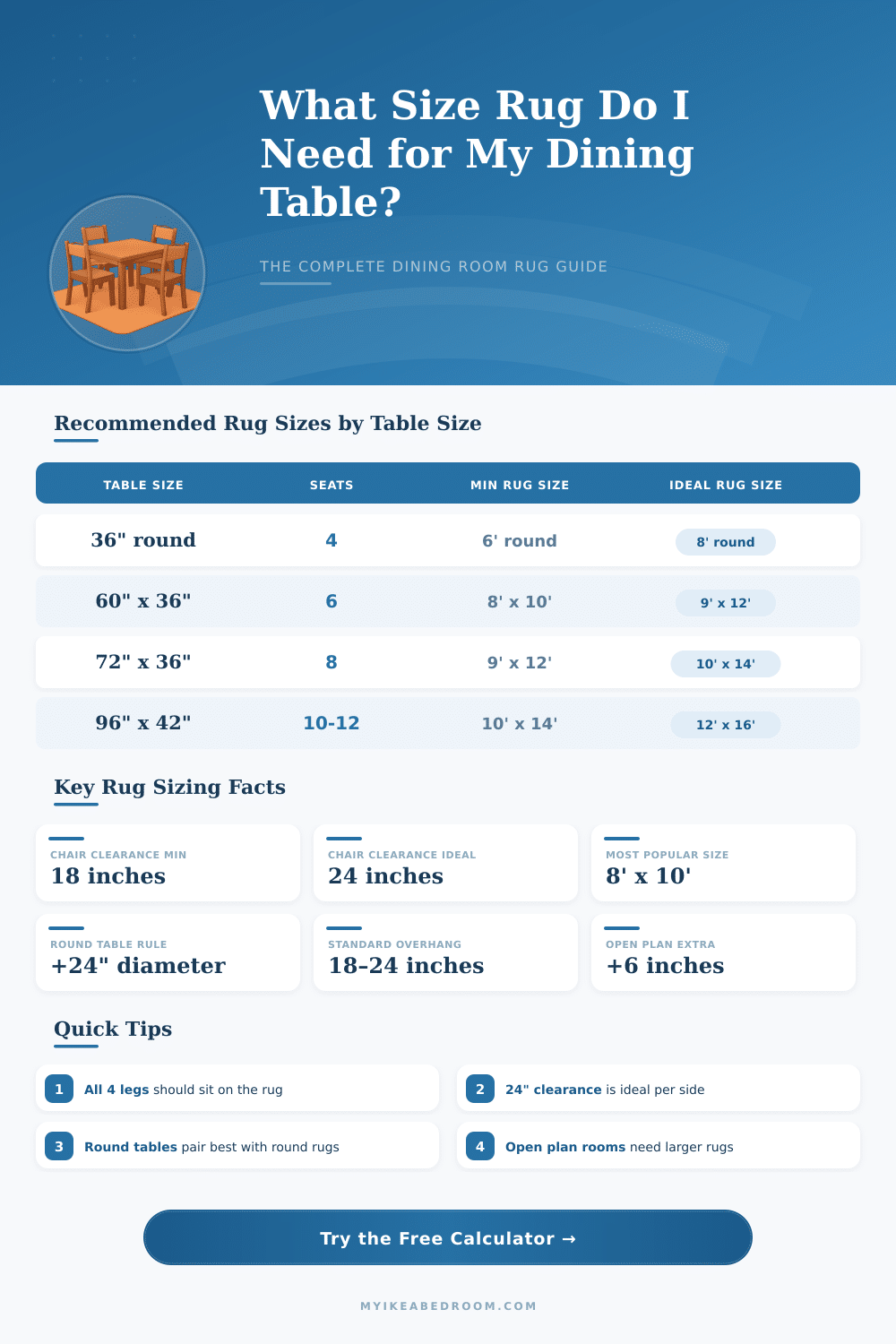
| Table Size | Seats | Min Rug (18" clear) | Ideal Rug (24" clear) |
|---|---|---|---|
| 36" round | 4 | 6' round | 8' round |
| 48" round | 4–6 | 7' round | 8' round |
| 60" round | 6 | 8' round | 9' round |
| 48" x 30" | 4 | 7' x 5' | 8' x 6' |
| 60" x 36" | 6 | 8' x 6' | 8' x 10' |
| 72" x 36" | 6–8 | 9' x 6' | 9' x 12' |
| 84" x 42" | 8 | 10' x 7' | 9' x 12' |
| 96" x 42" | 10 | 11' x 7' | 10' x 14' |
| 108" x 42" | 12 | 12' x 7.5' | 12' x 16' |
| Room Setting | Clearance | Imperial | Metric |
|---|---|---|---|
| Minimum (tight space) | Minimum | 18 in per side | 46 cm per side |
| Standard dining room | Recommended | 24 in per side | 61 cm per side |
| Open plan / spacious | Comfortable | 30 in per side | 76 cm per side |
| Statement / formal | Generous | 36 in per side | 91 cm per side |
Choosing the right Size of Rug can seem really hard. Even so, when you learn some basics, everything becomes much more simple. Common standard sizes like 5×8, 8×10 or 9×12 feet, help for various types of rooms.
A smaller Rug of 5×8 commonly works well for tiny spaces, for example studio rooms or little seating areas. Rugs from stores typically have standard sizes like 80×150 cm, 120×170 cm, 160×230 cm and 200×290 cm. Like this you not always find exactly that distance to the wall that you want.
How to Choose the Right Size Rug
Talking about walls, keeping equal space between the edge of the Rug and the wall is wise advice. Between 6 and 18 inches works well. Also, plan in around 1 to 1.5 feet between the floor and the Rug.
Use removable blue painter’s tape for marking the Rug Size before buying, that helps to imagine the look. Take the width and legnth of your room in inches, subtract 36 from each, and you will have good idea for the Rug. For tiny rooms, six-inch margin looks better.
If you hesitate, choose bigger.
When talking about living rooms, the Rug really must be quite big to cover whole furniture or at least the front feet. In tiny rooms, where furniture stands against the walls, it is enough to lay only the front legs of sofas and chairs on it, so that the setup seems united. A Rug of 5×7 almost never works for a living room.
For a standard living room, one commonly chooses 8×10 or even bigger. The Rug Size depends on the whole room design, not only on the sofa. If a Rug sits under a sofa, it should bee longer than the sofa itself, to give a smooth look and frame the seating area.
A 10×14 gives a really fancy, oversized look to the space.
Dining rooms follow their own rules. A Rug of 9×12 works well for big Dining Tables with 8 to 10 chairs, regardless of the shape. For medium tables with 6 to 8 chairs, 8×10 is the best.
The Rug must be both longer and wider than the Dining Table with chairs, when they are drawn out. Leave 30 to 60 cm between the edge of the table and of the Rug, as a good practical rule. At least 24 inches on every side allows that chairs stay fully on the Rug even when pushed back.
For bedrooms, a twin bed works well with a Rug of 5×8. A queen bed works with 6×9 or 8×10. For a king bed, 8×10 or 9×12 suit well. Also, one can lay smaller Rugs beside the bed, and 80×150 cm is good for that. Full room Rugs usually have length between 9 and 15 feet.
You can even combine small Rugs for more variety, while you show nice patterns. With Rugs, goingsmaller not commonly is the better choice.