📏 Shelf Bracket Spacing Calculator
Find the perfect bracket placement for any shelf length, material, and load type
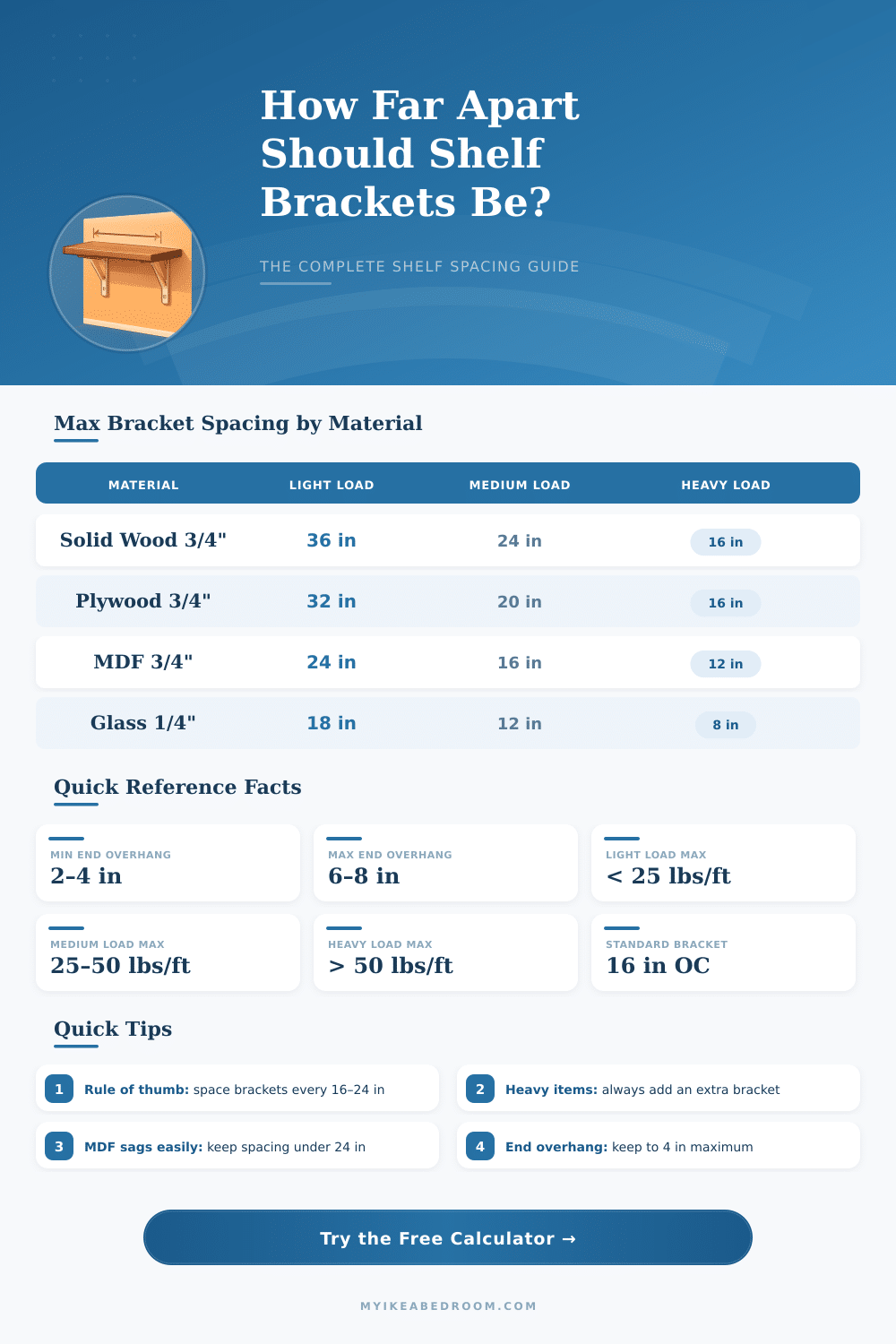
| Material & Thickness | Light Load | Medium Load | Heavy Load |
|---|---|---|---|
| Solid Wood 3/4" | 36 in (91 cm) | 24 in (61 cm) | 16 in (41 cm) |
| Solid Wood 1" | 48 in (122 cm) | 32 in (81 cm) | 24 in (61 cm) |
| Plywood 3/4" | 32 in (81 cm) | 20 in (51 cm) | 16 in (41 cm) |
| Plywood 1/2" | 24 in (61 cm) | 16 in (41 cm) | 12 in (30 cm) |
| MDF 3/4" | 24 in (61 cm) | 16 in (41 cm) | 12 in (30 cm) |
| MDF 1" | 30 in (76 cm) | 20 in (51 cm) | 16 in (41 cm) |
| Glass 1/4" | 18 in (46 cm) | 12 in (30 cm) | 8 in (20 cm) |
| Glass 3/8" | 24 in (61 cm) | 16 in (41 cm) | 12 in (30 cm) |
| Particleboard 3/4" | 20 in (51 cm) | 14 in (36 cm) | 10 in (25 cm) |
| Steel Shelf | 48 in (122 cm) | 36 in (91 cm) | 24 in (61 cm) |
| Shelf Length | Min Overhang | Max Overhang | Recommendation |
|---|---|---|---|
| Up to 24" (61 cm) | 1 in (2.5 cm) | 3 in (7.6 cm) | 2 in each side |
| 24"–48" (61–122 cm) | 2 in (5 cm) | 4 in (10 cm) | 3 in each side |
| 48"–72" (122–183 cm) | 2 in (5 cm) | 6 in (15 cm) | 4 in each side |
| 72"+ (183 cm+) | 3 in (7.6 cm) | 8 in (20 cm) | 4–6 in each side |
| Load Type | lbs per linear ft | kg per linear m | Example Items |
|---|---|---|---|
| Light | < 25 lbs/ft | < 37 kg/m | Decor, light books, plants |
| Medium | 25–50 lbs/ft | 37–74 kg/m | Hardcover books, small appliances |
| Heavy | > 50 lbs/ft | > 74 kg/m | Tools, records, large appliances |
The spacing of bracket supports is one of those tasks that seems easy but often can fail quickly. The shelf itself should not extend between supports more than 24 to 36 inches, depending on the type of material and the weight that it must bear. For bigger loads or less thick materials, like fiberboard you need shorter distance, around 24 inches.
When dealing with lightweight to medium use, one should arrange the bracket supports with maximum spacing of 24 inches.
How to Space Shelf Brackets
You must set a bracket at every end of the shelf, so that the hanging part past the last support does not pass 9 inches. Between those final bracket supports, one must space any added ones equally. That regular arrangement has bigger importance than many believe.
On longer shelves, one needs more supports. The main reason is that long shelves easily bend because of too big spacing between the bracket supports. Make sure to give support along the whole length of the shelf.
The maximum distance between bracket supports depends on the strength of teh material. In theory, strong material allows bigger spacing between the supports on the wall. Even on materials with limited strength, one can lay quite a lot of heavy objects, if the bracket supports stand more closely one to the other.
The studs in the wall have a key role hear. In typical framed walls, they are set in 16 to 24 inches one from the other. For heavy uses, like bookshelves, it is best to use every open stud, with bracket supports placed in 16 to 20 inches.
For instance, 12-inch bracket supports, laid every 16 inches, can hold plywood boards that bear heavy doors in a garage.
For a shelf of 47¼ inches with only two bracket supports, the spacing between them should be around 27½ to 31½ inches. A shelf from pine long 36 inches can have supports at 32 inches or at 16 inches, and the shorter option is the more reliable choice. Some models of bracket supports include a central support for long shelves, and joined units can give a smooth look.
There is no set spacing for the height between shelves. Setting the size of the openings makes sense when one thinks about various objects, like canned goods, boxes of cereal or packed dinners. Setting the shelf heights based on thestored products is the wise choice.
A pencil and level are useful for marking the spots of bracket supports before mounting. When one adds a support strip at the back of the shelf, the spacing of bracket supports can be a bit bigger, if the material is solid, like three-quarter-inch plywood. Using a level also helps to avoid that the shelves end up uneven on the wall, which does not right away show, but stands out over time.
If you are not sure about the mounting of the pieces, stores with cabinets nearby can advise about specific details.