🧱 Wallpaper Removal Calculator
Estimate wall area, remover solution needed, and labor hours for your project
Multiplier relative to standard paper removal effort. Used to estimate labor hours.
| Product Size | Coverage (sq ft) | Coverage (m²) | Best For |
|---|---|---|---|
| Qt concentrate (32 oz) | 300–400 sq ft | 27.9–37.2 m² | Small bathrooms |
| 1 gal concentrate | 1,200–1,600 sq ft | 111–149 m² | Full rooms |
| Ready-to-use spray (qt) | 100–150 sq ft | 9.3–13.9 m² | Touch-ups & small areas |
| Ready-to-use spray (gal) | 400–600 sq ft | 37.2–55.7 m² | Single room |
| DIF concentrate (1 gal) | 1,000–1,400 sq ft | 92.9–130 m² | Stubborn vinyl |
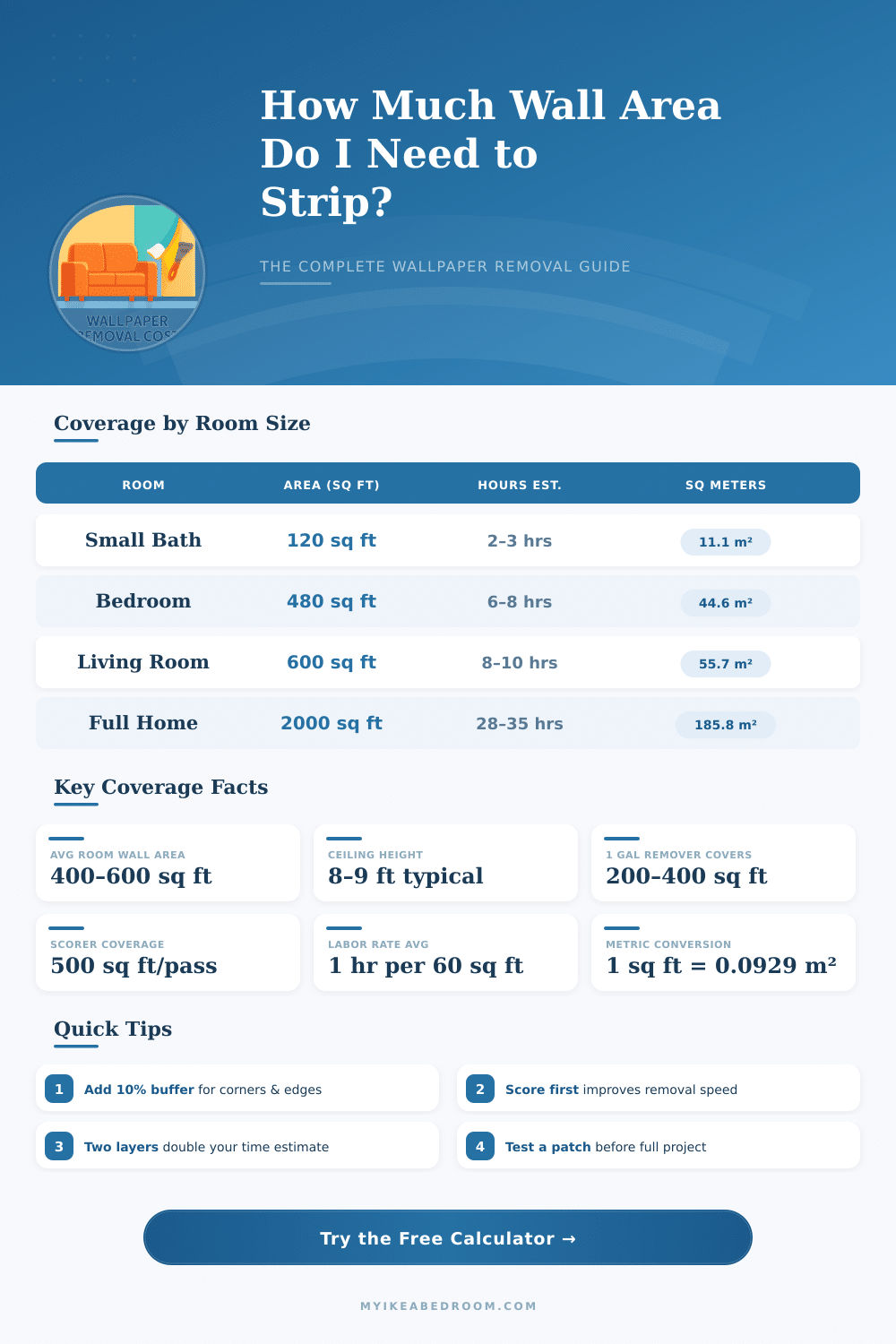
| Wall Area | Standard Paper | Vinyl-Coated | Double Layer |
|---|---|---|---|
| 100 sq ft (9.3 m²) | 1–2 hrs | 1.5–3 hrs | 2–4 hrs |
| 200 sq ft (18.6 m²) | 2–4 hrs | 3–6 hrs | 4–8 hrs |
| 400 sq ft (37.2 m²) | 4–7 hrs | 6–10 hrs | 8–14 hrs |
| 600 sq ft (55.7 m²) | 6–10 hrs | 9–15 hrs | 12–20 hrs |
| 1,000 sq ft (92.9 m²) | 10–17 hrs | 15–25 hrs | 20–34 hrs |
| Room | Floor Area | Net Wall Area | Remover (gal) |
|---|---|---|---|
| Small Bathroom | 5x8 ft | 180 sq ft | 0.5 gal |
| Standard Bedroom | 12x14 ft | 418 sq ft | 1.1 gal |
| Master Bedroom | 14x18 ft | 502 sq ft | 1.4 gal |
| Living Room | 15x20 ft | 594 sq ft | 1.6 gal |
| Dining Room | 12x14 ft | 418 sq ft | 1.1 gal |
| Hallway | 4x20 ft | 384 sq ft | 1.0 gal |
wallpaper removal seems easy, until you actually start the work. Then it turns into a whole trouble that tests your patience. About that silver cover?
There are several ways to remove it, and picking the right tool helps cut the headache in half.
Easy Ways to Remove Wallpaper
A steamer for wallpaper probably is the most used tool for folks that take on that task. It softens the glue below, so you can easily remove the paper with a scraper. One can rent such tool from hardware stores or from local shops, if you do not want to buy it.
Here the spot, those steamers work very well. A big room with four walls needs only some hours, and the actual effort stays fairly little. The process itself is basic: steam a part, leave it sitting, move the tool to the next bit later remove the softened material.
If pieces do not want to come off, simply repeat the step.
Another way, that surprisingly well works, is made up of a mix of warm water with soap in a spray can. Those mixes soften everything up and genuinely feel more nice than chemical solvent. Frothy warm water helps also for simple paper wallpaper.
The main moment is to soak the paper, until it quite a lot softnes so that the glue starts to give.
Chemical removers deserve note hear. Products like Zinsser DIF do their role, when you spread them on the surface and leave them sitting the right time. Rush that step, and you will be sorry soon after.
Even a simple clothes steamer helped some folks, especially on latex paint and old fiber-walls, where wallpaper stuck.
Before wetting any part, try to peel what it is possible, while the walls still are dry. Sometimes the vinyl upper layer simply peels right away, especially at the corners by the ceiling, if you pull carefully and slowly. Lucky breaks happen.
When the upper layer goes, the bottom sheds more quickly and easily. For wallpaper with vinyl outside, removal of that layer first does the next work a lot smoother.
A scoring tool pokes little holes, so that the liquid flows under the upper layer. It sounds easy, but genuinely there is danger here. Act too roughly with the tool, and you damage the drywall itself.
That balance is more tricky than one thinks. Some folks ripped the whole drywall and had to replace it, because the wallpaper stuck right to the bare plaster.
One home from the 1950s had thirteen layers piled up only in one room. That task took three whole weeks. Peel and stick wallpaper acts different though, it usually peels off without needing any remover.
When everything is off, wash the walls top to bottom and seal them with something like Gardz, before painting. If you want a truly smooth coat without wallpaper marks showing through the paint, joint compound helps cover the spots. Diluted vinegar beat store removersfor some folks, so worth to try it also.