📏 Ergonomic Standing Desk Height Calculator
Find your ideal desk height, monitor position & keyboard level for pain-free productivity
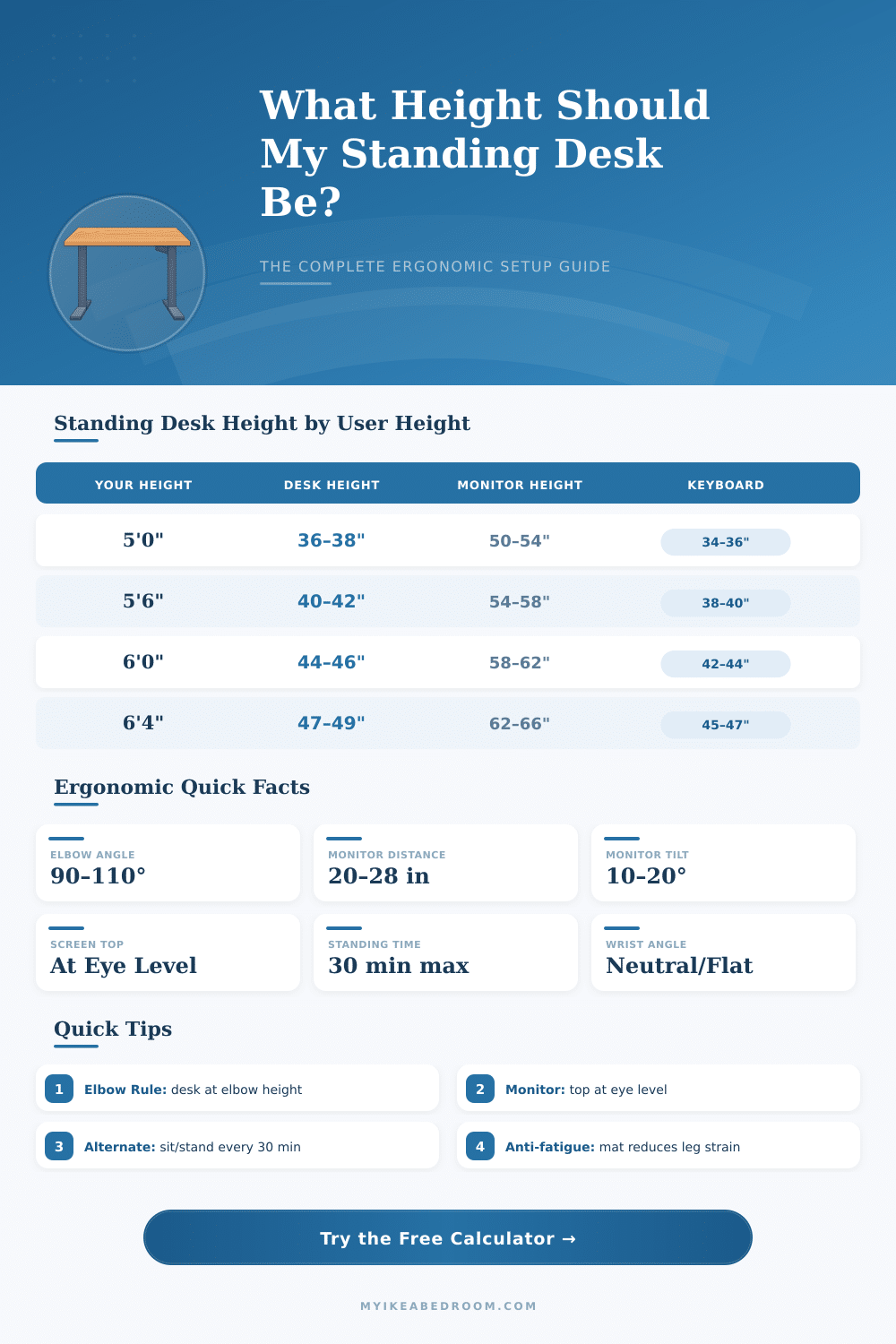
| Your Height | Desk Height (in) | Desk Height (cm) | Monitor Top (in) | Keyboard Height (in) |
|---|---|---|---|---|
| 4'10" (147 cm) | 33–35" | 84–89 cm | 48–52" | 31–33" |
| 5'0" (152 cm) | 35–37" | 89–94 cm | 50–54" | 33–35" |
| 5'2" (157 cm) | 36–38" | 91–97 cm | 51–55" | 34–36" |
| 5'4" (163 cm) | 37–39" | 94–99 cm | 53–57" | 35–37" |
| 5'6" (168 cm) | 39–41" | 99–104 cm | 55–59" | 37–39" |
| 5'8" (173 cm) | 40–42" | 102–107 cm | 57–61" | 38–40" |
| 5'10" (178 cm) | 42–44" | 107–112 cm | 59–63" | 40–42" |
| 6'0" (183 cm) | 44–46" | 112–117 cm | 61–65" | 42–44" |
| 6'2" (188 cm) | 46–48" | 117–122 cm | 63–67" | 44–46" |
| 6'4" (193 cm) | 47–49" | 119–124 cm | 65–69" | 45–47" |
| Monitor Size | Recommended Distance | Eye-to-Screen Angle | Tilt Angle | Notes |
|---|---|---|---|---|
| 22–24 inch | 20–24 in (51–61 cm) | 10–15° below horizon | 10–15° | Compact; arm mount ideal |
| 27 inch | 24–28 in (61–71 cm) | 10–15° below horizon | 10–20° | Most popular size |
| 32 inch | 28–32 in (71–81 cm) | 10–20° below horizon | 15–20° | Maintain arm distance |
| 34" Ultrawide | 30–36 in (76–91 cm) | 10–20° below horizon | 15–20° | Center at eye level |
| Dual Monitor | 24–30 in (61–76 cm) | Primary: straight ahead | 10–15° | Primary screen centered |
| Setting | Ideal Range | Common Mistake | Fix |
|---|---|---|---|
| Keyboard height | 2–3 in below elbow | Too high — raised shoulders | Lower desk or use negative tilt tray |
| Keyboard tilt | 0° to –5° (negative) | Positive tilt strains wrists | Use adjustable tray or wrist rest |
| Mouse position | Same level as keyboard | Mouse too far to side | Keep mouse close to body centerline |
| Reach distance | Within forearm reach | Reaching forward / stretching | Move keyboard closer to body |
| Wrist angle | Neutral / flat (0°) | Bent wrists (flexion or extension) | Ergonomic keyboard or palm rest |
| User Height Range | Min Desk Height Needed | Max Desk Height Needed | Recommended Desk Range |
|---|---|---|---|
| Under 5'4" (163 cm) | 22" (56 cm) | 38" (97 cm) | 22–48" |
| 5'4" – 5'8" (163–173 cm) | 24" (61 cm) | 42" (107 cm) | 24–50" |
| 5'8" – 6'0" (173–183 cm) | 25" (64 cm) | 44" (112 cm) | 25–51" |
| Over 6'0" (183 cm) | 26" (66 cm) | 48" (122 cm) | 26–52" |
| Shared / Multiple users | 22" (56 cm) | 49" (124 cm) | 22–52" |
Choosing the right Height for your Standing Desk really matters for comfort and for stopping pains in the back. The main idea is simple: keep good posture and escape that kind of stress that builds up in you during months and years. That correction makes the Standing Desk really valuable for use.
Here is an easy way to find the right Height. Stand straight with relaxed shoulders. Bend your elbows almost in a 90-degree corner.
Find the Right Height for Your Standing Desk
Now measure from the floor to the spot where your hands naturally hang. That will be your ideal Height for the desk. While typing, your forearms should rest parallel to the floor.
It is great that small changes have big impact, sometimes half an inch is enough to remove back pain entirely.
For people of average Height, the best advice offers around 26 inches for sitting and 42.5 inches for standing. Around 42 inches commonly is the best spot for folks with typical body. The usual Height of Standing Desks range between 38 and 46 inches.
Interestingly, the standard desk Height works well for taller folks, especially those that are around 6 feet tall. Shorter folks usually need something under 28 inches to feel comfortable.
Most sit-stand desks that you find today move between around 28 and 47 inches. Modern Standing Desks? They offer a broader range, from almost 23 to 49 inches, which covers almost every Height and use case that you can imagine.
Some models go even further. One of them starts at around 24.75 inches and reaches 50 inches. For really tall folks; for instance 6 feet and 8 inches, even a desk that tops out at around 50.7 inches barely is enough.
Here is a useful rule for taller folks. For every inch above 6 feet, your ideal desk Height should grow by around 0.63 inches. That matches the general range of 0.5 to 0.75 inches per extra inch of Height.
Also, using an arm for the monitor or a stand for the computer, you can really help keep your eye level during standing.
One person shared that even at the lowest Height of 27.9 inches, his forearms tilted upward just too reach the keyboard (not ideal at all). Another bought a desk whose lowest position was 30 inches, and found it way too high. So, checking the lowest Height is just as important as the maximum.
An ergonomic calculator or tool can lead you to what will work best. Just do not forget to add the Height of your shoes, usually around one inch; to get numbers that truly matchthe reality.
Some desks work by means of electric motors with preset buttons for different positions, while others use a crank to move between around 27.5 and 47.25 inches. Either way, switching between sitting and standing during the day helps you feel more energetic and work more effectively.